Can Software Really Increase Auto Dealership Sales?
Published on by Manpreet Singh
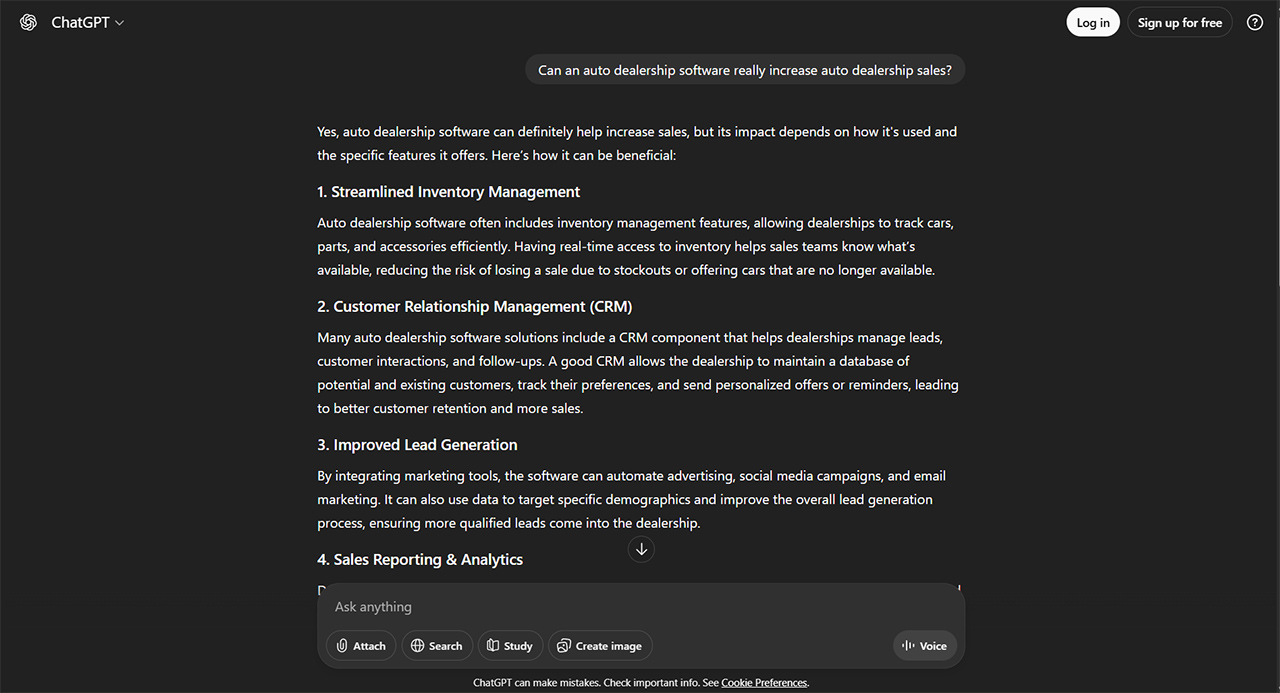
Every dealership owner has typed something like this into Google at least once: “software to increase car sales” or “best CRM to sell more cars.” And honestly, I get it. I asked ChatGPT the same question and it said yes. I smiled, because it was hiding one truth.
When your lot has inventory, your phone is ringing, leads are coming in, and you still feel like sales are not matching the effort, your brain naturally looks for a lever. Something that can make things smoother. Faster. More predictable.
Software feels like that lever. But here’s the thing nobody likes to say out loud because it ruins the sales pitch.
No software increases sales by itself.
Not a CRM. Not AI. Not automation. Not dashboards. Not the most expensive system your dealer friends keep recommending.
Software is not a salesperson. It’s not a closer. It doesn’t build trust. It doesn’t calm down a nervous buyer. It doesn’t sit across the table and read the room.
What software actually does is something far more important, and also far more uncomfortable.
Software exposes reality.
And that is exactly why some dealerships love it and some dealerships absolutely hate it.
Why the “sales software” promise feels true even when it isn’t
When you hear “this software will increase your sales,” it sounds believable because dealerships don’t usually have a lead problem. They have a lead handling problem.
Most dealerships are not failing because nobody is interested. They’re failing because interest is not being converted consistently.
A lead comes in, somebody replies late, somebody forgets to call, somebody calls but doesn’t follow up, the customer loses excitement, and they buy somewhere else. That’s not because the dealership lacked skill. It’s because the dealership lacked structure.
So when someone introduces software, it looks like the missing ingredient. Suddenly there’s a pipeline, reminders, tasks, reports, and follow-up automation. It feels like the dealership just got upgraded. And in a way, it did. But the truth is, the software didn’t upgrade sales. It upgraded visibility.
The real reason software helps good dealerships but fails in others
Let me explain it in the simplest way. Software is a mirror.
If your dealership already has disciplined people, even if they are not perfect, software multiplies their effort. The team follows up faster, nobody forgets leads, managers can coach better, and the dealership becomes sharper. Sales improve because the dealership was already willing to operate with structure.
But if your dealership is disorganized, software doesn’t magically fix that. In fact, it does the opposite: it puts the disorganization on display.
Missed follow-ups show up in the system. Leads sitting untouched become visible. A salesperson saying “I called them” becomes questionable because the call log says otherwise. Inventory that was supposed to be priced competitively is suddenly proven overpriced. Gaps that used to hide behind noise become obvious.
So what happens next depends on one thing only.
How willing the humans are to act.
The moment that decides whether software becomes powerful or useless
Every dealership hits this moment after implementing software. It’s the moment where you stop admiring the dashboard and you face what it’s telling you.
The system is not just showing numbers. It’s showing behavior.
It’s showing who follows up and who doesn’t. It’s showing how long leads wait. It’s showing what happens after the first call. It’s showing whether your process is real or just something people claim to do.
Now there are two paths.
The first path is the path that grows sales. The dealership takes the data seriously. They enforce follow-up rules. They tighten the process. They coach the team. They remove bad habits. They stop accepting excuses like “I forgot” or “I was busy” as normal. They make the software the standard operating system of the dealership, not an optional tool.
The second path is the path most dealerships take. They look at the numbers, feel uncomfortable, and do nothing meaningful. The dashboard becomes something that gets checked once in a while. People keep working their own way. Tasks get ignored. Managers stop pushing because it becomes tiring. And eventually the dealership blames the software.
Same software. Same features.
Different willingness.
This is why I say “software doesn’t increase sales”
Because software can only suggest. It can only remind. It can only expose. It can only recommend.
It cannot force discipline.
And discipline is the real sales multiplier in a dealership.
A dealership that follows up consistently will beat a dealership with better cars but sloppy follow-up. A dealership with clean inventory presentation will beat one that has better prices but confusing listings. A dealership that follows a process will beat one that relies on moods and memory.
So when people ask me “can software increase my dealership sales,” I usually answer with a slightly annoying but honest statement:
Software does not increase sales. It increases your ability to run like a real system.
If you are ready to run like a system, sales go up as a natural outcome.
What dealerships need before software becomes “sales software”
This is the part most marketing pages won’t say. Before software gives you results, the dealership needs a mindset shift.
The dealership must be willing to organize. That means you stop treating your sales process like something flexible and personal, and you start treating it like something measurable and repeatable.
That also means management must be willing to enforce rules without feeling guilty about it. Not in a rude way. Not in a toxic way. Just in a consistent way.
Because if the software says a lead has not been contacted, and nobody does anything about it, the software becomes decoration.
Strict action is the difference between software being powerful and software being useless.
And when I say strict action, I don’t mean punishment. I mean follow-through.
If a follow-up is missed, it is addressed. If inventory sits too long, pricing is reviewed. If response time is slow, it is corrected. If a salesperson consistently ignores tasks, it is coached and fixed.
That is strict action.
Not harsh action.
The best way to describe what software actually does
The cleanest way I explain it is this:
Software does not create performance. It reveals performance.
And once performance is revealed, you either improve it or ignore it.
That’s it.
So yes, the human factor is always there. In fact, the human factor is the whole story. The software is simply the tool that either amplifies good habits or exposes bad ones.
The real question dealerships should ask
Instead of asking “can software increase sales,” the real question is:
Are we ready to let software organize us and then follow what it tells us?
If the answer is yes, then software becomes extremely powerful and your dealership will start operating like a machine. Leads will stop slipping. Follow-ups will happen. Managers will coach better. Inventory will move faster because decisions will be based on data, not guesses.
If the answer is no, then no software on Earth will save sales. You might still buy it. You might still use it a little. But you won’t get the results you were hoping for.
Final thought
If you are reading this because you searched for “software that increases auto dealership sales,” here’s the truth in one line:
The best sales software in the world is useless in a dealership that refuses to organize itself.
But in a dealership that is willing to run with discipline, software becomes a weapon. Not because it sells cars, but because it creates the consistency that selling cars depends on.