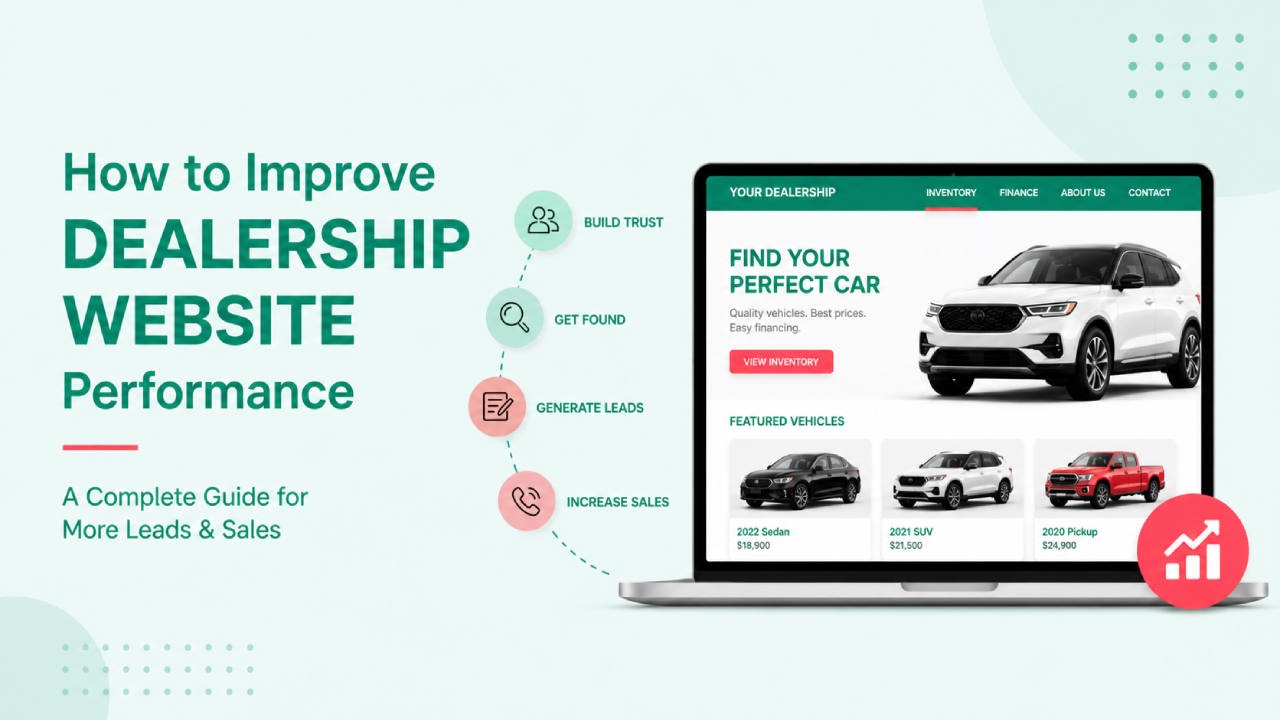
A dealership website should do more than look good. It should attract traffic, build trust, generate leads, and move shoppers toward contact, test drives, and sales.
Why This Matters
Most dealership buyers start online, compare multiple options, and make decisions before they ever call. That means your website, Google presence, and social channels must work together as one sales system. If the basics are incomplete, you lose leads before your team ever gets a chance to respond.
A strong checklist helps dealership owners, managers, and staff stay consistent. It also makes it easier to spot weak points in marketing, inventory presentation, and follow-up.
What most dealers miss: traffic is not the problem anymore. Attention is already there. The real issue is converting that attention into action.
Business Profile and Brand Consistency
The first thing a dealership should get right is its identity across the web. The website link must be correct on Google Business Profile, Facebook, Instagram, and every other major channel. The dealership name, phone number, address, hours, and branding should match everywhere without variation.
This consistency helps customers trust the business and also supports local search visibility. Even small mismatches can create confusion or reduce confidence.
- Add UTM tracking to profile links to measure traffic sources.
- Keep holiday hours updated on all platforms.
- Use the same logo, colors, and tone everywhere.
- Ensure WhatsApp and phone numbers are clickable.
Inventory Presentation
Vehicle inventory is the core of a dealership website, so every listing must be complete and current. Each vehicle should have its own page with clear pricing, mileage, trim, features, condition notes, and strong photos. Where possible, add walkaround videos, financing CTAs, and a direct way to call, text, or submit a lead.
A VDP should not feel like a bare data sheet. It should answer the buyer’s key questions quickly and make it easy to take the next step. Inventory should also be updated in real time or at least daily so shoppers never waste time on sold vehicles.
- Add a “Why buy this vehicle?” section with a human explanation, not only specifications.
- Highlight urgency such as new arrival, price drop, or limited availability.
- Show similar vehicles to keep visitors engaged.
- Add finance or payment estimation if available.
- Show inspection, certification, warranty, or condition details clearly.
Content That Builds Trust
Many dealership websites fail because they look thin or generic. Buyers need enough content to feel confident that the dealership is real, active, and professional. That includes showroom images, staff photos, an About page, FAQ content, finance information, and helpful vehicle descriptions.
The homepage should clearly explain who the dealership serves, what inventory it offers, and why customers should trust it. VDP pages should also contain more than photos and specs. They should include selling points, condition details, and reasons the vehicle stands out.
- Add real delivery photos and customer handover moments.
- Add a Recently Sold section.
- Show warranty, inspection, or certification badges where applicable.
- Explain dealership policies clearly where needed.
- Add video testimonials or simple customer story videos.
Social Media and Traffic Flow
Social media should not be disconnected from inventory. Every vehicle post should include a direct link back to the vehicle page, not just a photo with no next step. Facebook, Instagram, YouTube, and other channels should all support traffic back to the website and help turn attention into leads.
Dealerships should post inventory, promotions, sold stories, arrivals, and useful content regularly. The more structured the posting process is, the easier it becomes to keep the dealership visible and active.
- Always share VDP links, not only the homepage.
- Use WhatsApp and direct message replies with specific vehicle links.
- Retarget visitors who already visited the website.
- Use story highlights for inventory categories.
- Promote best-performing vehicles repeatedly.
Review and Reputation
Reputation is one of the strongest conversion factors in automotive retail. After every sale, the dealership should send a Google review link and make review collection part of the sales process. Positive reviews should be displayed on the website, and the team should respond professionally to negative feedback.
A steady review strategy helps future shoppers feel safer choosing the dealership. It also improves local credibility and can support search performance over time.
- Ask for reviews at the happy moment, such as vehicle delivery.
- Train staff to request reviews naturally.
- Display review count and rating prominently where possible.
- Showcase specific customer stories instead of only generic testimonials.
Lead Generation and Conversion
A dealership website must make it easy to contact the business. Call buttons, text buttons, lead forms, finance applications, trade-in forms, and test drive booking options should be visible and simple to use. Forms should be short, mobile-friendly, and tested regularly to make sure they work.
The site should also track where leads come from, which pages convert best, and which CTAs perform well. Without tracking, the dealership is guessing instead of improving.
- Add live chat or instant messaging options.
- Use offer-based CTAs such as Get Best Price, Check Availability, or Unlock Offer.
- Use return visitor or high-interest visitor offers where possible.
- Respond fast because lead response speed directly affects conversion.
SEO and Local Visibility
Search optimization is not just about ranking. It is about being found by the right local shoppers. Key pages should have unique title tags, meta descriptions, location references, and structured data where appropriate. Google Business Profile categories, hours, photos, and location details should also be accurate and updated.
Dealerships can strengthen visibility by creating useful pages for financing, trade-ins, service, and local market content. Over time, these pages help the website become more useful to shoppers and more visible in search results.
- Each vehicle page should target search intent such as make, model, and city.
- Use internal linking between inventory, finance, trade-in, and content pages.
- Submit and maintain the sitemap in Google Search Console.
- Check indexing regularly so important pages are discoverable.
Performance and User Experience
A dealership website must load quickly and work well on mobile. If pages are slow, hard to navigate, or cluttered, shoppers leave fast. Clean menus, strong search filters, easy inventory browsing, and prominent CTAs all make the experience better.
The goal is to reduce friction at every step. A buyer should be able to move from homepage to inventory to VDP to lead form with as few clicks as possible.
- Use sticky call, WhatsApp, or contact buttons on mobile.
- Optimize images so pages load faster.
- Keep navigation simple and clear.
- Provide useful filters such as price, make, model, year, mileage, and body type.
Operational Habits
A good website is not built once and forgotten. Staff should follow regular habits like uploading new inventory quickly, marking sold vehicles immediately, checking broken links, refreshing promotions, and updating holiday hours. Website content should be reviewed weekly, not only when something breaks.
This is where a checklist becomes valuable. When the team follows the same standards every time, the website becomes a reliable sales tool instead of a passive brochure.
- Upload vehicles without delay.
- Remove or mark sold vehicles immediately.
- Review underperforming listings regularly.
- Test lead forms and CTAs weekly.
- Assign website responsibility to a specific team member.
Practical Checklist Categories
To make this easy inside Dealersip, organize the checklist into categories such as:
- Branding and profile links
- Inventory and VDP quality
- Content and trust signals
- Social media distribution
- Reviews and reputation
- Lead capture and tracking
- SEO and local visibility
- Performance and mobile usability
- Daily and weekly operations
This structure makes it easier for a dealer to understand what is missing and what needs attention first. It also makes the checklist more useful for managers and staff because they can act on it immediately.
Final Thought
The best dealership websites are not the most expensive or visually complex ones.
They are the ones that connect every platform, guide every visitor, build trust quickly, and make it easy to act.
A strong checklist turns all of this into a repeatable process.
And when that process is followed consistently, your website stops being a passive presence and starts becoming a reliable source of leads and sales.