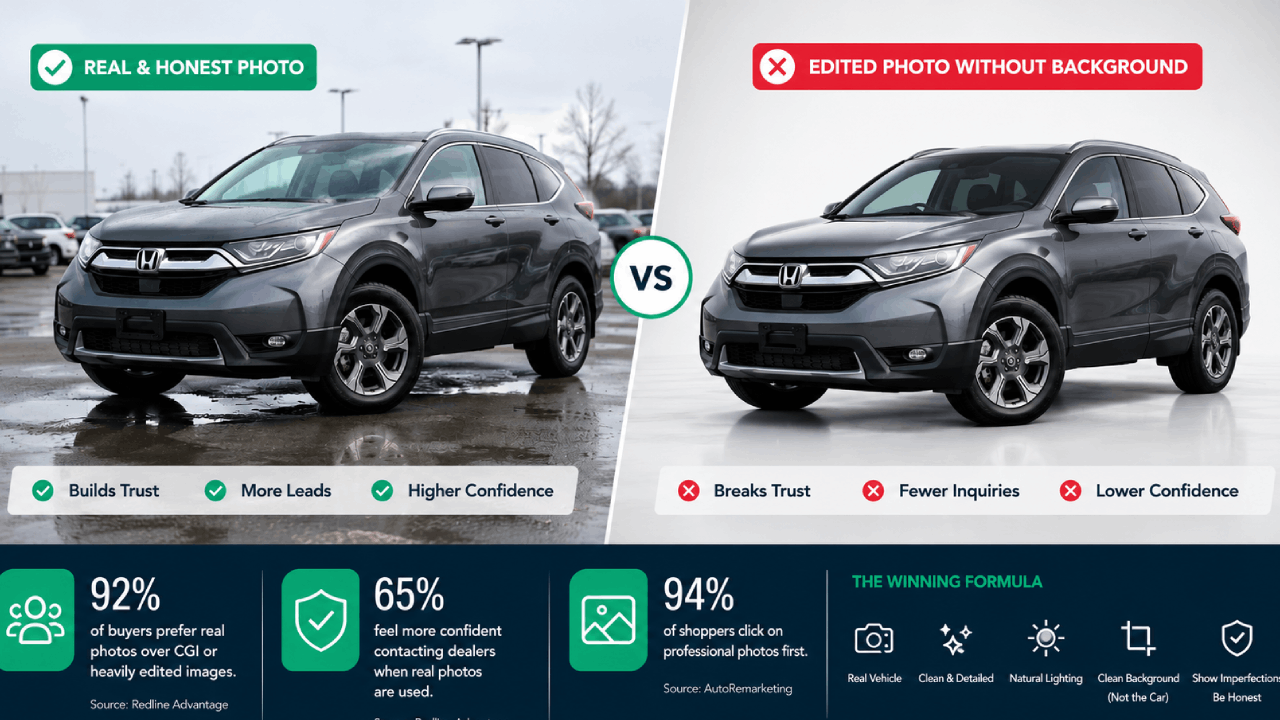
An in-depth look at how vehicle photography shapes buyer trust, click-through rates, and dealership credibility in the digital age.
In today's automotive market, a car is sold twice - once online, and once on the lot. The first sale happens the moment a buyer scrolls past your listing. If your photo doesn't earn their trust in under three seconds, they move on.
This raises one of the most important questions in modern dealership management software and digital automotive retailing: do buyers respond better to raw, realistic photos or to polished, professionally edited inventory images?
The research is clear, and the answer is more nuanced than most dealerships realize.
The Digital Forecourt Has Replaced the Showroom
Modern car buyers spend more than 14 hours researching online before visiting a dealership. By the time they walk through the door, most have already shortlisted their vehicle, compared prices, evaluated dealership credibility, and formed an emotional connection - or disconnection - based on listing photos alone.
According to research shared by AutoRemarketing , professional-quality vehicle photography dramatically impacts buyer engagement and click-through behaviour.
This means your inventory photos are no longer a supplement to the sales process. They are the sales process.
A weak photo doesn't just fail to impress - it actively signals to buyers that the dealership may have something to hide. In the world of car dealership CRM, automotive inventory management software, and online retail competition, trust has become one of the strongest conversion factors.
What Buyers Actually Think About Edited Photos
A landmark consumer study conducted by Redline Advantage surveyed hundreds of car buyers and compared their reactions to real vehicle photos versus CGI or heavily edited imagery.
The findings were decisive:
- 92% of buyers preferred submitting a lead on vehicles using real photos rather than heavily edited or CGI imagery
- 65% felt more confident contacting dealerships that used authentic photography
- Buyers identified fake or unrealistic images with surprisingly high accuracy
- High-income buyers showed significantly lower confidence in over-edited listings
The takeaway is powerful: buyers are smarter than many dealerships assume. They can often sense when a vehicle image has been manipulated beyond reality.
This is particularly important for dealerships using car dealer inventory software, dealer management systems, and AI-generated merchandising tools. Technology can improve presentation, but once realism disappears, trust disappears with it.
But “Realistic” Does Not Mean “Poor Quality”
One of the biggest misunderstandings in dealership marketing is assuming that “realistic photos” means uploading low-quality, poorly lit smartphone pictures from a crowded lot.
That interpretation is equally damaging.
Research highlighted by AutoRemarketing showed that:
- 95% of consumers believe professional-looking photos increase vehicle value perception
- 94% click on professional listings first
- Higher-quality photos generate more inquiries and engagement
Buyers want two things simultaneously:
- Authenticity
- Professional presentation
They want to see the real vehicle - but they want to see it presented clearly, cleanly, and professionally.
The winning formula is not “raw” versus “edited.” The winning formula is real and professional at the same time.
When Editing Starts Destroying Trust
The biggest collapse in buyer confidence happens when the vehicle shown online no longer matches the vehicle seen in person.
Research discussed by 360Booth and CarBackground.AI highlights how over-editing creates unrealistic expectations that damage dealership credibility.
When buyers arrive expecting a flawless showroom-quality vehicle and discover hidden scratches, paint damage, faded trim, or imperfections that were digitally removed, trust immediately breaks.
And in today's world of Google Reviews, Facebook recommendations, Reddit discussions, and viral dealership experiences, disappointed trust spreads quickly.
Some of the most damaging editing practices include:
- Removing scratches, dents, or paint chips from the vehicle body
- Artificially enhancing paint quality to hide oxidation or fading
- Using unrealistic AI-generated studio environments
- Cloning out imperfections around bumpers, mirrors, and wheel wells
- Using fake lighting effects that no longer look natural
According to 360Booth , some forms of misleading automotive image editing may even expose dealerships to legal risks under consumer protection and false advertising standards.
What Honest Professional Vehicle Photography Looks Like
The dealerships performing best online are not necessarily the ones with the most expensive studios. They are the ones creating inventory photos that feel believable, transparent, and professionally presented.
1. Photograph the Actual Vehicle
Never rely on stock photos or manufacturer images for used inventory.
Buyers expect VIN-specific photography. They want to see the exact vehicle they are considering purchasing.
Using actual inventory photography builds immediate trust and reduces surprises during showroom visits.
2. Clean the Vehicle Before the Shoot
Professional photography begins with vehicle preparation - not Photoshop.
Wash the vehicle, clean the wheels, vacuum the interior, remove clutter, and ensure the dashboard and infotainment displays are clean and presentable.
As explained by 360Booth , presentation quality strongly influences perceived vehicle value.
3. Use Natural and Consistent Lighting
Overcast daylight often produces the best vehicle photos because it eliminates harsh reflections and heavy shadows.
Midday sunlight can create strong contrast that hides or exaggerates vehicle condition inconsistently.
Good lighting helps buyers accurately evaluate paint condition, body lines, wheels, and interior materials.
4. Remove Background Clutter - Not Vehicle Reality
Background removal has become widely accepted in automotive merchandising when done honestly.
According to Impel AI , clean backgrounds improve listing consistency and help buyers focus on the vehicle itself.
Similarly, API4AI explains that background cleanup improves professionalism without misleading buyers - if the vehicle itself remains untouched.
The key rule is simple:
Remove distractions around the car. Never alter the car itself.
Natural shadows underneath the vehicle should remain intact because they preserve realism and reassure buyers that the image is authentic.
5. Show Imperfections Honestly
Ironically, one of the strongest trust signals a dealership can send is photographing minor imperfections honestly.
A small bumper scuff, minor wheel rash, or tiny paint chip documented upfront reduces buyer anxiety dramatically.
When buyers arrive with calibrated expectations, negotiations become smoother, objections decrease, and post-sale satisfaction improves.
Research from Redline Advantage strongly supports the idea that authenticity increases dealership trust and lead confidence.
6. Deliver Complete Vehicle Coverage
Modern vehicle listings should include:
- Front three-quarter view
- Rear three-quarter view
- Driver-side profile
- Passenger-side profile
- Interior front seats
- Rear seats
- Dashboard and infotainment
- Odometer reading
- Wheel close-ups
- Cargo area
- Engine bay when relevant
- Visible imperfections
Photography guidelines shared by Trader.ca emphasize that thorough inventory coverage improves engagement and buyer confidence.
The Psychology Behind Buyer Trust
Vehicle photography influences far more than aesthetics.
Buyers subconsciously interpret image quality as a reflection of dealership behaviour itself.
Professional yet realistic photography communicates:
- The dealership is transparent
- The dealership pays attention to detail
- The dealership values presentation
- The dealership is confident enough to show the real vehicle
On the other hand, over-processed or deceptive imagery communicates uncertainty and manipulation.
Even if buyers cannot explain exactly why a listing feels “off,” the emotional distrust still affects click-through rates, inquiry behaviour, and showroom confidence.
Why This Matters for Used Car Dealerships
Independent dealerships often assume they need expensive studios or large photography budgets to compete online.
That is no longer true.
Today, with modern auto dealership software, AI-assisted background cleanup, and smartphone camera quality improvements, dealerships can create highly trusted listings without massive production costs.
The most important ingredients are consistency and honesty.
You need:
- A clean vehicle
- Good natural lighting
- Stable photography angles
- Consistent inventory presentation
- Background cleanup that does not alter the vehicle
- Honest representation of condition
These simple practices outperform aggressively over-edited inventory because they generate the one thing buyers cannot buy elsewhere:
Confidence.
Final Thought
The question is not whether buyers prefer realistic photos over edited photos.
The real question is whether your inventory photography makes buyers believe the vehicle they see online is the same vehicle they will see on your lot.
The dealerships winning online today are not the ones creating fantasy showroom images.
They are the dealerships creating listings that feel honest, clean, professional, and believable.
That alignment between digital expectation and physical reality is where trust is built.
And in modern automotive retail, trust is what closes sales.