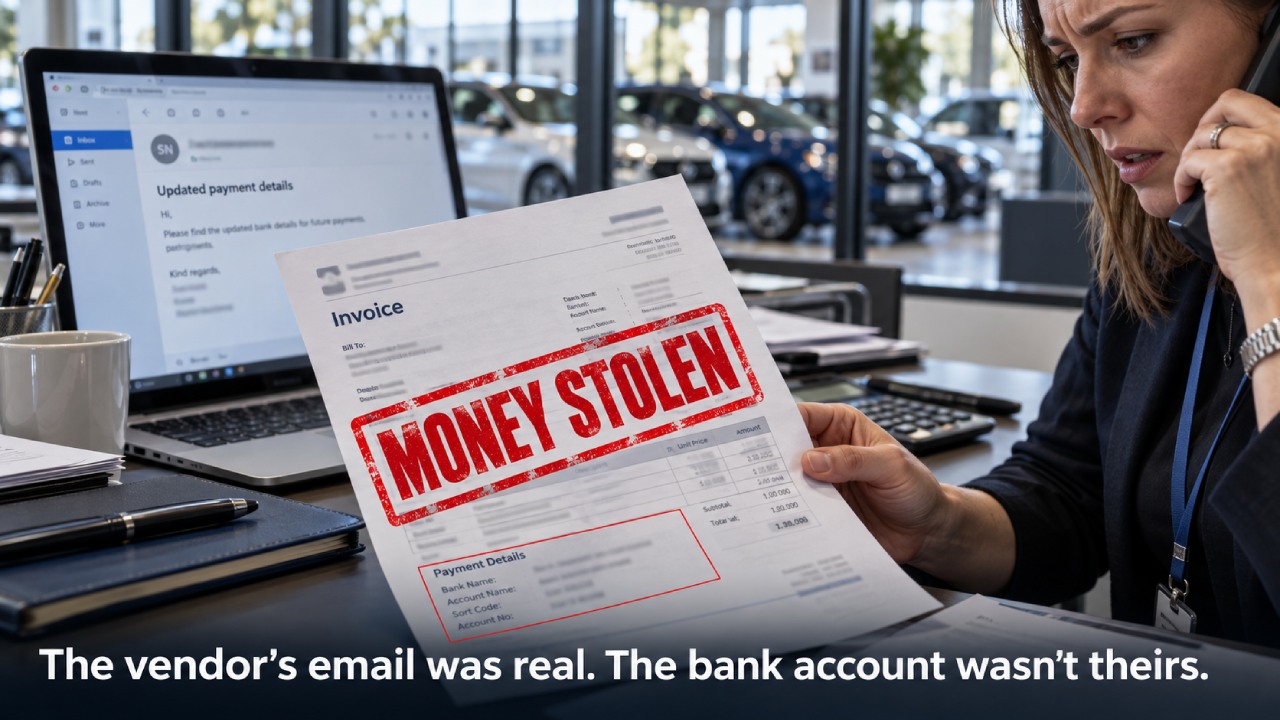
Can you trust new bank instructions because they arrived from your supplier's real email address? No. The FBI explains that criminals can access genuine billing conversations and use what they learn to make fraudulent payment requests convincing.
If you handle payables at a U.S. dealership, that leaves a question ordinary sender checks cannot answer: did the supplier authorize this destination for your money? You may hesitate to delay an auction settlement or challenge a longtime vendor. Neither concern makes the mailbox proof of authority.
An attacker can take over the conversation
Business email compromise, or BEC, includes fraud conducted through a legitimate account that a criminal has taken over. Unlike a look-alike address, the compromised account can be the very address already saved in your vendor records.
In an alert about compromised mailboxes, the FBI's Internet Crime Complaint Center, or IC3, describes criminals examining messages for financial transactions and using that information to redirect payments. It also warns that attackers can create mailbox rules that delete important messages. Access to the account gives the criminal context for the request and opportunities to conceal interference.
Consider a made-up request from a transport company: “The delivery invoice is unchanged. Our receiving account has moved. Please use the attached instructions for this payment.” It appears in the thread you used to resolve a delivery charge.
Your records confirm both the delivery and the invoice amount. The earlier correspondence is real, but none of that establishes who authorized the replacement account. The attacker does not need to invent a purchase when an existing payable already gives you a reason to send money.
Email checks answer a narrower question
The Federal Trade Commission describes email-authentication tools that check a sending server's authority or validate a message's digital signature. Those checks concern the email's origin and integrity. They do not evaluate the banking instructions inside it.
The implication for payables is straightforward: a message sent through a hijacked account can pass checks aimed at forged senders. Even confirmation from IT that the message traveled through the supplier's email system would not establish that the supplier's finance staff authorized its contents.
Keep examining addresses and links because those checks address other ways to impersonate a vendor. They cannot replace confirmation of a new payment destination.
More replies and approvals are not independent evidence
Replying to ask whether the change is genuine leaves you inside the same channel. If the criminal controls that mailbox, the criminal can answer. Starting a fresh message to the correct address has the same limitation when that account itself is compromised.
Calling a number supplied in the request changes the medium without establishing an independent contact. Whoever supplied the fraudulent bank details could also have supplied the phone number. A reassuring conversation would then establish only that someone can repeat the request.
A second internal approval serves a different purpose. Nacha recommends dual control over payment initiation and changes to payment information. But consider what your general manager actually knows when approving that transport bill: the dealership owes the money, not necessarily that the replacement account belongs in the payment instructions.
If both approvers rely on the same email, neither has brought independent evidence of the supplier's authorization. The second approver needs to review the verification behind the change, rather than merely reread the message. Approval to settle a debt and confirmation of its destination are separate judgments.
A known contact must confirm the actual instructions
An independently established phone number gives you a route back to the supplier that the payment request did not choose. In its BEC prevention guidance, IC3 recommends calling numbers known beforehand instead of using contact details supplied with the request.
For your dealership, that means a number established during vendor onboarding or earlier verified dealings. Saving a number from the new email in the vendor master does not make it trusted. Otherwise, the request supplies its own evidence.
The conversation must reach a known vendor contact who is authorized to confirm banking instructions. A familiar parts representative may know your account without having authority over receivables. Use the established contact route to reach the person who can authorize the change.
The question is more precise than “Did you send an email?” The contact needs to confirm the beneficiary name and complete routing and account numbers, along with when the instructions take effect. An acknowledgment that the company changed banks leaves too much unresolved if nobody compares the actual payment details.
That conversation supplies evidence that an authorized vendor contact independently confirmed the instructions. It is not confirmation from the receiving bank about who owns the account. Its value is that the potentially compromised mailbox no longer supplies the entire basis for your decision.
Verification belongs before anyone changes the vendor's payment record or releases funds using the new details. A false account saved in the vendor master can become the destination for subsequent invoices. Keep a record of the contact's confirmation and the number you called, so the payment approver can distinguish a completed check from an unsupported “verified” note.
If the authorized contact cannot confirm the instructions, the change remains unverified. Escalating the payment deadline internally may address the business pressure, but it does not resolve the missing authorization.
A suspected misdirected payment needs immediate attention
If you suspect the dealership has already sent money to a fraudulent account, contact the sending bank immediately. The IC3's incident guidance calls for contacting the originating financial institution to seek a recall or reversal. Ask the bank to contact the receiving institution, as the FBI also recommends.
Report promptly to IC3 with the transaction information available to you. Include the transfer amount and date, along with the sending and receiving account details. Do not postpone the bank call while waiting for the supplier's IT team to establish exactly how the mailbox was compromised.
A recall request is not confirmation that money has been recovered. Treat the bank contact and the IC3 report as urgent responses to suspected fraud, not assurances that the transfer can be undone.
Before the next payment, the deciding question is whether an authorized supplier contact has independently confirmed the instructions you intend to use. A familiar sender can explain why a request reached your desk. It cannot, by itself, justify where the dealership's money goes.