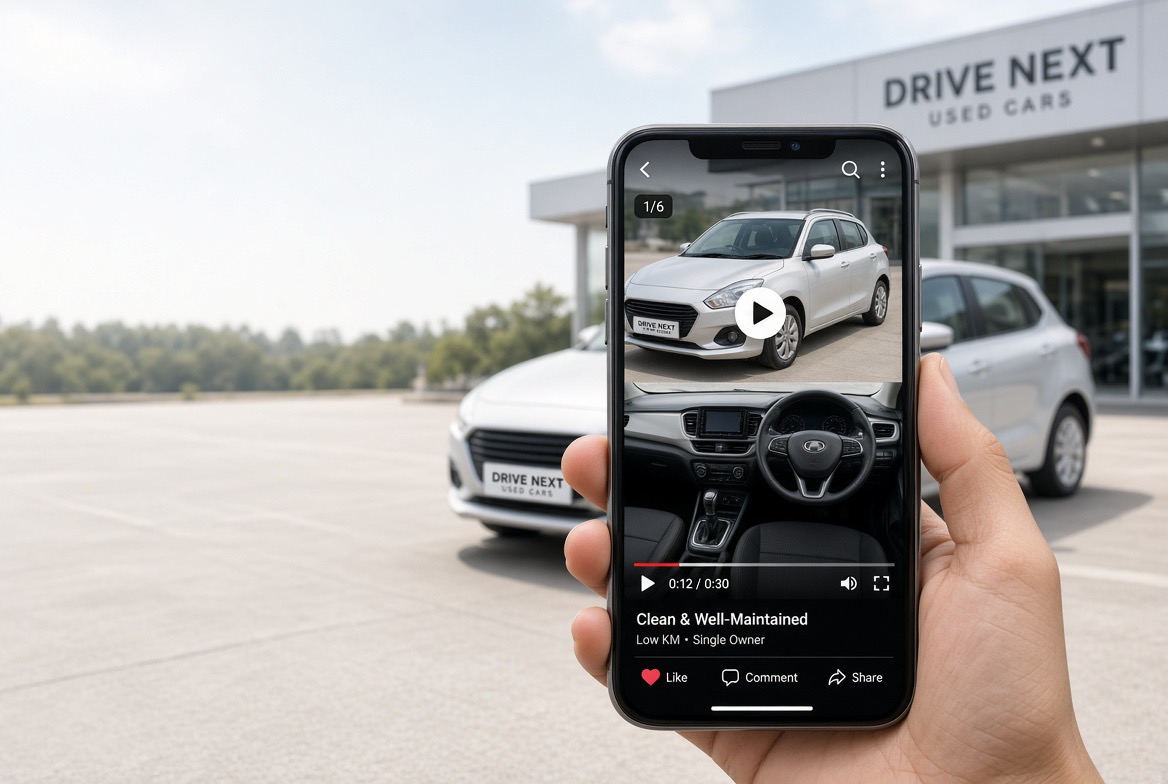
What can a buyer reasonably decide after watching your used-car reel? They can decide whether to investigate that car further; the footage cannot establish its full condition or history.
If you film stock for an Indian dealership, that is the boundary your presentation and reply should respect. The buyer may be protecting a day’s travel or time off work, while you want a serious enquiry. Helping them shortlist the car is a worthwhile job without suggesting that inspection has already happened.
Clear footage establishes what is visible on that car
A clear interior view can show the seating arrangement and dashboard layout. Close footage can reveal worn upholstery or a damaged door trim. These are useful details because the buyer can decide whether the car’s arrangement suits them and whether visible wear deserves a closer look.
Showing a feature is different from establishing its condition. A touchscreen appearing in the dashboard establishes that a screen is fitted; it does not demonstrate that every function works. Similarly, showing the rear seat gives buyers a view of the space, but it cannot tell them how comfortably they will sit there.
All of this depends on identifying the actual vehicle offered. A stock reference, supported by the exact model and variant, connects the enquiry to one car rather than a collection of similar-looking vehicles. Mixing exterior footage from one car with another car’s cabin destroys that connection.
The distinction between seeing a defect and not seeing one matters too. A clearly shown seat tear is evidence of that tear. A quick sweep across the cabin is not evidence that every surface is undamaged.
Labels change what the buyer thinks the numbers mean
Manufacture year and registration year
The registration year does not necessarily identify when the car was manufactured. The RC template published by MoRTH on Parivahan records manufacture and registration dates separately. Calling a car simply a particular year’s model can therefore leave the buyer unsure which date you mean.
State both years when they differ, with the labels attached. A later registration does not change the manufacture date, and the buyer should not discover that distinction after travelling to your showroom.
Displayed kilometres and verified distance
Filming the odometer establishes what the display reads at that moment. It does not independently establish the vehicle’s lifetime distance. Maruti Suzuki describes using authorised service history when verifying distance travelled in its used-car programme, rather than relying on the display alone.
Describe the number as the current odometer reading unless you can explain the evidence behind a stronger claim. If you call the kilometres verified, the next conversation should concern the records supporting that description.
Asking price and down payment
A down payment is the upfront contribution towards a financed purchase, not the vehicle’s sale price. Making it look like the asking price gives the buyer the wrong basis for deciding whether to visit.
The Advertising Standards Council of India says digital advertisements should include unavoidable taxes and charges in quoted prices where those costs apply to all or most buyers. Put the full asking price prominently in the reel and distinguish any finance illustration from it. The buyer should not need a phone call to discover that the headline amount buys only the initial contribution.
A tidy appearance cannot establish a clean history
Fresh paint shows the finish as it appears now. It does not explain why the panel was painted or what repairs sit beneath that finish. Equally, repainting alone does not establish a serious accident: the repair history and physical assessment need to answer that question.
A spotless cabin has the same limitation. Bosch Car Service’s Indian guidance on water ingress identifies possible damage to electrical systems and the engine, and discusses inspecting carpets for dampness and other signs. The implication for your reel is straightforward: clean upholstery cannot clear a car of previous flood exposure.
An engine clip captures how the engine sounded during that recording. It does not demonstrate how the transmission behaves during a drive or how the car responds under braking. Even without music or editing, an idle recording leaves those questions unanswered.
Presentation becomes misleading when you use an attractive view as evidence for a much wider claim. Describe the visible finish accurately, but let the evidence determine whether you can make statements about accident history or mechanical condition.
Each unknown needs evidence suited to the question
Vehicle identity comes before interpreting the paperwork. Matching the chassis number physically marked on the car against the registration certificate connects the vehicle in front of the buyer to the document. It is an identity check, not an assessment of previous repairs or present mechanical health.
Available service records address a different question: what work and kilometre readings were recorded over time? The dated entries give you something to compare with the current odometer and the history you describe. Gaps remain gaps; they do not prove either careful maintenance or neglect, and a consistent sequence is supporting evidence rather than certainty about every kilometre travelled.
A test drive adds information that paperwork and static footage cannot provide. Maruti Suzuki’s buyer guidance identifies steering response and braking behaviour as matters to assess while driving. The buyer can also judge their own driving position, although the drive only reveals behaviour under the conditions encountered.
An independent inspection gives a technician chosen by the buyer access beyond your camera’s view. Bosch Car Service’s inspection guidance distinguishes a general assessment from additional diagnostic work and explains that a check cannot guarantee future performance. That makes the agreed scope important: an accident or flood concern needs to be raised explicitly, rather than left inside an unspecified request to check the car.
These forms of evidence answer different questions. A matching chassis number cannot fill a missing service history, and a pleasant test drive cannot settle a concern about structural repairs. Your job is to connect each concern with the evidence that could address it.
The enquiry reply should make inspection the next decision
The reply should establish what the buyer would actually come to see and what they would be asked to pay. For an available car, suggested wording to adapt is:
You’re asking about [make, model, variant and stock reference], the vehicle shown in that reel. It is available to view at [showroom]. The total quoted purchase price is [full price in ₹], including [charges covered]. Any optional purchases are shown separately in the attached breakdown.
I can share the available service records and confirm the manufacture and registration dates. When you visit, you can match the chassis number against the RC and take a test drive. You’re welcome to arrange an independent inspection before making your purchase decision.
That reply gives the buyer a specific car and a complete quote, then explains what the visit is for. If records are incomplete or you know of previous repairs, explain that before the visit rather than letting the reel’s appearance speak for you.
If the featured car has sold, say so before offering an alternative. Another car needs its own footage and supporting information; it does not inherit what the buyer saw.
A useful reel gives buyers enough information to decide whether an inspection is worth their time. The purchase decision belongs after they have examined the evidence and the car, not at the end of the video.