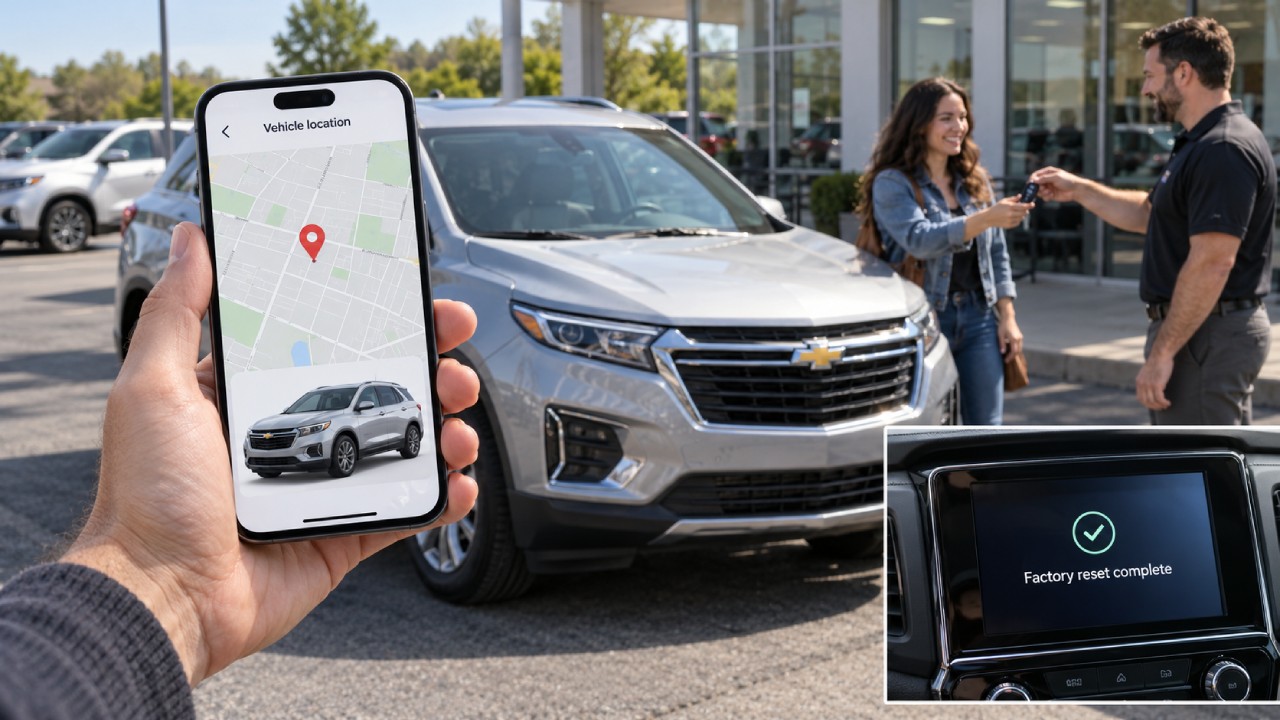
Potentially, yes. The contrast between Ford's reset guidance and Tesla's ownership instructions supports a conditional answer: a reset can end connected access, but clearing the vehicle does not universally replace an account transfer. A former owner's location permissions need to be revoked, not merely hidden behind a fresh-looking screen.
If you prepare used cars for delivery, that distinction determines what you can tell the buyer. This comparison uses U.S. manufacturer guidance. The buyer wants reassurance that someone else cannot locate their car, and an empty phone book does not answer that concern.
Stored information and remote permissions are different things
Ford's privacy notice identifies contacts and paired-device names as information removed by a master/factory reset. These are records left inside the vehicle. Clearing them addresses what the next occupant might see when using the screen.
Connected access answers a different question: which accounts can obtain information from the car or send it commands? Ford's app documentation describes vehicle-location features and available remote locking and starting through an activated modem connection. That access depends on the connected system, not on whether a familiar phone name remains visible.
For handover purposes, there are therefore separate results to establish: removal of the seller's onboard information and termination of their remote authorization. One manufacturer operation may accomplish both. Where it does not, the clean screen proves less than the buyer expects.
The manufacturer's instructions determine what a reset accomplishes
Ford says its master/factory reset disconnects modem-equipped vehicles from associated Ford and Lincoln accounts while clearing imported information. Its policy makes a separate distinction for vehicles fitted with what it calls a Connectivity Device: those require removal of the VIN from the associated accounts. Even within one manufacturer's guidance, the installed connectivity hardware matters.
Tesla's Model 3 manual describes an in-car factory reset followed by removal or transfer through the app. Tesla also specifies the order: the reset comes before account removal because the ordinary reset requires the account credentials. The ownership instructions therefore provide no basis for treating the reset alone as a completed transfer.
General Motors' U.S. privacy statement likewise separates the jobs. GM advises sellers to erase personal information from the vehicle and contact the company about transferring or canceling their account. It directs owners to their vehicle manual for the data-erasure or factory-settings instructions.
These are different handover arrangements, not competing descriptions of one universal reset. A recon entry that says only “factory reset done” leaves the delivery advisor to guess which result it establishes. The relevant instruction is the one for the vehicle and its installed system, including any account action that the manufacturer requires.
The seller can release access, but the manufacturer controls the account association
The seller's role extends beyond handing over the keys when the manufacturer requires an account action. Tesla's transfer guidance explains that a completed ownership transfer withdraws the former owner's access and gives the new owner the vehicle's app capabilities. Tesla also provides an ownership-claim process for third-party purchases, using the VIN and supporting documents.
That gives you a route when an auction purchase arrives without a cooperative seller. Tesla says it can review the claim when the previous owner cannot be contacted. The important distinction is between submitting evidence of ownership and having the manufacturer finish changing the account association.
A buyer's working app is not automatically proof of that change. Tesla's driver-access guidance says an additional driver can receive vehicle-location information. Someone can therefore demonstrate app access without demonstrating that they have replaced the account owner.
Former authorizations can also extend beyond the person who sold the car. Ford says that when account removal is used to stop remote access, the vehicle must be removed from every associated account. Removing it from the seller's own account is not necessarily the whole job.
For delivery, the distinction is simple: demonstrating that the buyer has permission does not establish that everyone else has lost theirs. The manufacturer's transfer or revocation process supplies that missing evidence.
Confirmation must match the access you say has ended
A useful handover record identifies the VIN and the actual manufacturer procedure completed. Where the manufacturer says a particular reset disconnects prior accounts, successful completion supports that stated result. Where the instructions also require an account release, the reset record cannot stand in for it.
Tesla provides a concrete example of completion evidence: its transfer guidance says both parties receive an email when the transfer finishes. Tesla separately describes an acknowledgment sent when a request is submitted. Those messages establish different things, so a request acknowledgment should not be recorded as a finished transfer.
When the account status remains unclear, a support conversation needs to address revocation directly. You could ask: “Has the former owner's account been disconnected from this VIN, and does that also remove access previously granted to other drivers?” The answer needs to establish what has ended, rather than merely confirm that a new customer record exists.
A case number documents an inquiry, not its resolution. If support confirms the release, the dealership record should preserve the date and the scope of that confirmation. If support confirms only the buyer's enrollment, the unanswered question about earlier access remains open.
A failed remote command is weaker evidence. Ford's app guidance requires cellular connectivity for remote features, so a command failure could reflect a connection problem rather than withdrawn permission. That makes it unsuitable as the sole basis for declaring the former account disconnected.
An unresolved release needs a clear delivery explanation
When the manufacturer has not completed a required account action, the delivery explanation should distinguish finished recon work from unfinished account work. A suitable explanation would be: “The information stored in the car has been cleared. The connected-account release is still pending, so I cannot yet confirm that the former owner's remote access has ended.”
That does not claim the seller has actually accessed the vehicle. It tells the buyer precisely which assurance the dealership cannot yet give. The unresolved item also needs a named person at the store to obtain the manufacturer's answer, so the buyer is not left chasing a support request that nobody owns.
The title's answer depends on what the reset actually revoked. At delivery, your defensible assurance is specific: the applicable manufacturer process has finished, and its stated result or support confirmation establishes that the former connected access has ended. A reset label by itself cannot carry that assurance.