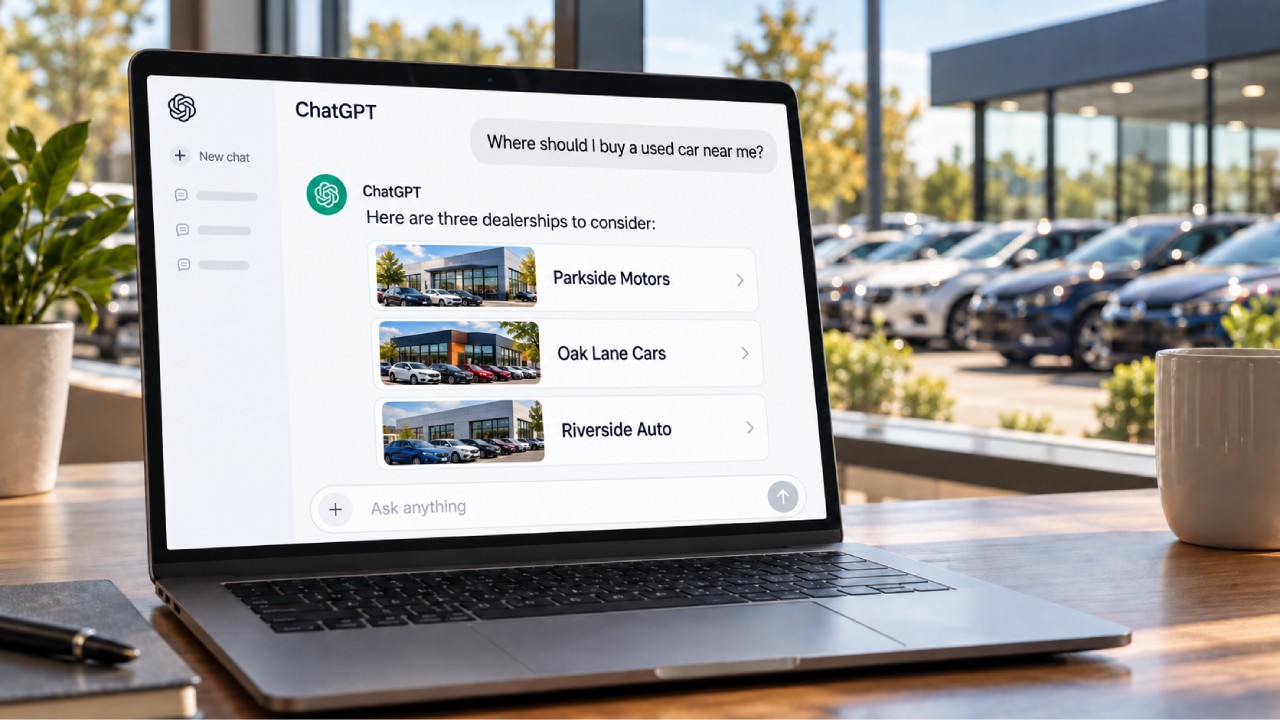
Can you influence whether an AI assistant suggests your showroom when a buyer asks where to buy a car? You can make your business information available for consideration. You cannot secure a recommendation simply by rewriting your homepage, and meeting a platform’s requirements does not guarantee a place in its answer.
If you handle your dealership’s marketing, the worry is being left off the buyer’s shortlist before anyone sends an enquiry. The question here concerns public tools that search the web, including ChatGPT search and Google’s AI search experiences. Your own website chatbot and paid advertising are separate subjects.
A mention is not a dealer endorsement
A tool mentions your dealership when it includes your name. A citation links to a page as supporting material, which could be your website or somebody else’s listing. A local recommendation goes further by proposing your showroom as somewhere the buyer should consider visiting.
These appearances have different meanings for your marketing. A citation to your buying guide does not establish that the assistant recommended your business. None establishes that the platform inspected your stock or independently assessed how you treat customers.
OpenAI warns that search information and citations may be wrong or out of date. The sensible interpretation is that an answer gives the buyer a starting point for investigation, not a certificate of dealer quality.
Search access comes before selection
Google Search Central explains that its generative search features retrieve material from Google’s search index to help construct answers. For a supporting page to qualify, Google needs it in that index and must be permitted to display a search snippet. Ordinary search accessibility therefore remains relevant to AI discovery.
There is also a participation setting. Google’s Search Console documentation describes a control that lets owners exclude their website from its generative search features. Inclusion is the default, but a site’s setting must permit it to participate.
OpenAI’s crawler documentation assigns search discovery to OAI-SearchBot. It advises website owners to allow that crawler through their robots.txt rules and permit requests from its published IP ranges. Robots.txt tells automated crawlers which parts of a website they may access; hosting security can impose separate blocks.
OpenAI distinguishes this from GPTBot, which collects material that may be used for model training. You can permit its search crawler while refusing its training crawler. Making your stock pages searchable is therefore a different decision from allowing their use in training.
Your public details should identify the same showroom
Google’s Business Profile guidance says complete, accurate information makes businesses more likely to appear in relevant local results. It also identifies distance from the searcher as a ranking consideration. These are documented Google local-search factors, not a formula that every AI assistant follows.
Google’s business-representation rules require a name that reflects the actual business and an accurate location. They also call for a phone number or website representing the individual business location.
For your dealership, the practical implication is consistency of identity. Your stock pages and public profiles should point to the same trading business, with current contact details. A complete showroom address, including the locality and PIN code, is more useful than a landmark alone. Where you operate several branches, make clear which branch the phone number reaches and which branch holds the vehicle.
The purpose is to remove conflicting information, not to perform a ritual of identical punctuation across directories. A different address abbreviation is a different problem from sending a buyer to premises you have left.
Stock pages need to connect vehicles to your business
Google Search Central’s AI-feature guidance recommends making important information available as text and helping crawlers find pages through internal links. It also highlights access through the website’s hosting infrastructure. A page that looks fine to your marketing team may still have an access problem.
Applied to a dealership, that means giving each advertised vehicle a public page with useful particulars. Its model and variant, fuel type, transmission, asking price and availability should be readable without requiring a login or a WhatsApp conversation. Photographs matter to buyers, but they should not carry all the information about the vehicle.
The page also needs to identify the selling dealership and the showroom holding that stock. A detailed vehicle description without a clear seller leaves an important part of the buyer’s question unanswered: where can I actually see it?
Availability deserves the same attention as the description. Leaving a delivered car advertised as available supplies the wrong answer to a stock enquiry. Marking it sold corrects your own page; it cannot ensure that every outside source has caught up. OpenAI’s warning about outdated search information is particularly relevant to stock that changes hands.
The buyer’s question changes which information matters
Google says its AI search features can expand a question into related searches. OpenAI similarly describes rewriting a user’s request into targeted queries for search providers. It also says ChatGPT may use an approximate location inferred from the user’s IP address. The assistant is not necessarily searching the exact sentence the buyer typed.
Imagine these buyer questions: “Which used car showrooms are near Baner?” and “Who has a used automatic hatchback available in Pune?” The first puts proximity at the centre. The second asks for matching stock across a wider area. A showroom’s location page answers a different need from a current vehicle listing, so you should not expect both questions to produce the same shortlist.
The source of the information matters too. Google says its business profiles combine public web information with licensed data and contributions from users, including owners. Your website is therefore one source within a broader public record, rather than the sole account of your dealership.
Google also says its AI search experiences can use different models and techniques, producing different responses and links. Add changing vehicle availability, and an answer captured on one occasion cannot establish permanent visibility. A different shortlist does not, by itself, prove that your website has developed a fault.
Pay for verifiable work, not guaranteed inclusion
Eligibility means a page can be considered. It does not mean the platform will select it. Google explicitly declines to guarantee indexing or display even when requirements are met; OpenAI likewise says search placement is not guaranteed.
That distinction should shape what you buy from a marketing agency. Correcting branch information and fixing crawler access are identifiable pieces of work. A screenshot showing your name is evidence of one answer, not proof that buyers throughout your catchment area will receive that recommendation. Any assessment needs the original question and location context to mean much.
You can take responsibility for the information your dealership publishes and whether search tools can reach it. Spend on making that information accurate and useful to a buyer. The assistant still decides what belongs in each answer.
Frequently asked questions
Do I need an llms.txt file to appear in Google’s AI answers?
No. Google Search Central says Google Search ignores llms.txt files and does not require special AI files or schema.org markup for its generative search features. That guidance concerns Google specifically. Such a file is not a substitute for crawler access or the platform’s normal eligibility requirements.