“Was this one built in Canada?” When a buyer asks about a vehicle on your lot, the badge cannot answer for you. A brand’s home country and a familiar model name do not establish where that particular car was assembled.
For Canadian dealership staff, the job is to connect the vehicle to manufacturer evidence, then explain the result without overstating Canadian content. A customer may be trying to support Canadian factory jobs. Answering with the nationality of the manufacturer could miss their point.
1. Find out what Canadian means to this buyer
Ask: “Do you mean assembled in Canada, or are you asking about Canadian parts as well?” Final assembly concerns where the completed vehicle came together. Component origins require separate evidence.
If the customer means Canadian ownership of the automaker, treat that as a different question. An assembly record cannot establish corporate ownership. Before recommending stock or bidding on a vehicle, settle which requirement matters; “Canadian car” is too loose to guide either decision.
2. Decode the plant using the right manufacturer information
The manufacturer lookup is the main evidence-gathering step. Comparing the vehicle with its stock record is a routine identity check, not an origin finding.
For standard 17-character VINs, the Government of Canada’s Motor Vehicle Safety Regulations assign the model-year code to position 10 and the manufacturing-plant code to position 11. Interpret those characters using information that applies to the manufacturer and model year.
Here is a practical demonstration using a 2023 Ford Edge. Its model-specific sheet appears on page 12 of Ford’s 2023 VIN guide:
- Identify the vehicle. Photograph the Edge’s full VIN and compare every character with the stock record. If you are buying remotely, request that photograph from the seller rather than relying on the advertisement’s typed number.
- Confirm the model year. Count from the left to position 10. Ford’s model-year table on page 4 identifies P as 2023, and the Edge sheet also shows that mapping. Check the actual character rather than accepting the advertised year.
- Read the assembly plant. Move to position 11. On Ford’s Edge sheet, B identifies Oakville, Ontario, Canada. The conclusion comes from matching the vehicle’s code to the applicable manufacturer entry, not from recognizing the Edge name.
Do not stop at a chart of VIN first characters, or apply Ford’s plant codes to another make. You need the manufacturer’s interpretation for the vehicle being checked.
When applicable decoding information is unavailable, request written assembly confirmation or a VIN-specific build record from the manufacturer’s Canadian customer service team or an authorized dealer. Specify that you need the plant and country; an options list without a plant entry will not answer the question.
3. Corroborate the result with vehicle documents
Compare the decoded plant with any build record or original window sticker available for that VIN. Accept a document as corroboration only when it explicitly identifies the assembly location.
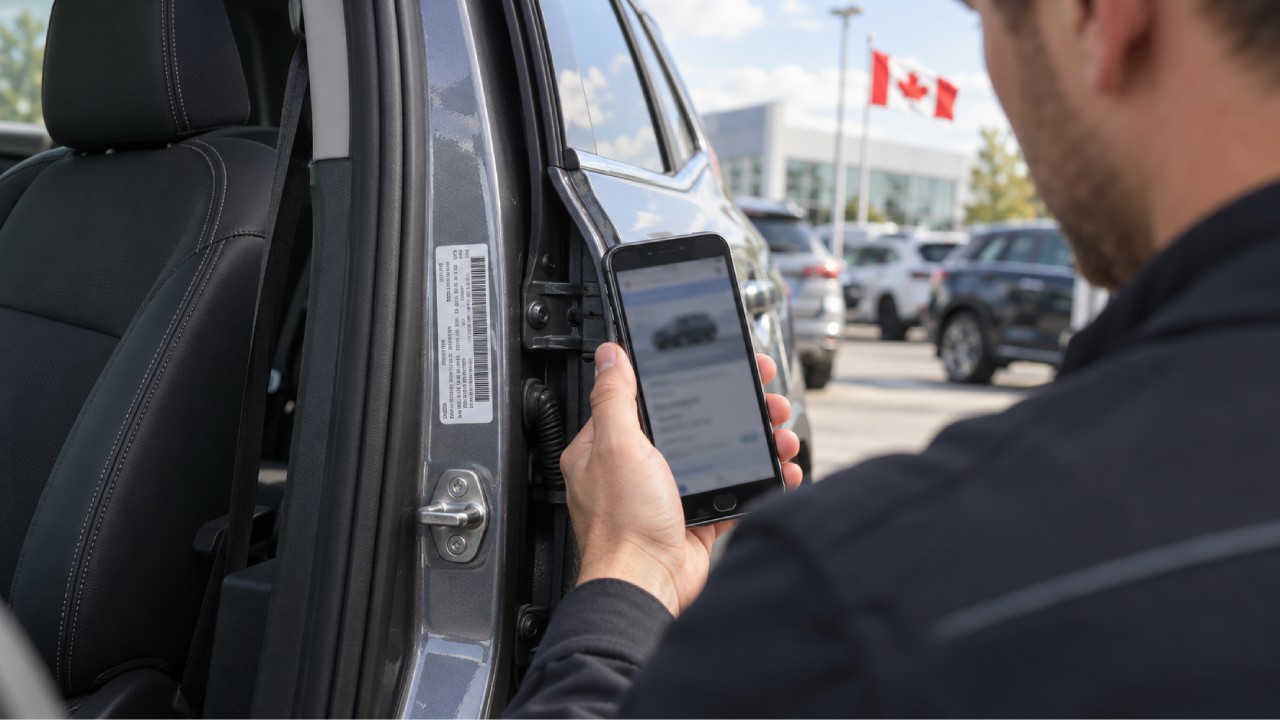
The compliance label can help connect the car with its paperwork. Toyota Canada directs owners to the driver’s door frame or door edge and says the label includes the VIN, manufacturer name and production date.
Read those fields literally. A Canadian mailing address is not an assembly declaration, and “Canada” in a manufacturer’s name does not identify the plant.
If documents disagree, check for a transcription error or an incorrect model-year guide. Ask the manufacturer to resolve any remaining conflict before making an assembly claim. Picking the document that helps sell the car is not verification.
4. Separate assembly from broader Canadian-content claims
The Competition Bureau distinguishes specific process descriptions from broader origin claims. Its guidance sets out when it generally will not challenge “Made in Canada” and “Product of Canada” representations; the Bureau does not certify or approve them.
| Claim | Supporting basis |
|---|---|
| Assembled in Canada | Evidence of assembly in Canada, with an appropriate qualifier where needed. Surrounding wording and imagery must not imply broader Canadian content. |
| Made in Canada | Canadian expenditures represent at least 51% of total direct production costs; Canada is where the last substantial transformation occurred; an appropriate qualifier explains imported content. |
| Product of Canada | Canadian expenditures represent at least 98% of total direct production costs, and Canada is where the last substantial transformation occurred. |
The Competition Bureau’s detailed guidance illustrates a qualified assembly claim that acknowledges foreign parts. It also explains that Canadian flags or maple leaves can imply origin claims, depending on the overall presentation.
Under that guidance, direct costs include production labour and materials. Substantial transformation means a fundamental change resulting in a different good. Those percentages measure costs, not the number of Canadian components; decoding a VIN supplies neither a parts-origin breakdown nor a production-cost calculation.
5. Show the buyer what you confirmed
Give the assembly country and name the plant when the evidence identifies it. For an Edge whose records confirm Oakville, you could say: “This Edge was assembled at Ford’s Oakville plant in Ontario. Here’s the Ford guide showing what its VIN means. That confirms Canadian assembly, but it doesn’t tell us where all the parts came from.”
Carry that wording into the listing and any shortened social post. Review the finished advertisement, because a headline or graphic can make a broader claim than the sentence you carefully checked.
Keep one record that another salesperson can use
Put the conclusion and its support together in the stock file, so the next person does not have to reconstruct your work:
- The verified, complete VIN.
- The manufacturer source and applicable model year, including the relevant guide pages. For the Edge check, save Ford’s pages 4 and 12.
- The confirmed plant and assembly country.
- The listing wording approved within your dealership.
- Any unanswered question, including component origins.
The check is complete when a colleague can use that record to reach the same conclusion and explain its limits without asking what you remember.
Begin with the buyer’s meaning
At the next origin inquiry, first establish whether the customer means assembly or something broader. Then check the vehicle itself and follow its VIN to the manufacturer’s evidence. Your answer should identify what you can prove, without filling the remaining gaps with assumptions.