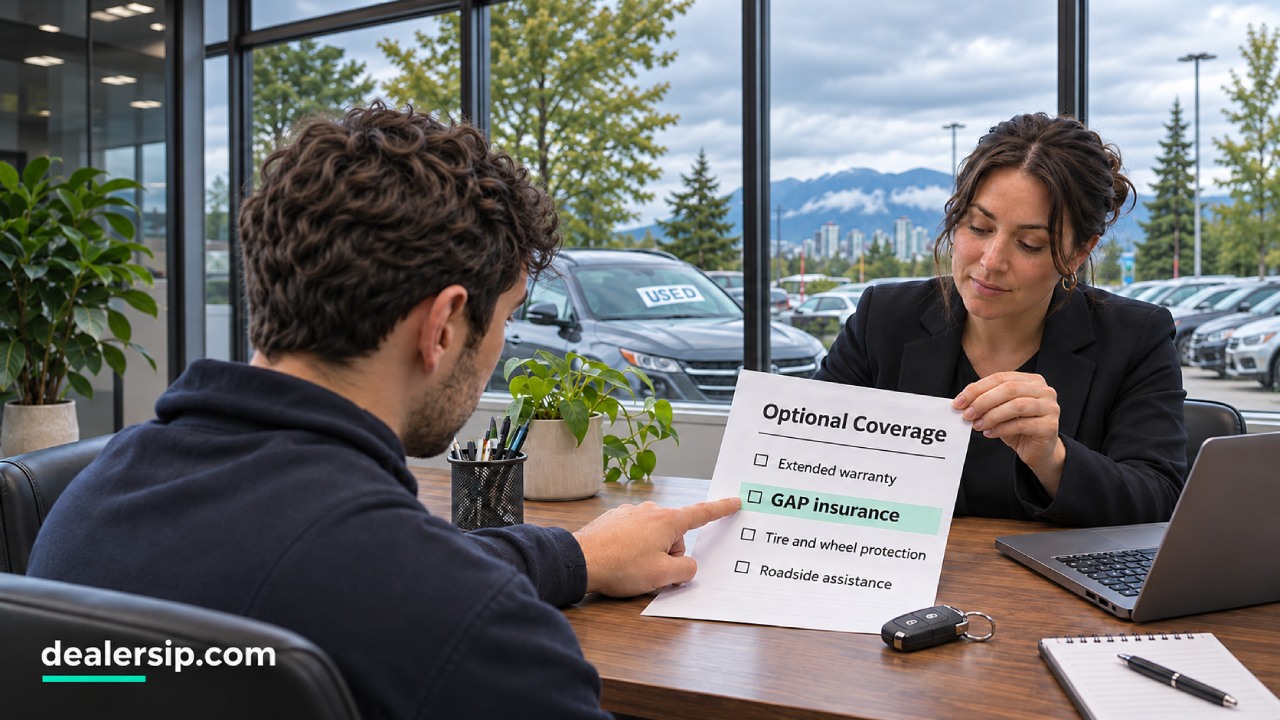
If you sell F&I insurance at a used-car dealership in British Columbia, Canada, whether you need a restricted insurance agency (RIA) licence depends on your contracts and existing authority. The Insurance Council of BC says businesses leaving specified exemptions need to apply, while some existing limited-product licensees can retain their licences.
This guide follows Council's guidance available on November 11, 2026. Start with the product and permission tests, not an assumption that every dealership must stop insurance sales on January 1, 2027.
1. Classify the contracts, not the menu labels
Pull the current contracts for your F&I products, including bundled coverages. Council lists credit protection insurance, guaranteed asset protection (GAP) insurance and vehicle warranty insurance for motor vehicle dealers.
Ask each provider to identify the insurance class and who guarantees the benefit. The BC Financial Services Authority distinguishes vehicle warranty coverage for mechanical failure from automobile insurance covering events such as collisions or theft.
The BC government's regulation, made under Order in Council 598/2025, defines GAP insurance by its coverage of financing or lease debt after other insurance proceeds following total loss or unrecovered theft. Ask the provider to explain how your contract fits that definition.
A sales name does not answer those questions. Give this review priority over collecting company details: classification can change your application route, while copying registration information is largely administrative.
2. Establish which permission covers your dealership
If none of your contracts falls within the motor-dealer insurance categories, those categories do not trigger an RIA application. Insurance outside them needs a separate licensing answer, not an assumption that RIA covers everything.
For covered products, match your legal entity to the appropriate route:
- Sales under an exemption: identify the specific exemption supporting your current activity. Establish transition eligibility before relying on continued sales.
- An existing limited-product insurance licence: Council permits eligible businesses to keep it or switch to RIA. However, Council's Q&A says retained limited-product licences cannot be changed.
- New insurance sales: Council's implementation guidance says businesses starting covered sales from January 1, 2027 need an RIA licence before beginning.
Read the actual licence conditions. A supplier's licence number does not establish your dealership's permission, so send uncertain arrangements and classifications to Council before choosing a route.
3. Apply the dates to your route
Council's published timetable separates three dates. They serve different purposes:
- January 1, 2027: the regulation takes effect.
- January 4, 2027: RIA applications open.
- March 31, 2027: qualifying formerly exempt businesses must have applied to preserve continuation beyond that date.
The continuation provision is narrower than a general grace period. Section 7 of BC's regulation preserves specified exemptions for qualifying activity immediately before January 1, 2027; without a qualifying application, that protection ends on March 31, 2027.
Under section 7, a qualifying applicant that properly delivers its application by the deadline retains the exemption until the end of the 30th day after Council refuses the licence, or the 90th day after Council issues it. This does not authorize a new entrant to sell while awaiting approval. Confirm uncertain eligibility with Council rather than treating March 31 as everyone's deadline.
4. Assign the people and assemble the evidence
Choose an eligible designated representative (DR) to oversee insurance activity and compliance. Council's DR guidance requires a corporate officer or director, a partner, or the sole proprietor, with the DR course finished before application. An F&I manager's job title alone does not establish eligibility.
Separately name the person assembling and submitting the file, with authority to act for the business. Council's application instructions call for registration and ownership records, applicable business licences, suitability disclosures and qualification evidence.
Council's licensing requirements specify errors and omissions (E&O) insurance covering the relevant insurance business, with minimum limits of $1,000,000 for each claim and $2,000,000 annually in aggregate. Obtain written authorization to represent a BCFSA-authorized insurer where required. If your provider says a warranty exception applies, confirm that with Council before omitting the document.
Under standard RIA licensing, staff must finish approved training before offering the relevant products, according to Council's training guidance. Ask your provider for accreditation status and staff completion records; attending supplier training does not establish Council approval.
Council allows term-licence applications before March 31, 2027 where representatives have completed training meeting its performance requirements and the business satisfies every other qualification. The business must attest to the completed training, which must be submitted for accreditation. Council states that these term licences expire on May 31, 2028; confirm the conversion conditions and do not schedule a term application for the March 31 deadline day.
A small store works through the decisions
Consider a fictional independent dealership where two employees present credit protection and the owner believes the supplier handles licensing. The owner asks, “Which permission covers our company, and what documents will you provide?”
The provider confirms the contract's insurance classification. The owner documents the exemption supporting current sales and asks Council to confirm the transition requirements for that activity, rather than assuming the supplier's licence covers the store.
The owner is a corporate director and completes the DR course. The controller takes responsibility for the application and obtains submission authority, then collects both employees' training records alongside insurer authorization and E&O evidence.
The provider's course is awaiting accreditation, so the controller checks the term-licence conditions and records the outstanding approval. Supplier assistance now has a defined scope instead of standing in for the dealership's own application.
5. Complete your preparation sheet
Copy this working sheet for each legal entity, with a separate product entry for each contract. It is your preparation record, not Council's application form.
| Field | Information to enter |
|---|---|
| Product and provider | Contract version, supplier, insurer or guarantor, and confirmed insurance class. |
| Present permission | Licence and conditions, or specific exemption and supporting sales records. |
| Application route | Formerly exempt transition, retain existing licence, switch to RIA, or new entrant. |
| Designated representative | Name, qualifying business role and DR-course completion. |
| Staff training | Sellers, insurance classes, course accreditation status and completion evidence. |
| Insurance evidence | E&O certificate and limits; insurer authorization or confirmed exception. |
| Responsible person | Application owner, submission authority and document deadlines. |
| Unresolved questions | Question, Council or provider contact, written answer and follow-up date. |
| Submission and decision | Filed application, receipt, correspondence, approval and licence conditions. |
Council's application instructions schedule the detailed checklist for early December 2026. Set a review for that period and another for January 4, 2027, then reconcile your records with the released materials.
You are ready to submit when each product has a documented licensing route and the application requirements have supporting evidence. Retain the submitted file and Council's decision separately: a submission receipt is not approval.
Start by sending the current contracts to your providers and pulling the dealership's existing permissions. Those documents determine whether you need to apply.
Frequently asked questions
Do my F&I staff need individual insurance licences?
Under the RIA model, they do not need separate individual insurance licences. The Insurance Council of BC says representatives can sell permitted insurance under the business's RIA licence, subject to the required training. That answer does not automatically apply to an existing insurance licence your dealership chooses to retain.