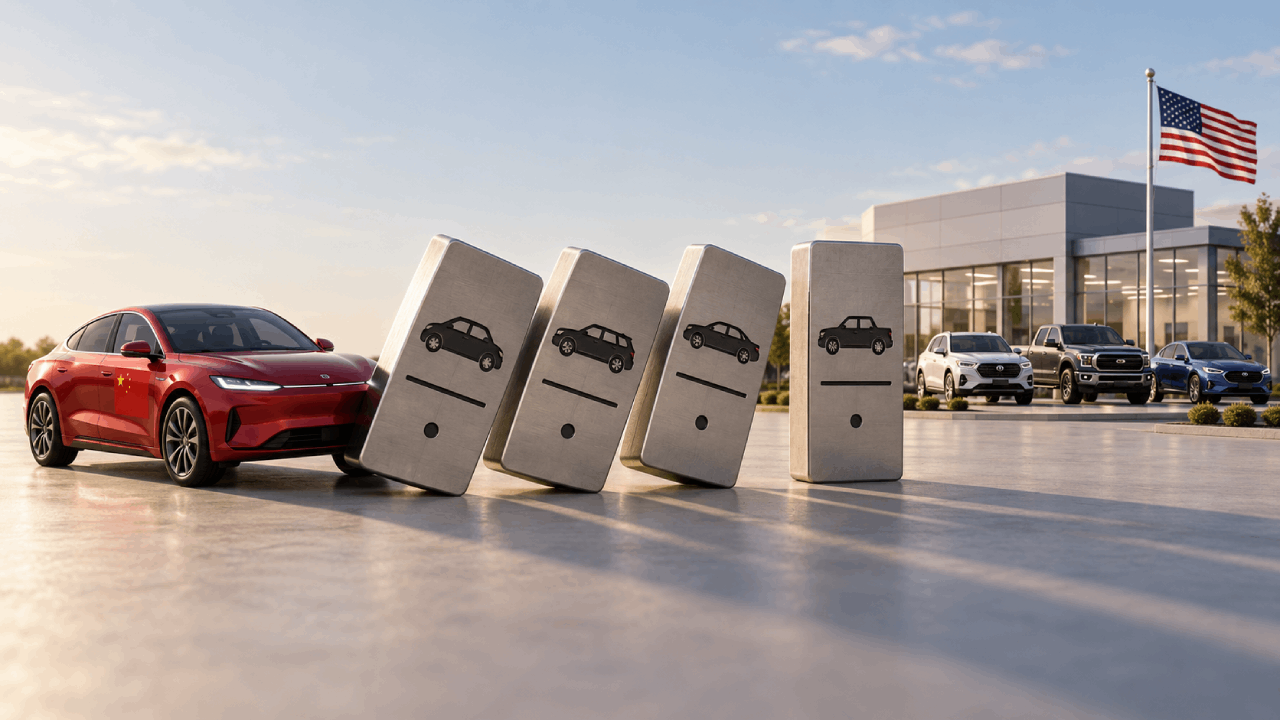
How can Chinese automakers affect your next showroom lineup if their vehicles face steep barriers at the U.S. border? The connection runs through the money your manufacturer earns abroad and the vehicle programs it chooses to fund.
For a franchise principal or general manager, that makes overseas competition relevant to a facility commitment or acquisition even when domestic deliveries look healthy. Today’s sales tell you what customers are buying. They do not establish what will replace those vehicles.
Tariffs protect a market, not worldwide earnings
The U.S. Trade Representative increased the additional Section 301 duty on covered China-origin electric vehicles to 100% in 2024. USTR’s May 2026 review notice identifies those modifications among the measures then in force. That percentage describes one tariff layer, not the combined duty on every Chinese vehicle.
The boundary matters more than the percentage here. A duty charged when a vehicle enters the United States cannot preserve another manufacturer’s pricing power in Shanghai or win back a customer in Europe.
In its 2025 risk discussion, Volkswagen Group identifies entrants from China among the sources of competition across international markets. The exposure therefore extends beyond selling vehicles inside China. A manufacturer can also encounter Chinese rivals elsewhere without either company bringing those vehicles to America.
GM and Volkswagen show the exposure, with important differences
In its 2025 annual report, General Motors recorded approximately 2.85 million U.S. vehicle sales, compared with 2.71 million during 2024. Yet GM reported a roughly $0.3 billion equity loss from its automotive joint ventures in China. That result included $0.6 billion of restructuring-related charges.
GM attributes difficulty sustaining China earnings to intense local competition. But the direction of change matters: its reported China equity loss narrowed substantially from the $4.4 billion recorded for 2024. These figures show domestic strength alongside overseas restructuring, not an uninterrupted deterioration in China.
Figures in Volkswagen’s 2025 annual report show that its proportionate operating result from equity-accounted Chinese companies fell approximately 45% against 2024. Volkswagen reports this measure separately from consolidated operating profit, so the two should not be treated as interchangeable.
Separately, Volkswagen’s consolidated results show an operating margin of 2.8% for 2025, versus 5.9% a year earlier. Its explanation emphasizes charges associated with Porsche’s revised product plans and U.S. import tariffs, among other factors. Calling that entire decline a consequence of Chinese competition would misstate the report.
More recently, Volkswagen’s September 18, 2026 disclosure lowered its expected 2026 operating margin to no more than 1%, citing worsening conditions particularly in China alongside impairments and restructuring expenses. That is manufacturer guidance, not a completed annual result or an announcement that a particular U.S. model has been canceled.
Lower returns change which projects can compete for funding
The first connection to your showroom is financing. If overseas operations generate less cash, a manufacturer has less internally generated funding available unless another business makes up the difference. It can borrow or use reserves, but those choices do not make a weak vehicle program economically attractive.
This is not a dollar-for-dollar transfer from a China profit account into an American product budget. Volkswagen’s investment planning describes financing automotive investment from its own resources, while its Chinese joint ventures finance their investment plans separately.
Reported earnings also differ from cash available to spend. A noncash impairment reduces the recorded value of an investment without consuming the same amount of cash that year. Its significance for product planning lies in the weaker expectations behind that valuation, rather than an identical hole suddenly appearing in the development budget.
The implication is that management may become more selective even without a funding crisis. A marginal replacement program must compete with investments offering stronger expected returns. The pressure can reach a U.S. vehicle that sells adequately but no longer looks attractive as part of a worldwide program.
A smaller global production run changes the replacement decision
The second connection is scale. Shared vehicle engineering lets a manufacturer recover development spending across multiple products and markets. Volkswagen’s technology report describes platform sharing within the group and supplying platforms or components to outside manufacturers as ways to extend that scale.
Consider a fictional vehicle program requiring $2 billion for development and tooling. Assume sales in both markets help recover that same shared investment. Hold that budget constant while changing the expected overseas sales over the program’s life:
| Program forecast | U.S. lifetime sales | Overseas lifetime sales | Upfront spending per vehicle |
|---|---|---|---|
| Original | 400,000 | 600,000 | $2,000 |
| Weaker overseas demand | 400,000 | 400,000 | $2,500 |
The American forecast has not moved, but fewer vehicles must recover the same investment. This is a simplified cost-recovery calculation, not a prediction of sticker prices. It shows how a shared program could be affected, without demonstrating that any particular U.S. vehicle depends on overseas volume this way. Discounting abroad could weaken the program further by reducing what each overseas sale contributes.
Management could respond by keeping the existing model longer or dropping a low-volume body style from its successor. Either decision could leave your franchise with fewer fresh products despite steady U.S. demand. The causal connection is the revised business case, not the arrival of a Chinese vehicle on your local shopping list.
The United States could receive more investment instead
There is no requirement for every region’s product budget to shrink together. If management expects stronger returns from American customers, weaker prospects elsewhere can strengthen the case for concentrating investment here. Local production may also become more attractive when importing vehicles carries additional costs.
On June 24, 2026, GM announced $150 million for its Spring Hill assembly operation in Tennessee to support a forthcoming gasoline-powered Cadillac. The announcement also reiterated plans to start building the Chevrolet Blazer there in 2027.
Those are identified manufacturing commitments, not an analyst’s inference about where investment might go. They demonstrate why overseas pressure does not justify assuming that American product spending must retreat.
But factory spending and lineup breadth are different things. Moving an existing vehicle into a U.S. plant does not necessarily add a nameplate for your franchise. A manufacturer could expand domestic production while concentrating on fewer vehicles.
Judge the replacement pipeline separately from current sales
A strong sales year can reflect successful products funded under earlier assumptions. The successor faces a different decision: whether its expected earnings across its planned life justify the next investment. That timing difference explains how a busy showroom can coexist with uncertainty about future replacements.
For your dealership, a manufacturer’s announced program deserves more weight than an analyst’s projected launch date. Neither a forecast nor a general spending pledge establishes that your franchise will receive a particular model. Likewise, a cancellation announcement does not establish Chinese competition as its cause unless the manufacturer provides evidence connecting them.
This changes how you assess a long-term dealership commitment. Current earnings help establish what the franchise produces now; announced replacements help establish what your investment would depend on later. Chinese competition matters because it can alter those replacement decisions overseas, well before any Chinese-branded vehicle competes for a customer in your showroom.