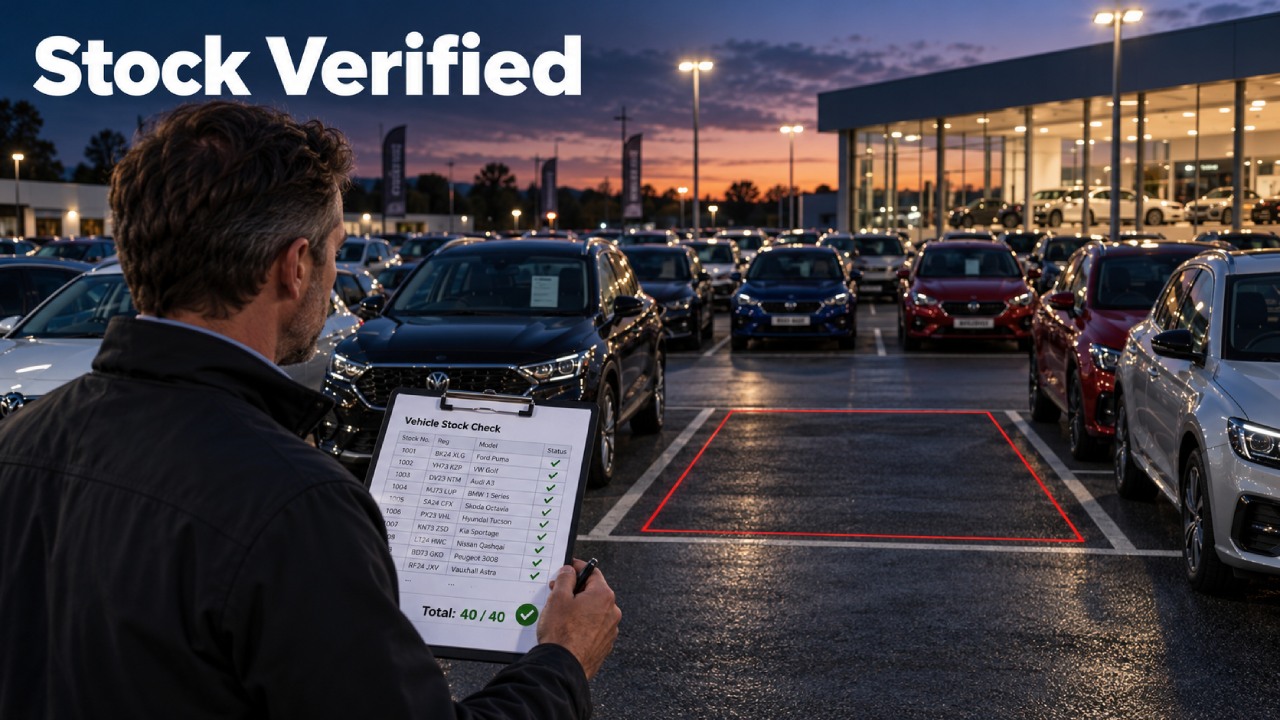
A matching stock total does not establish that the cars in your yard are the cars in your register. To find what is missing, match each chassis number to its record, then work backwards through the register until every listed vehicle has evidence of its whereabouts.
Consider a simple illustration: a customer-owned car awaiting sale gets counted as dealership stock while a dealer-owned car is absent. The total agrees, although the vehicles do not. An acquired car that nobody entered in the register could conceal the same shortage.
A clean total is tempting when you are trying not to delay deliveries. But this exercise must establish vehicle identity and custody, including legitimate off-site stock. It does not establish where sale proceeds went or, by itself, prove fraud.
Reconcile vehicles in both directions
ICAI’s SA 501 describes testing from records to physical stock and from physical stock to records. It also distinguishes evidence that an item exists from evidence of ownership. Apply those principles to the entire vehicle list within your reconciliation scope.
Fix the cut-off and preserve the starting list
Choose one date and time for every location included. Save a read-only copy of the stock register before anyone corrects it, so subsequent changes cannot erase the discrepancy you are examining.
Build a working sheet with the full chassis number and stock reference. Give each row separate fields for recorded location, observed location, ownership category and supporting evidence. Distinguish dealer-owned vehicles from customer vehicles held for sale or another purpose; leave uncertain ownership visibly unresolved.
Record when each vehicle is checked. Pause movements during counting where practical; otherwise, log each arrival, departure and internal transfer against its chassis number. You need that movement history to establish where the car was at the cut-off, rather than merely where someone found it later.
Start with the cars, then find their records
Walk every area where vehicles can stand, including the service centre and overflow parking. Record chassis numbers directly from the vehicles before matching them to the register. Starting with a pre-filled list encourages you to recognise expected cars and overlook unexpected ones.
Use registration numbers and model descriptions as supporting details, not substitutes for reading the full chassis number. Retain the observed identity separately if it differs from the stock record. Do not overwrite either version merely to create a match.
Trace each observed car to a stock entry or a customer custody record. Check the stated ownership category against the purchase or exchange file, or the customer’s agreement. Put unmatched vehicles on an exception list: physical presence does not authorise you to treat an unexplained car as dealer-owned stock.
Return to the register and account for every entry
Now take the preserved stock list and match every row to your physical observations. This is the main missing-car test: a walk around the yard cannot identify a vehicle that is absent unless you also work through what should be there.
Require a one-to-one match. A chassis number observed once cannot clear duplicate stock entries, and a similar-looking car cannot clear an unmatched row. Flag duplicate identities separately rather than deleting them during the exercise.
For every car not observed, record the claimed location and the person or business holding it. Give those rows priority. Adding the totals again is an arithmetic formality; it provides no answer about an unmatched chassis number.
Verify off-site custody directly
Contact the workshop, auction operator or storage provider yourself. Independently verify the contact details rather than relying solely on a number supplied by the employee responsible for the movement.
ICAI’s SA 505 explains why direct external responses can carry more weight than internally generated evidence and requires auditors to control confirmation requests. For your reconciliation, have the custodian send its reply directly to the person conducting the check.
Ask which chassis numbers it held for your dealership at the cut-off, at which address, and under whose custody. Request its intake reference and details of any subsequent release. Compare those details with your movement records; a workshop job card proves little about present custody if the car has already left.
If the reply conflicts with your records, or no reliable reply arrives, arrange an independent physical inspection. Keep the vehicle unresolved until the evidence supports its location. An employee’s forwarded message saying “still at the bodyshop” is not a completed confirmation.
Explain movements across the cut-off
ICAI’s inventory audit guidance covers movement controls and cut-off procedures, including cross-checking information from different departments. Use that approach to connect the saved register with what you observed.
Match recent arrivals to dated intake acknowledgements and departures to authorised release documents. Compare the actual handover time with the time someone entered the transaction. For an off-site transfer, match your release record to the receiving location’s acknowledgement using the same chassis number.
A timing explanation needs evidence for the intervening movement. A car that returned after the cut-off needs evidence of where it was before returning. A car delivered before the cut-off needs the recipient’s handover acknowledgement and review of why it remained on the stock list. A later sighting alone does not settle either question.
Keep unresolved cars separate from bookkeeping corrections
Assign each exception a named person responsible for follow-up and a deadline. Preserve its evidence and original entry even after a correction is authorised, so someone else can understand what changed and why.
- Verified recording error: the evidence establishes the vehicle’s identity and location, but an entry contains a transcription error or duplication. Correct the record with approval and retain the explanation.
- Supported timing difference: dated movement documents explain the difference between the cut-off and the observation. Record the adjustment against that specific chassis number.
- Unresolved identity or custody: the chassis does not match, ownership remains unclear, or nobody can substantiate the claimed location. Escalate the exception to management without offsetting it against an extra car elsewhere.
- Unresolved sale proceeds: evidence establishes delivery, but receipt of the money remains uncertain. Refer that question for a separate accounts reconciliation; locating the vehicle’s recipient does not establish payment.
Avoid substitutes for seeing the right vehicle
Do not count keys, registration certificates or purchase files as cars. ICAI’s SA 500 distinguishes what different forms of evidence establish. A document supporting a purchase does not, by itself, demonstrate that the vehicle remains where the register says it is.
Do not let the person who controls a disputed vehicle also approve their own explanation. Have someone outside that custody responsibility review the evidence. This is a check on the explanation, not an accusation against the employee.
Finish with evidence for each identity
The reconciliation has done its job when every recorded vehicle has either traceable location evidence or an explicit unresolved exception, and every observed vehicle has an explained place in the records. A shortage can remain open even though the reconciliation work is complete. Do not describe the stock as fully verified while those exceptions remain.
Start by saving the current vehicle list and agreeing the cut-off. Then collect chassis numbers from the cars themselves. The question to settle is which recorded vehicle you cannot substantiate, not whether you can make the totals agree.