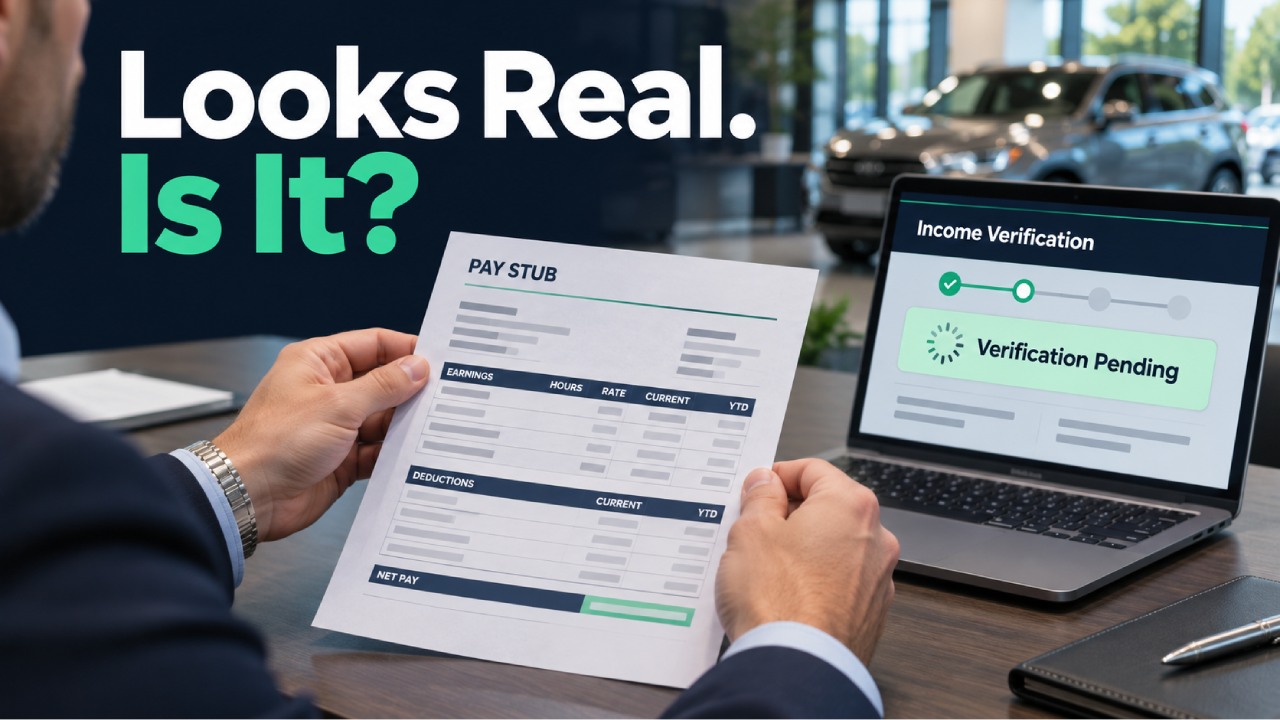
A convincing pay stub does not clear an income stipulation. If you handle F&I at a U.S. dealership, you need to connect the applicant’s stated earnings to evidence the lender accepts before you authorize delivery.
Put the investigative effort into confirming the source, not inspecting the design. Explain the process upfront: a buyer may worry that another request means you suspect dishonesty, or that you want unrestricted access to their banking.
1. Identify the claim you need to verify
Match the applicant and employer on the stub to the credit application. Identify the earnings period and distinguish the current payment from year-to-date totals so you know exactly what the document claims.
Treat the visual review as an intake formality, not authentication. Correct arithmetic establishes that the figures agree with each other; it does not establish that the employer paid those wages.
This problem predates generative AI. In its 2018 enforcement announcement, the Federal Trade Commission described allegations involving fabricated financial documents and a service that purported to confirm employment claims supported by those documents.
2. Establish the lender’s requirements and the buyer’s permission
Read the approval stipulations alongside the lender’s current funding instructions. Confirm the acceptable evidence and required date range, then ask who must perform the verification: your store, the lender or its designated service.
For example, Capital One’s proof-of-income guidelines require a submitted W-2 employee’s pay stub to fall within 45 days of the contract date. That is a Capital One requirement, not a universal deadline. Use the instructions attached to your lender and program.
Before accessing records or contacting an employer, confirm that the applicant has provided the authorization required for that specific method. Do not assume permission to obtain a credit report covers every payroll or bank-access service. Have the customer complete any separate authorization through the approved process.
Request only the records needed for the stipulation and any specific discrepancy. The FTC’s business security guidance advises against collecting sensitive information without a legitimate business need. If the lender requires complete statements, obtain those rather than improvising a cropped substitute.
3. Confirm income through a source outside the submitted document
This is the substantive verification step. Use the lender’s accepted payroll or bank connection, or an independently located employer contact where the lender permits it. Do not demand every method when an accepted route resolves the requirement.
Know what the result establishes. Plaid’s technical documentation, for example, distinguishes payroll-account information about employment and gross earnings from bank-account information about net income received. With whichever service your lender accepts, confirm that the returned record belongs to the applicant and covers the required period.
A second uploaded PDF is another submitted document, not an independent connection. If you need to establish authenticity, ask for the lender-approved retrieval process rather than simply requesting another screenshot. Let the customer authenticate privately; never ask them to give you their password or security code.
For employer verification, locate the employer’s official website independently and use its published switchboard or verification instructions. Do not start with a phone number or link printed on the disputed stub. Confirm the contact’s role before requesting authorized information, and disclose only what the verification requires.
Ask for the earnings information the lender needs, including the applicable period and pay frequency. Confirmation that someone works there does not establish their wages. If HR provides employment status only, or the payroll service returns no record, ask the lender which alternative will complete the income check.
4. Reconcile the earnings with the payments
Compare records covering the same period before deciding that amounts conflict. Separate the reconciliation into these checks:
- Payment dates: Distinguish the period worked from the payday and bank posting date. Ask about a timing difference rather than treating different date labels as contradictory.
- Gross to net: Follow the listed earnings and deductions through to take-home pay. Compare a payroll deposit with the amount payable, not with gross wages, and ask payroll to explain unfamiliar adjustments.
- Payment destinations: Establish whether the paycheck went to one account or was divided. ADP’s payroll documentation allows deposits across accounts and a paper check for a remainder. Obtain the lender-accepted evidence needed to reconcile the relevant portions.
- Earnings over time: Compare current earnings with the year-to-date record and documented employment dates. Ask about changes in hours or overtime, and use the lender’s calculation method rather than projecting the largest paycheck across the year.
Do not count every bank credit as wages. Identify the payer and payment purpose, and separate transfers between the applicant’s accounts from earnings so the same money is not counted twice.
For self-employment or benefit income, switch to the lender’s documentation requirements for that source rather than demanding an employee pay stub. The Consumer Financial Protection Bureau’s Regulation B prohibits excluding income merely because it comes from part-time work or retirement benefits, while allowing creditors to assess its amount and likely continuation. Verify the income actually offered to support the application.
5. Resolve exceptions before releasing the vehicle
Describe the discrepancy without labeling the document or buyer. You could say: “The deposit shown here is smaller than the take-home amount on your statement. Does part of your pay go to another account?” Ask for the specific evidence that would resolve the difference.
If the explanation changes the income used in the application, submit the correction through the lender’s process. Send unresolved contradictions or suspected alterations to the lender’s designated review contact and your store’s compliance lead. Keep delivery on hold until the income issue has a documented disposition and the financing requirements are satisfied.
Apply the same escalation triggers to comparable applications under the same program. An unexplained payment mismatch should receive the same review regardless of how familiar the buyer seems. Record the factual trigger rather than a judgment about the person.
Preserve the verification source and retrieval date, along with the responder’s name and role for employer contacts. Record the discrepancy, supporting explanation and lender’s disposition so another manager can follow the decision without repeating the investigation.
The FTC’s auto-dealer Safeguards Rule guidance explains the obligation of covered dealerships to protect customer information through a written security program. Keep verification records in approved, access-controlled storage, not personal messages or public AI tools. Follow your retention policy, including applicable legal requirements, when disposing of records.
Avoid shortcuts that undermine the verification
Never edit a customer’s stub to make it acceptable or coach them toward the income an approval needs. If a source document contains an error, obtain a correction from its issuer and preserve the explanation. Correct application-entry mistakes through the proper process rather than changing the supporting evidence.
Do not treat a successful document upload as confirmation that the lender accepted it. Check the actual stipulation status and resolve any remaining request before treating the income condition as complete.
Make the result traceable
You have completed the process when another authorized manager can identify the accepted evidence, follow the income calculation and see how each exception was resolved. A file containing attractive documents without that connection is still unfinished.
For your next income-stipulated application, start with the lender’s current requirements and identify the approved independent verification route. That gives you a defensible stopping point: supported income and a resolved stipulation, rather than a document that merely looks convincing.
Frequently asked questions
What if the customer refuses to link their bank account?
Ask the lender which alternative verification method it accepts; refusal to link an account is not proof of fabricated income. Explain the available options without requesting the customer’s credentials. If no accepted alternative establishes the required income, leave the stipulation unresolved and refer the application to the lender for a decision.