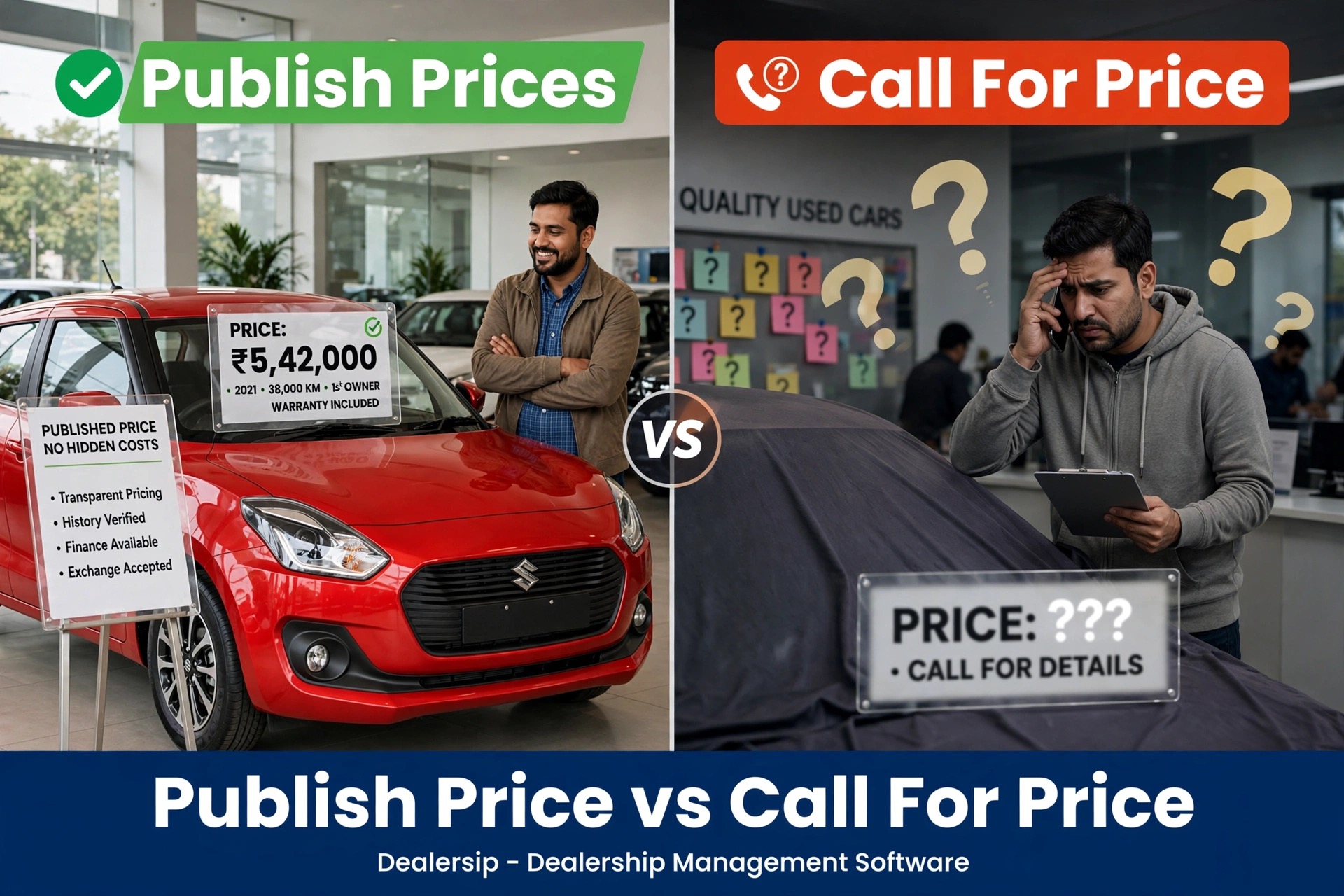
For a used car showroom in India, publish a current asking price for ordinary, sale-ready stock. Consider price on request when a specialist quotation genuinely depends on a discussion with the buyer, subject to the disclosure rules governing your sales process.
The attraction of withholding is understandable: you want to defend your margin before someone dismisses the car as expensive. But an enquiry created by leaving out the price has not yet established that the buyer can afford what you are selling.
A price enquiry has not cleared the budget question
Consider these illustrative opening questions: “What are you asking for the car?” and “I have seen the price. Can I bring my mechanic to inspect it?” The first caller is discovering whether the car belongs on their shortlist. The second has seen your starting position and wants to examine the vehicle.
Neither question guarantees a sale. The inspection caller may still need finance or an exchange valuation. Equally, the person asking for the price may have the money ready and simply lack information that your listing omitted.
The distinction matters when you judge enquiry quality. A salesperson who supplies the price and immediately loses the caller has answered a necessary question, but has not necessarily lost an achievable sale. If you count that contact as proof that withholding prices works, you are rewarding the creation of a question rather than progress towards a purchase.
What keeping the price private actually protects
Negotiation flexibility is the strongest argument. A conversation lets you understand what the buyer values before discussing money. You can explain why the car commands a premium, or suggest another vehicle if the budget does not fit. Publishing a figure gives up the chance to make that explanation before the buyer rejects it.
However, an asking price need not reveal your minimum acceptable price. You can publish a genuine starting position and still consider an offer after inspection. The discipline is deciding what justifies a concession, rather than treating every request for a “best price” as a reason to reduce it.
Changing costs deserve a different response. If inspection has uncovered work whose scope remains unsettled, you may not yet have a sale-ready car to price. Identify it as awaiting preparation or valuation. Once you know what you are selling, ordinary changes in your costs are a reason to review the advertised figure, not a permanent reason to hide it.
Competitor visibility is a real trade-off. A published price gives another dealer an easy comparison point. It does not disclose your purchase cost or the deal you will eventually accept. Keeping that information private also keeps it from buyers, so weigh the competitive concern against the usefulness of the number to someone deciding whether to contact you.
A published price establishes fit, not value
A buyer who sees the asking price can decide whether the car is within reach before entering a sales conversation. That is useful self-selection, provided the figure represents the car they can actually buy. A low headline figure dependent on an undisclosed condition does not establish affordability.
The cost is early rejection. Someone who might stretch their budget after seeing the vehicle could rule it out before speaking to you. That is the strongest reason to put the evidence supporting your price beside it, rather than expecting the number to explain itself.
Price alone cannot show how well a car has been maintained or what your preparation included. Where you seek a premium, describe the relevant condition and support it with records. “Excellent condition” gives a buyer little basis for comparing your car with a cheaper listing. Documented work gives them something specific to examine and discuss.
Publish ordinary stock and justify each exception
For a mainstream hatchback, saloon or SUV with a settled specification and completed preparation, a current asking price is more useful than a compulsory call. The buyer needs a starting figure; you already have one. Making them telephone simply moves that information into a conversation your staff must handle.
Specialist stock can justify a different approach when the conversation determines the quotation. A collector vehicle offered with alternative restoration scopes is different from a completed car awaiting a buyer. The question is what must be agreed before you can name an honest price, not whether the vehicle is expensive.
Rarity alone is a weak reason to withhold. If the sale includes a clearly defined vehicle and you have settled your asking figure, explain its unusual value and publish the price. If you genuinely need a discussion, state what the quotation depends on.
Commercial preference does not override disclosure duties. Under the Department of Consumer Affairs rules, inventory e-commerce entities must prominently display a total price with an itemised breakdown covering mandatory and optional charges, including applicable tax. Sellers using marketplace e-commerce platforms also have price-disclosure duties. Before adopting quote-only listings, establish how those requirements apply to your sales process; unusual stock has no automatic exemption.
Make the quotation match the advertised proposition
Publish an asking price that includes applicable GST and unavoidable dealership charges for the advertised vehicle. Explain what preparation or included cover the buyer receives. Calling a charge “documentation” does not make it optional if you will not sell the car without it.
Keep genuinely optional services separate. An additional warranty or delivery service should have its own price and require the buyer’s agreement. If a service is already included in the advertised package, do not charge for it again when preparing the quotation.
Treat statutory transfer costs separately from your fee for handling the work. Parivahan, the transport ministry’s portal, identifies prescribed fees and applicable tax as part of ownership transfer. Identify the buyer’s destination RTO before quoting any location-dependent amount, and label an estimate as an estimate. Do not present your own administrative charge as a government levy.
Where an amount cannot be established from the listing alone, identify the charge and the information needed to calculate it. Then provide an itemised total before asking for a booking amount. The Central Consumer Protection Authority includes drip pricing among the unfair practices addressed by its dark-pattern guidelines. A generic warning about possible extras is a poor substitute for explaining the actual charge.
Keep an exchange allowance separate from the selling price. Otherwise, the buyer cannot tell whether the apparent reduction comes from a discount on your car or the value assigned to theirs. A quotation should clarify the negotiation, not reopen the basic question of what the advertised price meant.
Judge the policy by what happens after the price is known
To decide whether your showroom needs exceptions, examine what happens when callers receive the asking figure. Do they move towards inspection, discuss a credible offer or end the conversation because the car is outside their budget? Record those outcomes separately rather than treating every incoming enquiry as equally valuable.
When comparing pricing approaches, use similar stock and look at completed sales and achieved margins alongside inspections. Also consider the staff time spent pursuing budget mismatches. A higher enquiry-to-sale percentage can look impressive simply because fewer people contacted you, so keep the actual number of sales in view.
If the extra calls mostly exist to reveal a number you already know, publish it. Retain individual quotations where a conversation establishes something necessary to price the vehicle. That is a defensible dividing line between useful selling work and making a buyer ask for missing information.