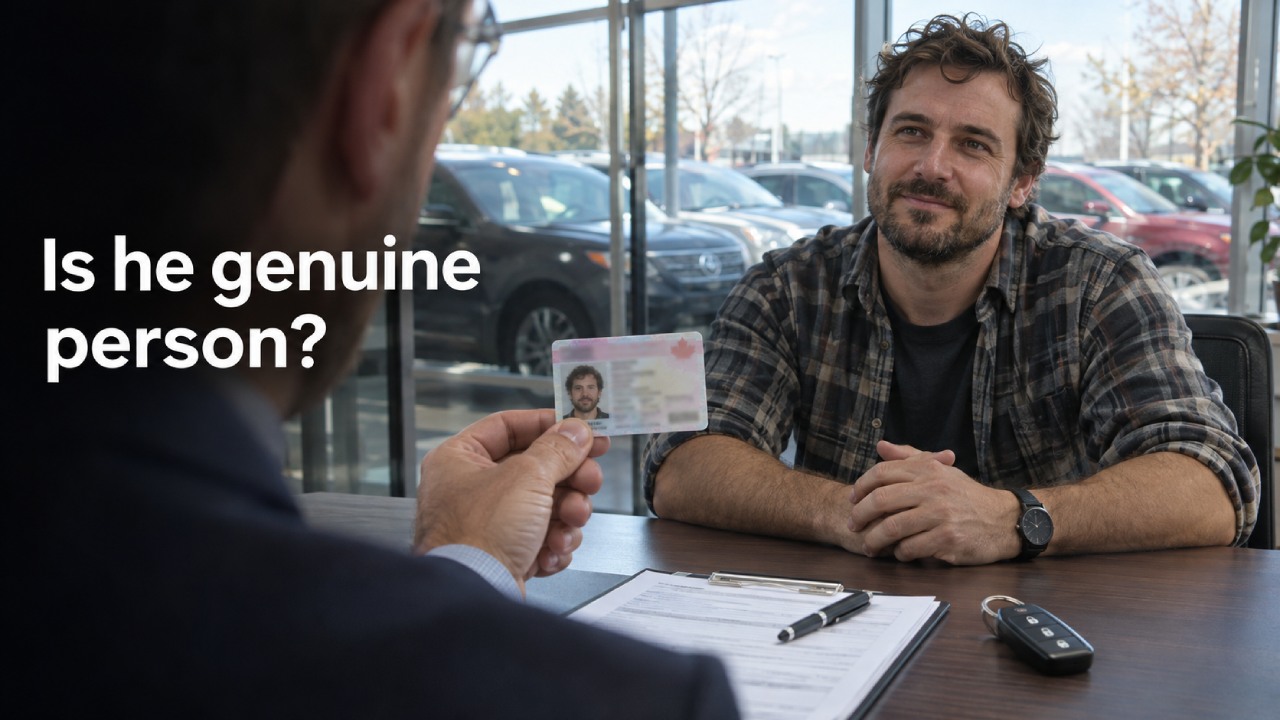
In a Puslinch dealership case, Ontario Provincial Police alleged that identification carried the collector’s photograph alongside someone else’s personal details. For Ontario used-car sales and delivery staff, the uncomfortable point is that a photo comparison could appear to check out while the borrower’s identity remains unresolved.
Separate from that police account, imagine checking a licence number through Ontario’s online service. The Ontario Ministry of Transportation says its Driver’s Licence Check returns status information for the number entered, along with certain licensing conditions, but excludes the driver’s personal information. Even a “valid” result would leave the delivery question unanswered: is the person at your counter the approved borrower?
The OPP release was reproduced on October 27, 2026. It described alleged dealership incidents on September 29 and October 13, 2026; the photograph allegation concerned the October transaction.
Ontario checks licence status, not the person at your desk
The practical limit follows from the ministry’s description: a valid result concerns the licence number submitted. It does not authenticate the physical card or connect the presenter to the underlying licence record. You cannot use a result that excludes personal information to confirm that the government holds the photograph and identity details printed on the card in front of you.
The ministry also says the service does not provide the licence class. The lookup has limits even when you are checking driving entitlement, before you consider borrower identity.
The document, the person and the credit decision are separate
Document authenticity concerns whether the identification is genuine rather than altered or fabricated. Reading information from a card is different from examining its authenticity. Before relying on a third-party tool, establish which of those jobs it performs.
Buyer identity concerns the connection between the person and the identity being claimed. For its photo-identification method, FINTRAC’s guidance for reporting entities requires scrutiny of the document’s authenticity and currency, alongside matching the person’s name and appearance to the identification. A photograph comparison alone leaves part of that work undone.
Driving entitlement concerns permission to drive. Ontario’s status service contributes information to that question, within its stated limits. It does not settle borrower identity merely because the document being checked is a driver’s licence.
Credit assessment concerns the lending decision. FINTRAC distinguishes using credit-file information to verify identity from conducting a credit assessment. A lender may perform identity checks during approval, but you need to know what its approval covers and what remains your responsibility. An authenticated licence can support identity verification; a status lookup and a credit decision are not substitutes for that process.
Separately, Halton Regional Police announced charges on November 3, 2026, following a vehicle-financing investigation involving allegedly stolen identities and false documents. That investigation began in May, with searches conducted on October 20. These accounts describe allegations, not convictions, and do not establish a rising provincial fraud rate.
The lender’s instructions need a clear owner in your store
You may hesitate to delay someone who already has an approval and a promised collection time. That pressure is why staff need agreed authority to pause delivery, rather than having to negotiate permission while the customer waits. The handover recommendations here are editorial advice, not a police-endorsed procedure or a statement of Ontario law.
Lender requirements are a separate matter. A Santander Consumer Bank dealer notice requires digital identity verification before funding from February 15, 2026, with evidence of a successful result retained. The notice says this requirement supplements existing identification duties under the dealer agreement rather than replacing them.
Your store’s policy should identify who completes the required identity checks and who resolves discrepancies with the lender. Delivery staff also need a named manager who can authorize release after those matters are settled. Otherwise, the person holding the keys has to guess what an earlier approval meant.
Changed documents or collection arrangements should return to that review before handover because the earlier decision may no longer cover the transaction being completed. If someone other than the borrower collects, the manager should establish whether the lender permits it and verify the recipient’s identity and authority. A customer’s request to change the collector should not silently become permission to release the vehicle.
A mismatch calls for clarification, not an accusation
Consider a fictional delivery following an online finance application. Credit has been approved, the arriving customer resembles the licence photograph, and the submitted licence number returns a valid status. However, the birth date on the application conflicts with information obtained through the lender-approved identity process.
The photo comparison and status result do not explain the conflicting birth dates. The appropriate recommendation is to pause delivery and involve the designated manager, who contacts the lender through the established channel. Simply editing the application to agree with the card would conceal the discrepancy rather than explain it.
You can say: “There’s a difference between the application and the information from the identity check. I need our manager to review it with the lender before I can release the vehicle. If it’s an entry error, we’ll establish what needs correcting.”
If the approved verification process establishes a clerical error, the manager can arrange the correction and any further verification the lender requires. The file should explain the resolution before the manager authorizes delivery. If the conflict remains unresolved, the handover stays paused.
Apply that response consistently to the discrepancy, regardless of the customer’s appearance or accent. Do not use ethnicity as a reason for additional scrutiny. A pause should give an innocent customer a route to correct the record, not force them to defend themselves against an accusation.
A useful verification record is not a pile of ID copies
Record which employee performed each required check, when it happened and what it established. Where a discrepancy arose, record how it was resolved and who authorized release. That tells the next employee why the transaction could proceed; an unexplained image of a licence does not.
The Office of the Privacy Commissioner of Canada’s retailer guidance distinguishes inspecting identification from recording its details or copying the whole document. It calls for explaining the collection purpose and limiting information to what that purpose requires. It also identifies employee initials or confirmation on transaction paperwork as a less intrusive way to document that identification was examined.
That guidance does not cancel a legitimate requirement to retain particular information. Santander’s notice, for instance, requires proof of the successful verification result but tells dealers not to send photo-ID copies unless requested. Keep the required evidence under the applicable retention schedule, rather than collecting additional identification without a defined reason.
The Privacy Commissioner’s safeguards guidance also identifies restricted, need-based access as a protection for personal information. In practice, delivery staff need the verification outcome and release authority, not unrestricted access to every document used during the review.
Release depends on resolving the identity question
A valid licence-status result answers a limited question. Before you hand over the vehicle, the file should show that the required borrower-identity work is complete and any material inconsistency has been resolved. Confidence in a photograph or an approval cannot supply the missing answer.
Frequently asked questions
How long must an Ontario dealership keep identity-check records?
The retention period depends on the record and the obligations applying to the dealership. OMVIC states that prescribed dealership records, including transaction and financing records, must be kept for six years. That requirement does not mean every identity document must be photocopied.
For businesses covered by its financing-or-leasing regime, FINTRAC requires customer information records to be retained for at least five years after the last business transaction; other prescribed arrangement records have a five-year minimum measured from creation. Santander’s identity-verification notice directs dealers to their dealer agreement and applicable legal requirements for retention. Your compliance lead should reconcile the relevant requirements by record type before setting disposal dates.