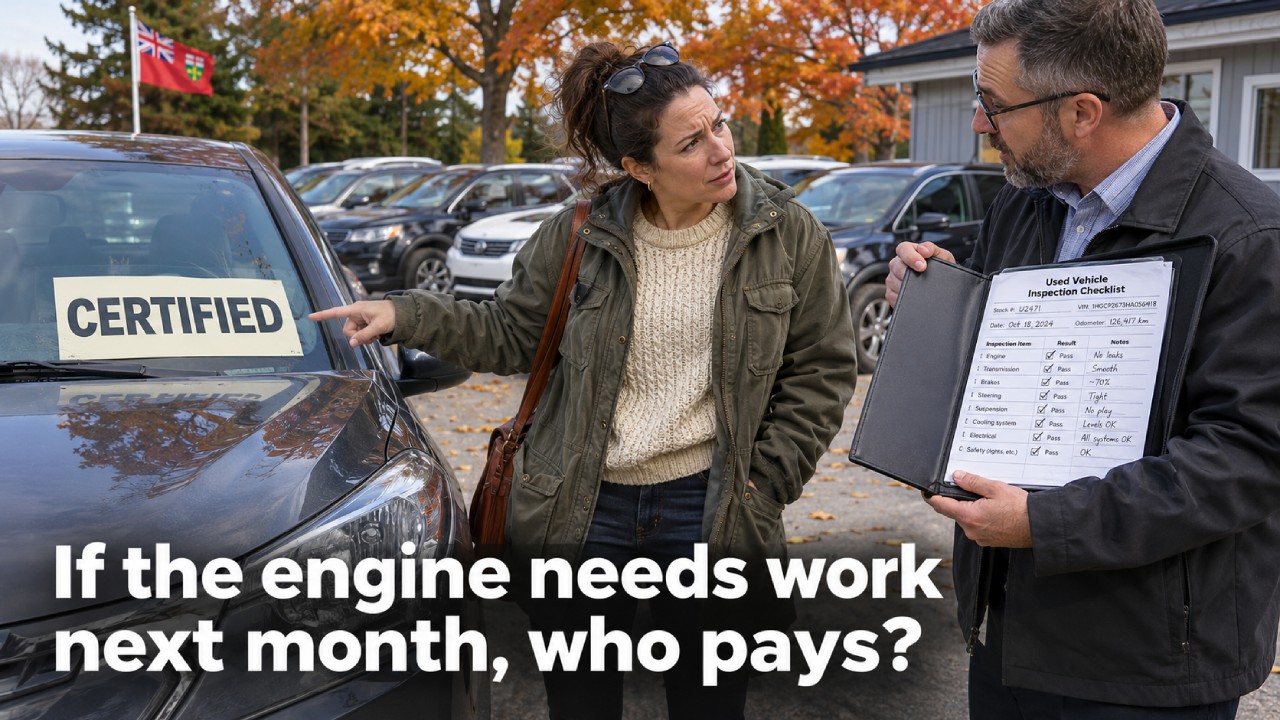
“It says certified. If the engine needs work next month, are you paying?”
Consider a fictional sale at your independent Ontario used-car dealership. A buyer shows your salesperson the listing.
Your salesperson needs to explain what the dealership is selling without turning an inspection into a promise to pay. “Let me check what that word means for this car before I answer.”
The distinction is worth making explicit. In its 2026 U.S. study, Cox Automotive found that only 27% of used-vehicle shoppers who were open to certified pre-owned (CPO) vehicles said they understood precisely how CPO differed from ordinary used vehicles. That is evidence about U.S. shoppers, not a Canadian finding.
Find out whose certification the listing claims
You pull the vehicle file before defending the advertisement. The manufacturer’s VIN-specific record shows no CPO enrolment and confirms that the original powertrain warranty has expired. Your store has not enrolled the car in a separate dealer certification program either.
The salesperson finds an Ontario safety standards certificate and identifies the issuing DriveON inspection centre to the buyer. That is what the listing writer meant by “certified.” The advertisement never explained the distinction.
According to OMVIC, manufacturer CPO programs have their own eligibility standards and benefits, while dealer-run programs can offer different terms. Ontario safety certification establishes minimum safety compliance when inspected; it does not warrant the vehicle’s overall condition.
A manufacturer badge would need evidence of actual program enrolment, not merely a car that appears eligible. A dealer program would need its own name and written commitments. Neither describes this car, so borrowing either explanation would make the original ambiguity worse.
The checklist shows what happened, not who pays later
The salesperson brings out the dated inspection checklist, matches its VIN to the car and identifies the technician who completed it. They show the recorded brake measurements and tire condition, then the repair order documenting replacement brake pads. The completed work supports a specific statement about preparation.
The buyer points to the road-test entry. “So the engine was checked and passed?” The salesperson could agree broadly and move the conversation along, but that would leave the buyer hearing more than the record says.
Instead, they explain the actual work: the technician recorded observations during the road test, but the file contains no internal engine measurements or dismantling. “This shows what the technician observed during those checks. It doesn’t establish the condition of every internal engine part.”
You keep the conversation on those findings rather than the checklist’s point count. A longer list would still leave the buyer’s payment question unanswered. The inspection evidence has become clearer, but the buyer still wants someone to accept the financial risk.
An engine on the coverage list is not an unconditional promise
The salesperson now separates the vehicle price from the optional protection proposal. No additional engine-repair warranty is included. They show the buyer the separate contract and point to the legal name of the third-party warrantor, rather than referring vaguely to “our warranty.”
Together they locate the coverage start date and duration, then the kilometre ceiling. The salesperson explains how the deductible applies and shows the maximum claim payment. Those details determine when the protection ends and how much an accepted claim could leave the buyer paying.
The contract lists specified internally lubricated engine parts, but excludes pre-existing faults. Its procedure requires the repairer to obtain authorization before dismantling. The salesperson identifies the claims administrator and explains who must contact it, rather than promising that any repair invoice can simply be submitted afterwards.
This scrutiny follows the distinctions in OMVIC’s extended-warranty guidance, which directs buyers to examine deductibles and claim limits, along with exclusions and repair-facility restrictions. OMVIC also cautions that mechanical-breakdown protection does not necessarily cover ordinary wear.
The buyer returns to the inspection: “If you checked it before selling it, how could they call a problem pre-existing?” That question cannot be settled by pointing to the engine heading in the contract. The checklist does not establish when every possible internal fault began.
“I can show you the covered parts and the exclusion,” the salesperson replies. “I can’t promise how an unidentified failure would be assessed.” You stop them from replacing that uncertainty with “They usually cover it.” Nothing in the file supports that assurance.
Nor can the dealership treat an exclusion as the end of its own responsibilities. OMVIC’s Consumer Protection Act guidance explains that consumers cannot lose the Act’s protections through a contract. A decision under an optional warranty does not, by itself, decide whether the dealer has separate legal obligations.
Give the answer, then correct the promise everywhere
The salesperson can now answer the original question in two sentences:
“This car passed Ontario’s safety inspection at the DriveON centre named here, rather than entering a manufacturer or dealer certification program. No additional engine-repair warranty is included in the price, and the safety certificate itself provides no engine-repair coverage.”
The salesperson offers copies of the inspection records and the optional contract. The buyer understands the distinction but is not satisfied: “Then you’re asking me to buy protection I thought was already included.” Producing the paperwork has resolved the meaning of the documents, not the disagreement created by the advertisement.
You acknowledge that the listing should have been clearer. You do not present the optional contract as though it repairs the wording, and you do not add an unwritten promise to keep the deal moving. The buyer takes the documents away without signing.
Before another inquiry arrives, you have the listing writer replace the standalone certification claim on the vehicle page and marketplace advertisement. The window material and proposed agreement carry the same explanation: Ontario safety certification is included; an additional engine-repair warranty is not. The optional contract remains separately identified, and the salesperson uses the corrected explanation.
This change does not persuade the first buyer to return. It means the next buyer will not have to uncover the same distinction by asking who pays for an engine failure.
U.S. only: the Buyers Guide must match the final arrangement
Under the Federal Trade Commission’s guidance, U.S. dealers covered by the Used Car Rule must update the Buyers Guide when negotiated warranty terms change and give the buyer the final copy at sale. Provide any required separate written warranty and make its terms available before purchase; the Buyers Guide cannot substitute for that document. State law can restrict warranty disclaimers, and the FTC guidance explains exemptions and vehicle-size limits. These are U.S. requirements, not Ontario paperwork instructions.
What your store takes from the unresolved sale
The difficult moment was not finding the safety certificate. It was admitting that the store’s wording had encouraged an expectation the documents did not support. A salesperson needs authority to bring that mismatch to you, rather than being left to defend the advertisement.
For your listing writer, “certified” needs an identifiable provider and a claim the inspection record supports. Repair protection needs a separate explanation tied to the coverage actually included. When those answers differ from what the buyer expected, the job is to explain the difference accurately, not talk past it.