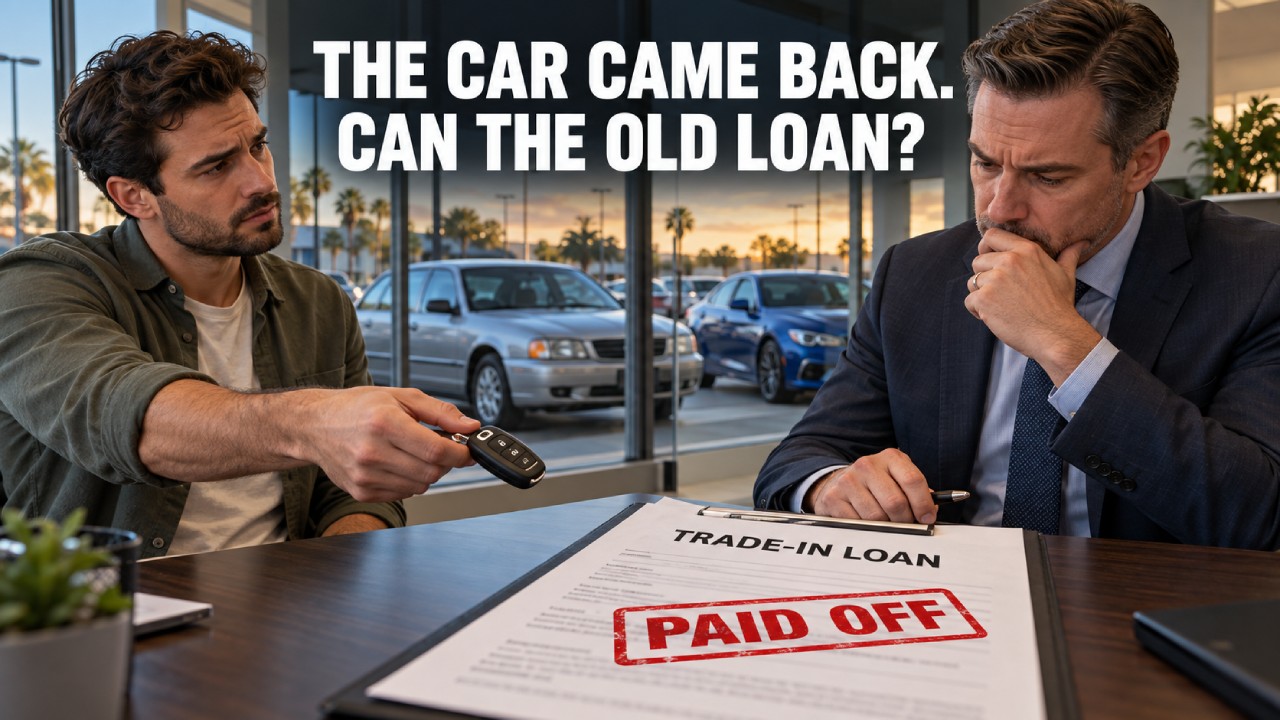
If your California store has already paid off a buyer’s trade-in loan, returning the keys does not restore the financing. The buyer wants the old payment back; your controller needs to recover the payoff. You can still have a cancellation to complete while that disagreement remains unresolved.
This walk-through concerns the new three-day cancellation right that the California DMV says begins October 1, 2026, for qualifying used vehicles costing $50,000 or less.
The California Legislature’s Civil Code section 1784.43 generally requires you to give back the trade and its keys. If you have sold it or started transferring its title, money replaces the vehicle. Whether its loan remains outstanding creates a separate question.
A Thursday delivery becomes a Monday cancellation
Consider one invented transaction with three possible outcomes. All transaction figures, including the valuation, are illustrative. On Thursday, October 1, 2026, your dealership sells and delivers a $30,000 used passenger car to a personal-use buyer. Assume another $3,000 in taxes and fees, without optional products.
The trade allowance is $18,000 against a $12,000 loan balance. That leaves $6,000 in equity. Together with the buyer’s verified $3,000 cash down payment, it reduces the $33,000 transaction total to $24,000 financed. Your assignee funds the contract.
Under the California Legislature’s enacted SB 766, counting starts the day after contract execution. The third day falls on Sunday, when your store is closed, so the buyer has until your Monday, October 5, closing time.
The buyer personally returns Monday at 3 p.m., having driven 180 miles. That is within section 1784.43’s 400-mile limit. The car has no damage or unrelated liens, and the buyer returns everything received with the deal. Your store charges $450 for restocking under SB 766’s 1.5% formula; the mileage does not trigger an additional charge.
1. Trade retained, payoff unsent
The trade remains on your lot, nobody has started its title transfer, and accounting has not released the payoff. You return the vehicle with every key the buyer supplied. The original loan continues, so the buyer needs confirmation that your store will not subsequently pay it off.
You do not also refund the $6,000 equity in cash. The buyer receives the vehicle that supplied that equity, still carrying its loan. Accounting returns the cash down payment after deducting restocking and records the cancellation separately from the continuing trade loan.
2. Trade retained, payoff completed
Change the payment status: the old lender received and applied $12,000 on Friday, discharging the loan. The trade remains available, with no title transfer underway. Section 1784.43 still calls for the vehicle’s return, but the buyer’s former financing no longer supplies a ready answer.
“Can I take my car back and keep making the same payment?” the buyer asks. The controller asks how the dealership gets its $12,000 back. The buyer cannot reimburse that amount in cash.
Your controller requests a payoff reversal and reinstatement on the original terms. The lender cannot immediately confirm either. The buyer rejects replacement financing because a different rate or term would change the obligation they expected to recover.
Section 1784.43 supplies no lender-reinstatement procedure. Its permitted debt deduction concerns an outstanding loan secured by the trade, not an express right to recover a debt already discharged. Your store cannot treat those situations as interchangeable.
The California Legislature’s Civil Code section 1692 permits courts to address restitution after rescission and adjust the parties’ interests. It does not itself authorize an automatic dealership deduction. Counsel must assess any reimbursement claim against the contracts and applicable law.
Your store completes the cancellation without demanding that the buyer first secure another loan. Accounting keeps the unresolved $12,000 recovery separate. Returning the trade settles possession, but it does not settle that claim.
3. Trade sold, payoff pending
Now follow the alternative where your manager resells the trade for $20,000 before Monday. The California Legislature’s Vehicle Code section 11709.4 bars sale, consignment or ownership transfer until the required payoff has been tendered to the lienholder.
Your dealership delivered $12,000 to the lender before the resale. That satisfies this section’s payoff-before-disposal requirement. At cancellation, the lender confirms that payment is awaiting application and the secured debt remains outstanding. Merely having a payment scheduled would not establish the same facts.
Section 1784.43 sets the trade refund at the highest amount among the agreed allowance, actual resale proceeds and fair market value. Your original $18,000 allowance therefore cannot end the calculation.
The store’s valuation worksheet records a $19,500 trade-in value dated October 5, 2026, using the vehicle’s documented October 1 condition. Its selected guide is Kelley Blue Book, which the California Legislature names in Vehicle Code section 11950(c)(2) among recognized pricing guides.
Under section 1784.43(a)(3)(C), that method creates a rebuttable presumption: use the guide’s trade-in valuation at cancellation, accounting for condition when traded. The alternative method uses a written purchase offer that the buyer received and the dealer honored, lasting seven days or longer. Neither method makes the value immune from challenge.
The $20,000 resale exceeds both other values. Deducting the still-outstanding $12,000 secured debt leaves $8,000 attributable to the trade. Accounting must follow the tendered payoff through completion, rather than deducting it and then stopping payment.
Section 1784.43 also requires proof of the resale with purchaser information redacted. The cancellation receipt must explain deductions and record the cancellation’s date and time.
The refund comparison excludes the completed-payoff dispute
The $10,550 refund below depends on scenario 3’s $12,000 remaining outstanding despite payment having been tendered. Section 1784.43(a)(3)(B) addresses outstanding secured debt. You cannot automatically apply this deduction after discharge. Scenario 2 is omitted because its reimbursement question remains with counsel.
| Cancellation item | 1. Trade retained, payoff unsent | 3. Trade sold, payoff pending |
|---|---|---|
| Cash refund to buyer | $2,550: $3,000 down payment less $450 restocking | $10,550: $8,000 trade refund plus $3,000 down payment, less $450 restocking |
| Trade-in vehicle | Returned with keys | Replaced by the trade refund |
| Original loan | Buyer continues owing $12,000 | Tendered $12,000 payoff must complete |
The funded $24,000 purchase contract requires its own reconciliation, outside the buyer’s cash refund. F&I sends the cancellation to the assignee and obtains settlement instructions. Accounting obtains confirmation that the buyer’s purchase obligation has ended; reversing an internal entry is not that confirmation.
For this transaction with verified payment, section 1784.43 requires cancellation and the refund within 48 hours. It allows for financial-institution delays beyond your control. An unresolved internal calculation is not the same thing.
Coordinate the trade hold with the payoff deadline
For your store, retaining the trade and postponing title transfer until the cancellation period expires keeps the vehicle available to return. A payoff hold needs separate approval against the written agreement and lender’s quote. The return window does not erase your payoff obligations.
Vehicle Code section 11709.4 generally requires tender within 21 calendar days, subject to a shorter written agreement and the earlier requirement before disposal. If the buyer keeps the purchase, accounting can tender before releasing the trade. If the buyer cancels, document rescission and have counsel confirm that the section’s rescission exception applies.
The answer depends on more than whether the trade is parked outside. Its transfer status determines whether the buyer receives the vehicle or money. Its actual loan status determines whether you are satisfying existing debt or facing an unresolved reimbursement claim.