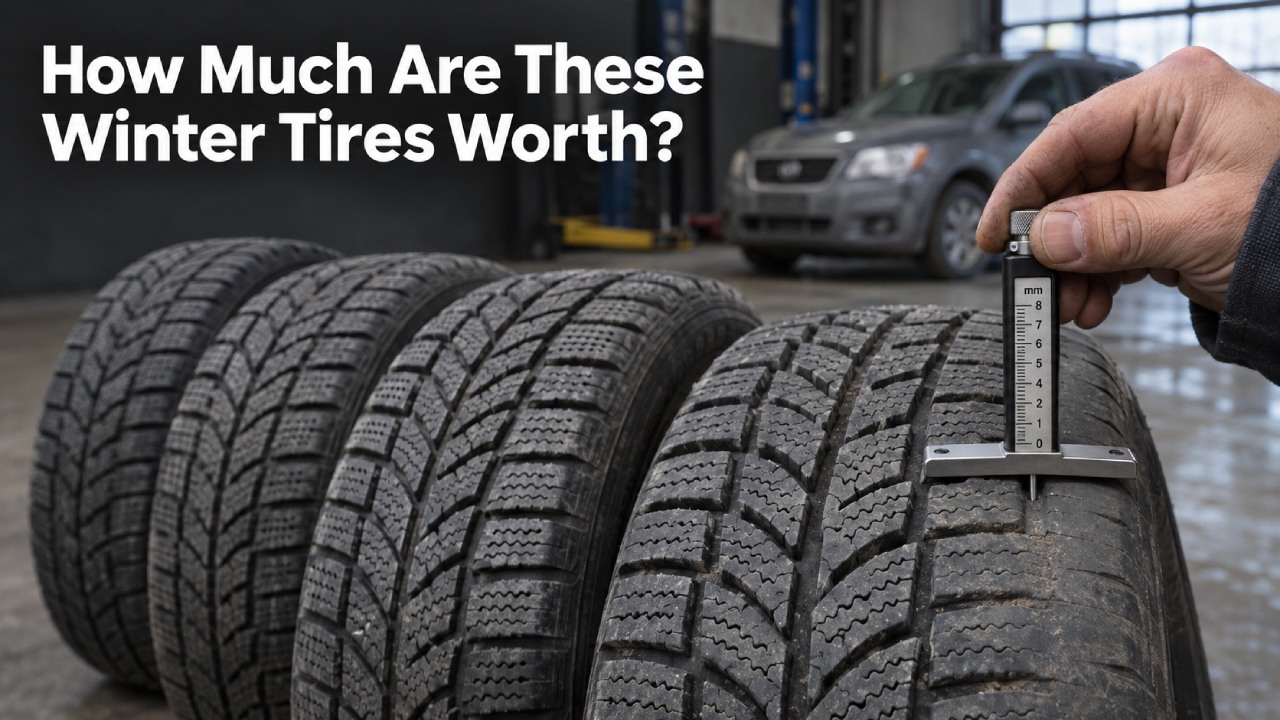
Give an extra winter set trade-in credit when its expected contribution to the next sale exceeds the work and expense you must absorb. Value the whole package when the tires and wheels qualify for reuse. If the rubber fails assessment, consider the wheels separately. Sometimes the right allowance is nothing extra.
For a Canadian used-car appraisal, the question is what you can reasonably offer the next buyer, not what the seller originally spent. This decision concerns the loose winter tires or wheel assemblies accompanying the trade, separate from the tires already mounted on the vehicle.
Identify what the seller will actually leave with you
A seller may see the winter set as money they have already invested in the car. Acknowledge that without treating their receipt as your valuation: the purchase price identifies a past expense, not the value available to your next buyer.
Count and photograph the tires or assemblies, and identify them separately on the appraisal. Record where they are stored and which vehicle used them. Confirm that the seller will deliver those particular items with the trade, including any separate wheel hardware they have offered.
Keep an unseen set out of the firm allowance. Agree with the seller that any proposed extra credit depends on receiving and assessing it, rather than trying to renegotiate an unconditional allowance later.
You can explain it plainly: “The invoice helps me identify the set. I need to establish what can be reused and what preparation will cost before I put a value on it.”
Confirm that the package belongs on this vehicle
Transport Canada identifies tire size, load capacity and speed rating as considerations when selecting replacements. Have a qualified tire professional verify the offered tires against the vehicle’s specifications and applicable manufacturer guidance. Do not substitute the seller’s recollection that they fitted another similar vehicle.
Check the winter marking too. In its winter-tire guidance, Transport Canada explains that the mountain-and-snowflake marking identifies tires meeting specified snow-traction criteria, and recommends fitting winter tires in sets of four. The marking establishes a performance category; it does not certify the present condition of used rubber.
When wheels are included, ask the professional to verify their compatibility with this exact vehicle, including clearance and the required mounting hardware. Treat an unresolved fitment question as an unresolved valuation, not as a minor detail for the buyer to sort out.
Assess winter usefulness, not just visible tread
Give each tire its own assessment record. Have tread measured across the tread and around the circumference, with shallow areas recorded rather than hidden inside an average. Record uneven wear and visible damage, and refer uncertain condition or previous repairs to the tire professional for assessment, including internal inspection where needed.
Transport Canada’s inspection guidance calls for checking damage and excessive or uneven wear. For appraisal purposes, a photograph is useful identification, but it should not replace the professional’s condition assessment.
Age belongs alongside those observations. Toyo Tires Canada explains that the four-digit date ending in the DOT identification number gives the manufacture week followed by the year. Record the code from every tire rather than assuming that the whole set was manufactured together.
Toyo also cautions that its age-based replacement recommendation does not establish a guaranteed service life. Apply the relevant tire and vehicle manufacturers’ guidance to the actual set; do not invent a universal expiry age or let substantial tread override a condition concern.
For snow-covered roads, Transport Canada advises against using tires whose tread has worn close to 4 mm. Treat that as winter-use guidance, not as a statement of your province’s legal minimum. A reading above that point does not establish how many winters remain.
That distinction matters to the allowance. Do not value a marginal set as a useful winter package simply because it has not reached a minimum wear limit.
Keep wheel value separate from failed rubber
Rejecting the tires does not automatically eliminate the wheels’ value. Assess compatible wheels as reusable items in their own right, but require a serviceability decision before assigning credit. Toyo’s guidance calls for replacing wheels that are cracked or deformed.
Then obtain the cost of stripping the rejected tires and preparing the wheels for their intended use. Include any disposal or handling expense your dealership will actually incur. Do not give wheel-only credit at the gross resale estimate while leaving the attached rubber’s costs outside the appraisal.
Set the allowance from the value left after costs
Start with the vehicle’s expected selling price without the extra set. Then estimate how much more you can reasonably realize with the assessed package included. That difference is the incremental resale value you are considering, not the retail price of an equivalent new package.
Use your own completed transactions where they reveal an actual price difference, or a credible buying offer for the specific used set. Treat classified asking prices as asking prices. A bundled vehicle sale does not establish the tires’ contribution unless you can distinguish it from the rest of the deal.
| Allowance choice | What supports it | What reduces or removes it |
|---|---|---|
| Credit the usable set | The tires and any included wheels suit the vehicle and pass assessment. | Preparation costs, incomplete contents or a weak expected resale contribution. |
| Credit reusable wheels only | The wheels qualify for reuse even though the tires do not. | Stripping, preparation and disposal expenses that consume the wheels’ value. |
| Allow nothing extra | No assessed option leaves a worthwhile contribution after costs. | Unresolved suitability also prevents a firm positive allowance. |
Build the expense estimate around what you intend to supply. Account for inspection and any collection or storage you must arrange. Include mounting and balancing when required, plus valve or tire-pressure-monitoring-system work identified by the professional. Loose tires and complete assemblies should not receive identical allowances merely because the rubber matches.
If you intend to advertise a usable winter package after replacing rejected tires, obtain the replacement quote before approving credit. Deduct that work from the expected value of the finished package. Otherwise, you are giving the seller credit for tires your dealership still has to buy.
The difference between expected extra revenue and these expenses is your ceiling before allowing for uncertainty and the contribution you want to retain. It is not an instruction to hand the entire difference to the seller. If the vehicle’s projected selling price already includes the winter package, do not add its value again.
Where the estimate leaves nothing worthwhile, allow nothing extra. If you nevertheless accept unusable items, record their handling costs against the acquisition rather than pretending that a zero allowance makes them cost-free.
Sell only the package you have valued
Carry the appraisal decision into the listing and sales agreement. Specify whether the buyer receives loose tires, complete assemblies or wheels without usable tires. Identify the items and describe their assessed condition, including any unresolved limitation, rather than relying on a vague reference to an extra set.
Retain the photographs and dated professional assessment with the stock record, and provide the relevant condition information at handover. Avoid “winter ready” or a claim of “two more seasons” when your evidence establishes only the items supplied and their condition at inspection.
Your dealership is on the credit side of the line when an assessed, deliverable set leaves a worthwhile contribution after its costs. When only the wheels meet that test, value only the wheels. The seller’s original expenditure does not move that line.