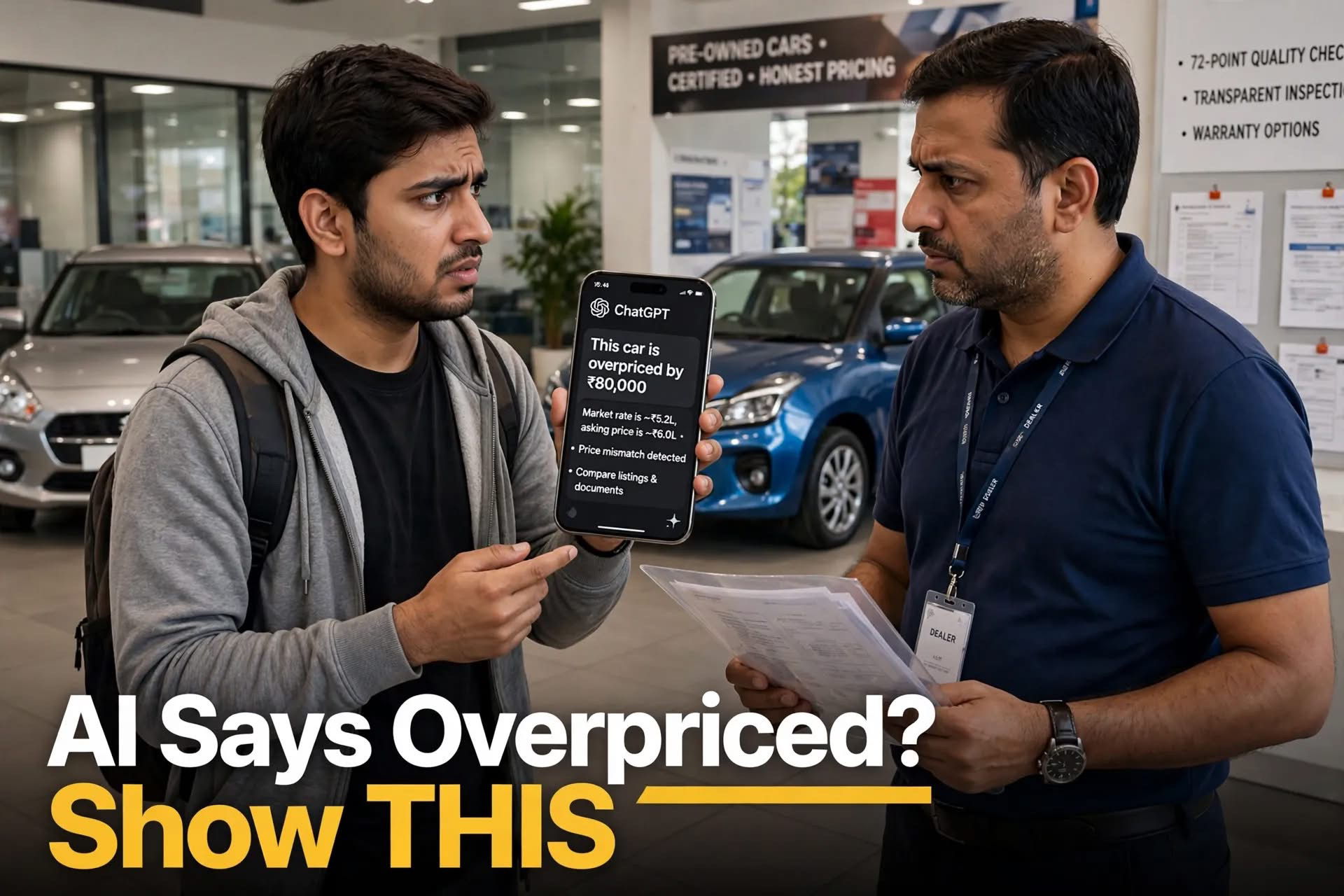
Show the buyer a short comparison backed by vehicle records and written prices. If an equivalent car is available for less and you cannot substantiate your premium, the objection deserves a price review, not another sales pitch.
For an Indian used-car showroom, that means comparing what the buyer can actually purchase, including applicable transfer expenses. Treat the objection as an attempt to avoid overpaying, rather than a challenge to your expertise. Your task is to establish whether the price difference buys anything the buyer values.
1. Open the estimate before explaining your price
Ask the buyer to show you the original question, the full answer and any listing links. Check when the answer was generated and whether it describes a retail asking price or the amount an owner might receive when selling.
Try this opening: “Can you show me the cars behind that figure? Let’s see whether they are alternatives you could buy.” That gives the buyer’s evidence a fair hearing without accepting the estimate as a verdict.
If the answer contains no supporting listings, record its assumptions and ask which advertised car the buyer would consider instead. Do not substitute another AI answer that happens to favour your price. You need something both of you can examine, not a contest between generated numbers.
2. Establish whether the alternatives really match
Spend most of your effort here. A different transmission or an unavailable car can change the comparison immediately; recording the chatbot’s name is largely a formality.
Start with the exact variant, engine and transmission. Record model year separately from first registration, then compare kilometres and the number of previous owners. Use the RC and available purchase documents to check identity, and dated service records to examine the mileage history. Mark anything you cannot verify as unknown.
Next, compare the condition evidence. Look for documented repairs, outstanding mechanical work and tyre condition rather than accepting descriptions such as “excellent”. Ask whether each car has been physically inspected and by whom. An inspection report should identify the vehicle, its date and the findings you are relying on.
Check where the alternative is registered and where the buyer intends to use it. With the buyer’s agreement, contact its seller to confirm availability and request a written purchase quote. Establish whether the advertised amount depends on finance or exchange.
Do not discard a cheaper car simply because its advertisement lacks detail. Put the missing information beside it. Apply the same standard to your own stock.
3. Put the prices beside the documents that explain them
Build a single-page comparison with a column for your car and one for each serious alternative. Keep the buyer’s strongest comparison on the page, even if it makes your asking price uncomfortable.
Include these entries for every car:
- Purchase price: the advertised amount and the seller’s confirmed quote, with mandatory charges itemised. Keep finance and exchange negotiations separate.
- Condition: inspection findings, relevant service invoices and written estimates for work still required. Distinguish completed repairs from promises to repair.
- Included cover: any warranty, its provider and its written limits. Attach the terms rather than assigning an unsupported rupee value to reassurance.
- Transfer expenses: confirmed charges payable by this buyer, showing what the selling price already includes and what remains to be checked.
The Ministry of Road Transport and Highways’ Parivahan guidance lists the RC and insurance certificate among transfer documents, with additional NOC-related documentation for vehicles registered outside the state. It also calls for applicable fees and tax. Obtain vehicle-specific figures from the relevant RTO before treating an interstate alternative as more expensive.
Show any dealership handling charge separately from government charges. Ask the insurer to confirm the buyer’s insurance expense rather than assuming the existing policy settles it.
Compare the confirmed purchase totals first. Show documented immediate repair costs separately, and mark an incomplete total as incomplete. A service invoice supports the work described on it; do not present it as proof that the vehicle has never suffered other damage.
Keep unsupported claims out of the explanation. The Department of Consumer Affairs explains that misleading advertisements include false product descriptions and deliberate concealment of important information. “Accident-free” needs more support than your confidence in whoever sold you the car.
4. Decide whether the remaining premium is defensible
Write down the rupee difference between the confirmed purchase totals. Then explain what the buyer receives for it. Keep documented expenses separate from your judgement about the value of better condition or equipment.
Keep the asking price when the evidence supports the difference
A premium needs a concrete explanation, such as documented work the alternative still requires or equipment the buyer specifically wants. Use other close, available listings to test a premium for specification or ownership history. Do not invent a standard deduction for every additional owner or kilometre.
Your reconditioning bill is supporting evidence, not an automatic addition to market value. Show what the work changed and let the buyer judge its relevance. If the buyer does not value the difference, stop treating that disagreement as a failure to understand.
Review the price when the cheaper car survives scrutiny
If the alternative matches closely, remains available and has comparable documented condition, take its written quote to the sales manager. State the price gap and the amount you propose removing. Explain which part of your premium the evidence no longer supports.
A single genuine alternative need not establish the market price for every similar car. It still matters to this buyer’s decision. Your acquisition cost and desired margin do not explain why they should pay more.
If the showroom cannot match the offer, say so plainly: “On the information we have, that car is the better-priced option. I cannot reach that figure.” Do not invent a fault in it to protect your margin.
Leave the question open when a material fact is missing
An unconfirmed listing price or missing inspection is a reason to investigate, not a reason to declare either side correct. Name the unresolved fact and who will verify it. Avoid negotiating a discount against a comparison whose purchase total is still unknown.
5. Give the buyer the comparison and the next move
Share the page with the listing links, dated quotations and relevant records. Redact previous owners’ personal details from copies. The buyer should be able to revisit your reasoning without relying on what you said across the desk.
Offer the next action that resolves the outstanding question. That may be an independent inspection of your car or confirmation of the alternative seller’s quote. If you have revised the price, put the revised total and its inclusions in writing.
Ask a specific closing question: “Would you prefer to verify that listing first, or arrange an inspection here?” Do not demand agreement with your valuation before allowing the buyer to investigate.
Avoid winning the argument and losing the comparison
Ridiculing the AI also dismisses the buyer’s effort. Cherry-picking expensive advertisements leaves their cheaper alternative unanswered. Calling every other car risky without inspecting it is speculation, even when you label it experience.
Nor should a small discount replace the investigation. If the buyer is concerned about an unexplained price gap, a concession without evidence leaves the same question hanging.
The process has worked when the buyer can identify what supports your premium, or when you have changed the offer because the alternative is genuinely stronger. An agreed verification step also counts as progress; an immediate booking is not the only useful outcome.
Start with the buyer’s actual answer and its underlying listings. That is where you find out whether to explain your asking price or reconsider it.
Frequently asked questions
Can I use the insurance IDV to prove my asking price is fair?
No. Insurance IDV is not evidence that a buyer can purchase an equivalent car at that amount. The Insurance Regulatory and Development Authority of India’s motor insurance handbook explains IDV as the basis for the vehicle’s own-damage sum insured, using manufacturer value and age-related depreciation. If an AI answer relies on IDV, bring the discussion back to available cars and their documented condition before defending or changing your retail price.