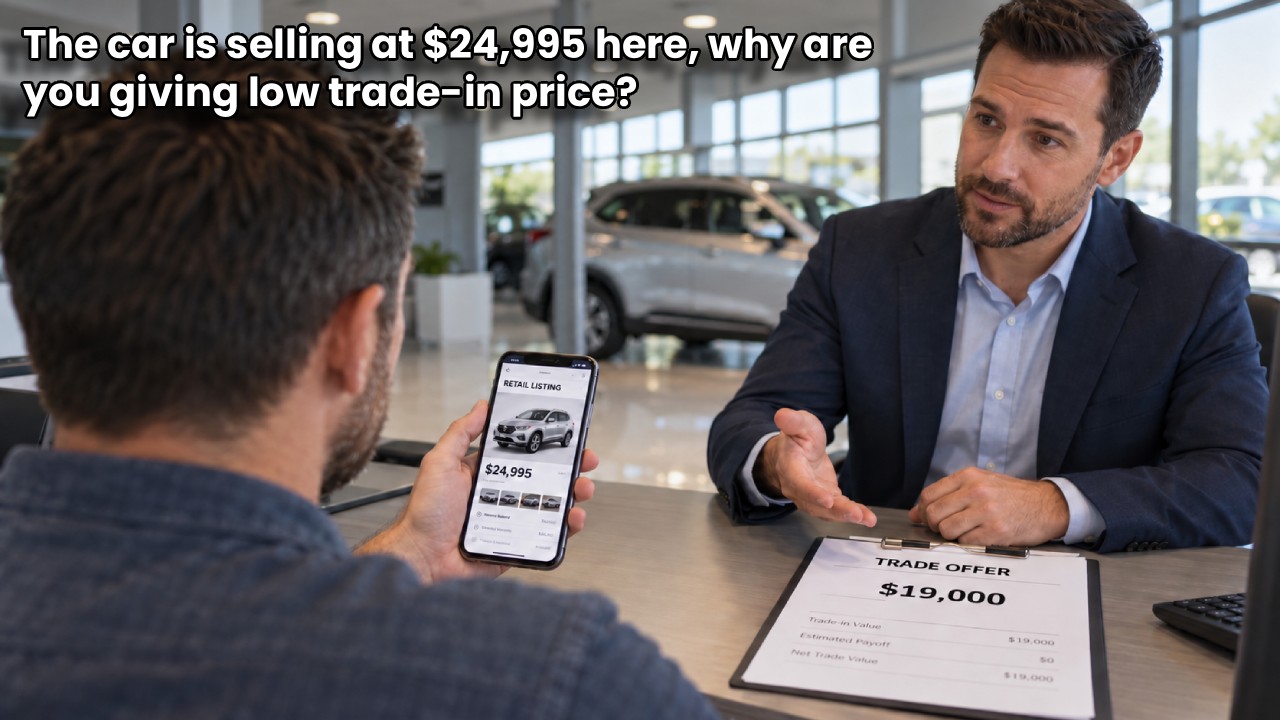
A buyer finds a car like theirs advertised for more than your trade-in offer and asks why you will not pay that much. They are comparing a seller’s retail asking price with your store’s offer to buy their car. Explain why those numbers differ, but check the comparison before assuming your appraisal is right.
They may be worried about accepting too little after researching their car. Respect that concern without treating an advertisement as a commitment to buy.
“Thanks for showing me. That’s the seller’s asking price, so it’s a different number from an offer to buy your car. Let’s compare the vehicles and check how we arrived at ours.”
1. Find out what the number represents
Ask: “Can you pull up the page? Is someone offering to buy yours, or is this a car they’re selling?” Read the label and any conditions beside the amount, rather than working from a cropped screenshot.
Separate an advertised retail price from a private-party estimate or a purchase offer. Kelley Blue Book defines private-party value around a sale between owners and explains that dealer preparation and operating costs affect trade-in value.
If the buyer already has a trade-in estimate, check its vehicle details instead of explaining retail prices. When the page clearly shows a retail listing, move straight to comparing the cars.
2. Review several comparable cars together
Give the vehicle comparison the most attention: it can expose a weak match or an error in your own appraisal. Edmunds says its valuations account for equipment, mileage and condition, along with location and recent transactions nearby.
Try: “Let’s look at a few similar cars around here, including the one you found. I want to check ours against the same market.” Put those listings alongside the appraisal record and discuss:
- Specification: Verify model year, trim, drivetrain and relevant options. Check your store’s entry as closely as the buyer’s comparison.
- Mileage: Use the actual odometer readings so both of you can see the difference.
- Condition: Compare inspection findings and documented history. Note advertised repairs or warranty coverage without assuming photographs establish mechanical condition.
- Market: Favor active listings nearby. Explain why a distant car belongs in the comparison if close matches are scarce.
Acknowledge the useful matches, including those that challenge your number. Where you have reliable transaction data, use comparable completed sales to test the appraiser’s expected selling price. Several closely matched advertisements strengthen the comparison, but they still show asking prices, not completed sales.
3. Explain how the store expects to sell it
Kelley Blue Book describes Typical Listing Price as a measure of dealer asking prices. It assumes reconditioning is complete and accounts for business expenses and profit; the eventual sale can close at a different price.
Before explaining your offer, confirm whether the appraiser expects to retail the trade or wholesale it to another dealer, directly or through auction. The National Automobile Dealers Association explains that trades intended for wholesale disposal need a wholesale-based valuation rather than a retail calculation.
For a retail vehicle, discuss the work your inspection supports and show the repair estimate. Identify any unpriced work as provisional. For a wholesale vehicle, explain the expected wholesale proceeds and supported expenses, such as applicable auction fees or transport. Do not justify that offer with retail preparation your store does not plan to perform.
Keep the business judgment separate from the repair bill. Explain the expected resale price and the risk of accepting less. The margin your dealership requires is a buying decision, not something wrong with the customer’s car.
Avoid a fixed discount from the advertisement or an invented reconditioning allowance. Check for duplicate deductions: when a condition adjustment already covers replacement tires, charging for those tires again counts the same expense twice.
4. Answer the objection, then let the buyer respond
This sample exchange assumes your store intends to retail the trade, the advertised car has lower mileage, and your inspection supports replacing the trade’s tires:
Buyer: “Mine is just as clean.”
You: “It looks good. The listed car has fewer miles, though, and our inspection calls for tires on yours. Let me show you the findings and tire estimate.”
Buyer: “But you’ll advertise mine for that much, too.”
You: “Yes, our appraiser plans to ask that price once the car is prepared. Let me show you the selling price we expect and the tire estimate behind our offer. We need to cover that preparation and make a profit from the selling price, and we take the risk that the car sells for less than we expect.”
Buyer: “So you won’t pay any more?”
You: “Let’s check the comparisons before deciding. If you’ve found a closer match, show me. A written purchase offer that’s still valid would help, too. I can take that back to the appraiser.”
Leave room for an answer after each exchange. If the buyer disputes the tires, resolve that finding before continuing with the price explanation.
If the trade is wholesale-bound, replace the retail explanation: “We’re planning to sell yours to another dealer. Let me show you what we used to estimate that sale.” Use the explanation that fits the actual plan. Another dealership that plans to retail the car may reasonably offer more, because your store’s wholesale plan does not set the car’s value for every buyer.
5. Take changed evidence back for review
Ask for a fresh look when you find an incorrect specification or a condition deduction the inspection does not support. Several stronger local comparisons, or reliable sales data that challenge the expected resale price, also justify returning to the appraiser.
Make the request specific: “These matches are closer than the cars we used. Can you review the selling price behind our offer?” Bring the listings or the disputed inspection item, rather than reporting only that the buyer wants more.
For a competing purchase offer, verify the vehicle, expiration and inspection conditions. Kelley Blue Book distinguishes its Instant Cash Offer from an estimated trade value and requires an inspection before redemption.
Use those checks to understand the offer, not dismiss it. Correct an established appraisal error without requiring the buyer to obtain another bid. Return with the revised amount and reason, or explain why your store is holding its offer. If another buyer can pay more, acknowledge that without claiming their price is unreasonable.
Keep the discussion on the trade’s value
A profit explanation cannot answer an incorrect appraisal, and criticizing pricing websites selectively is no substitute for discussing the evidence. Moving to monthly payments also leaves the valuation question unanswered.
In its consumer guidance, the U.S. Federal Trade Commission recommends negotiating the vehicle purchase price before introducing the trade, so an increased trade allowance does not mask an increased selling price. That is negotiating advice for buyers, not a legally required sequence for your conversation. Keep the purchase price and trade allowance clear rather than moving money between them to make the objection disappear.
Finish with an understood offer
Ask: “Have we cleared up the comparison, or is there something you still think we’ve missed?” The conversation has done its job when disputed evidence has been addressed and the buyer understands what your store will pay. Agreement with the amount is a separate decision.
Begin by asking the buyer to open their listing. Review the evidence together, then decide whether to confirm or revise your offer.