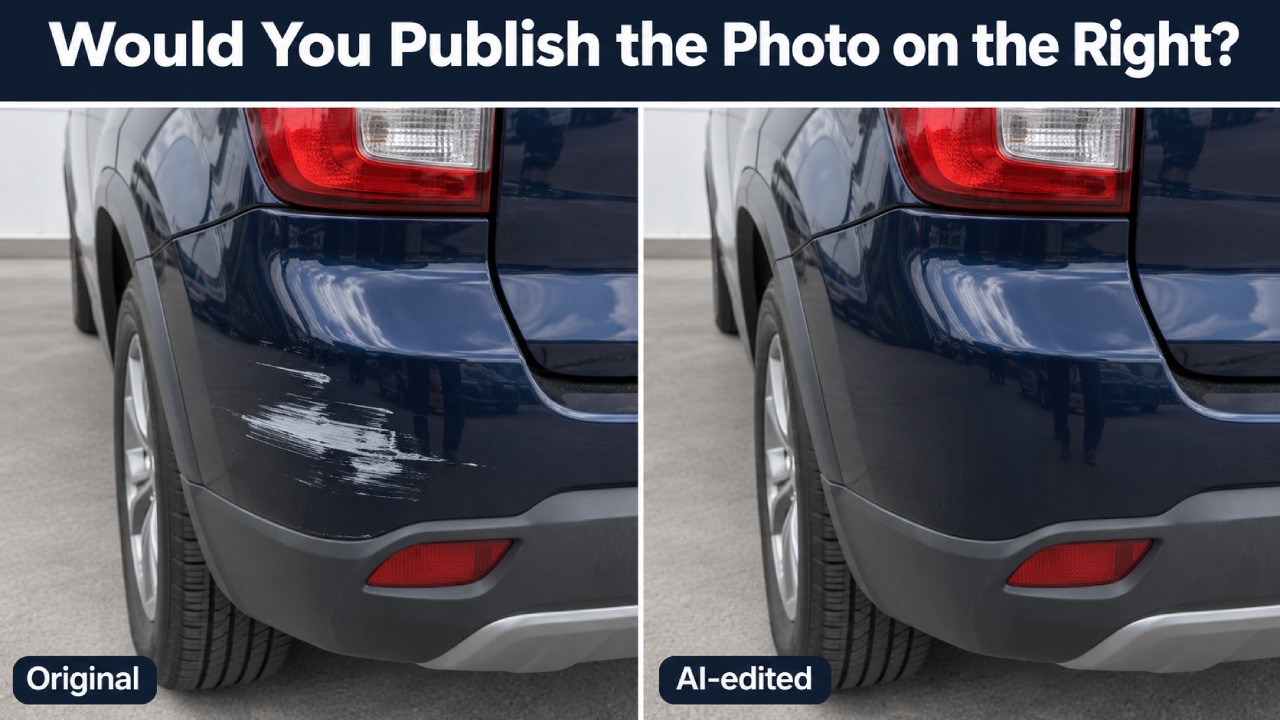
How far can you improve a vehicle photo before you misrepresent the car? If you merchandise inventory for a U.S. dealership, the practical boundary is what the finished listing leads a reasonable buyer to believe about that particular unit. An edit becomes a problem when it creates a false impression about something that matters to the buying decision.
You may want poor lighting or a crowded lot to stop making good inventory look neglected. That explains the appeal of cleanup. But improving the presentation is different from improving the vehicle on screen, and the Federal Trade Commission's advertising guidance provides a useful way to distinguish them.
A listing photo makes claims about one particular car
Once you place a photograph beside a VIN and asking price, you are presenting it as information about the vehicle for sale. The buyer has a reason to treat its visible details as evidence, rather than decoration.
In its Federal Trade Commission advertising guidance, the agency explains that it evaluates pictures alongside words and considers implied claims as well as explicit statements. Applied to your listing, a photograph showing upgraded wheels can communicate that the advertised car has those wheels, even when the description says nothing about them.
A vehicle photograph does not establish the condition of every hidden component. It does, however, represent the surfaces and equipment it shows. There is an important difference between a camera angle that cannot reveal the underside and an edit that removes visible corrosion from an area the photograph does show.
Improve visibility without changing the vehicle
A neutral replacement background can remove distractions while preserving the car's appearance. Straightening a tilted image can do the same. These changes serve the buyer when they make the actual vehicle easier to see without altering its condition or suggesting equipment that is absent.
Exposure and color adjustments need a more careful judgment. Correcting a lighting cast to restore the actual paint color is different from changing that color to something more appealing. Brightening a dark image can reveal detail; pushing brightness until scratches disappear conceals it. The name of the adjustment does not settle whether the result is faithful.
Even an operation described as background removal deserves scrutiny at the vehicle's edges. If the finished image loses part of a roof rail or redraws a hitch, the edit has changed the vehicle depiction. The instruction you gave the editor is not the picture your buyer receives.
Consider a made-up editing job: a bumper has a visible scrape, and another vehicle sits behind it. Removing the other vehicle changes the surroundings. Smoothing away the scrape changes the apparent condition of the bumper. Both versions may look more polished, but only the first preserves the relevant fact about the car.
The same distinction applies to replacing wheels or adding equipment. Those edits describe a different configuration, regardless of whether a person made them manually or an AI tool produced them automatically.
The buyer's overall impression determines what the image says
Under the FTC's deception policy, a representation or omission is deceptive when it is likely to mislead a consumer interpreting it reasonably in context and concerns material information. Information is material when it is likely to influence the consumer's decision or conduct concerning the product.
For your listing, that means the significance of an edit depends on what it changes about the buying decision. A different patch of pavement ordinarily says little about the car. Concealed body damage can change a buyer's assessment of its condition. A false paint color can matter even when it has no mechanical consequence.
The FTC considers the advertisement's overall impression, sometimes called its net impression. For a vehicle listing, that means considering the photograph together with the description and how the page presents it. Accurate specifications do not automatically neutralize a prominent image that depicts different equipment.
Nor should you rely on the salesperson to explain the discrepancy after the buyer arrives. The FTC's policy says that revealing the truth later does not necessarily undo deception at the initial contact. Applied here, the publishing decision belongs before the inquiry, not at the appointment.
An AI label does not identify what changed
A label reading “AI-edited” tells the buyer something about production. It does not explain whether you replaced the background or erased a dent. Someone could notice the label and still reasonably understand the vehicle itself to be accurately depicted.
The FTC's digital disclosure guidance distinguishes between qualifying a claim and contradicting it. A disclosure cannot rescue a false claim by supplying information that conflicts with a material representation. For an inventory photo, the practical implication is that a general AI notice cannot serve as permission to show a materially different car.
An illustration has a different purpose from a condition photograph. A separately presented visualization might show how optional accessories would look after installation. Its presentation should make that proposed configuration clear, including that the pictured accessories are not currently installed or included in the advertised offer, where applicable.
That distinction must be apparent where the buyer encounters the image. A rendering mixed into the actual-unit gallery invites a different interpretation from an explicitly identified accessory illustration. Calling it an illustration in distant fine print does not, by itself, change the job the image is doing in the listing.
Publish what you can support about the actual unit
The FTC's advertising substantiation policy requires advertisers to have a reasonable evidentiary basis for objective claims before publishing them. For visible condition and installed equipment, faithful photographs of the actual vehicle provide a starting point that a generated replacement cannot supply.
Keeping the original files alongside the published versions gives you a way to examine what changed. Associate them with the VIN and capture date so you can distinguish an editing discrepancy from a later change to the vehicle. This is a practical recordkeeping recommendation, not a claim that the FTC prescribes a particular photo-retention period.
Original files are a reference, not a substitute for checking the current unit. If the wheels have been changed since photography, even an untouched image may no longer represent what you are offering. If an important view is missing, obtain that photograph rather than generating a plausible version of an area nobody photographed.
The publishing boundary is therefore about evidence, not polish. Accept edits that preserve what the vehicle actually shows. Reject versions that invent equipment or conceal material condition details, even if they look convincing and carry an AI label. The buyer should arrive expecting the car you have, not the car the editor created.
Frequently asked questions
Can I edit out damage if the repair is already scheduled?
Do not present a digitally repaired image as proof of the vehicle's current condition just because the work is scheduled. A planned repair does not establish what the completed repair will look like. Use an accurate current photograph with a clear explanation of the planned work, then photograph the vehicle again after the repair is complete.