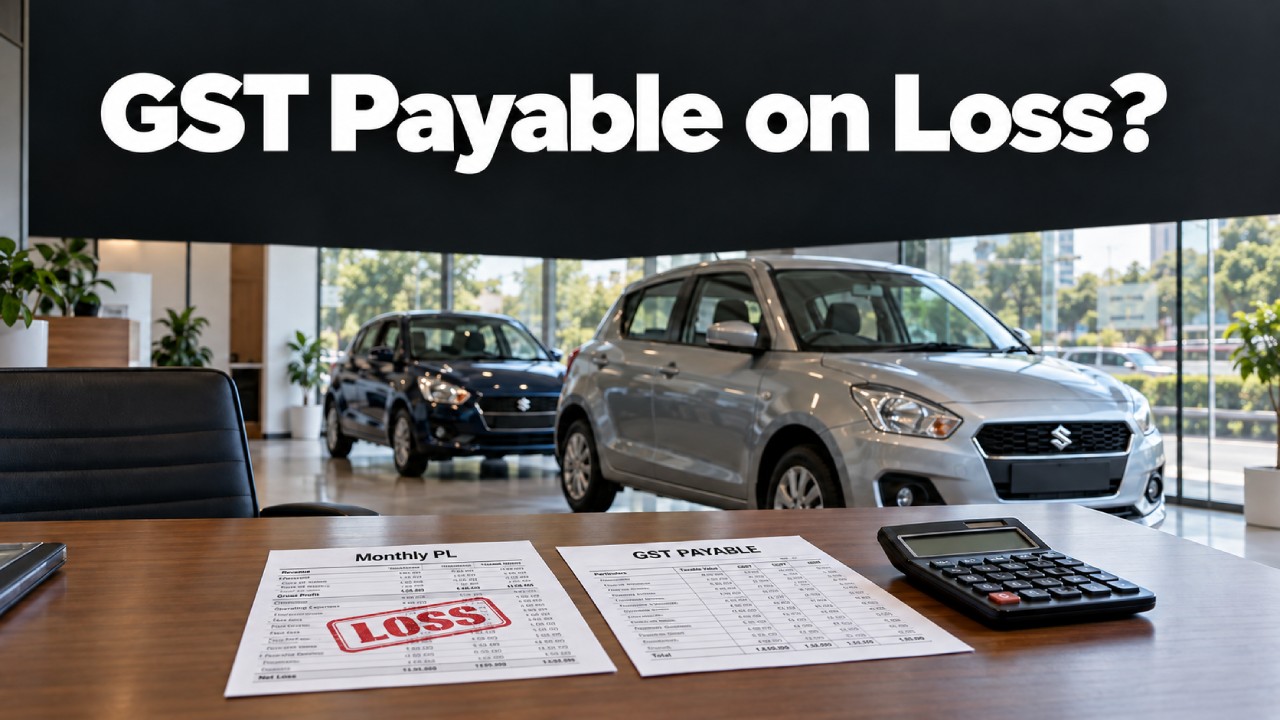
How can your used-car dealership report a monthly loss and still owe GST? In India, the answer lies in how the margin scheme treats each sale. Under CBIC’s CGST Rule 32(5), a negative margin is ignored for valuation rather than used to cancel a positive margin on another sale.
This explanation concerns GST-registered dealers selling eligible vehicles acquired as resale stock. It does not cover the disposal of cars on which the business claimed depreciation. For your monthly accounts, the important distinction is between the dealership’s actual trading result and the narrower margin that GST taxes.
GST counts each car’s margin before it totals the month
Rule 32(5) applies to dealers reselling second-hand goods without changing their nature, either directly or after minor processing. A condition is that you have not claimed input tax credit, or ITC, on those purchases. The valuation starts with each eligible sale, not with the balance at the bottom of your monthly profit and loss statement.
For a vehicle held as trading stock, subtract its purchase price from its selling price. A positive difference enters the margin-scheme tax base. If the difference is negative, that sale contributes nothing to the taxable margin total; it does not contribute a minus figure.
The Ministry of Finance’s Notification 8/2018-Central Tax (Rate) reinforces this treatment for used vehicles. Explanation (ii) uses the purchase-to-sale difference for cases outside its depreciation provision and requires negative margins to be disregarded.
The consequence is that you cannot add all vehicle gains and losses together and apply GST only if the final answer is positive. That approach lets loss-making sales reduce the taxable value of other supplies. The rule requires the negative-margin treatment before aggregation, not after it.
Your accounts retain costs that the GST margin does not deduct
Your monthly accounts answer a different question: did the dealership earn enough from its business to cover its costs? Losses on cars must remain in that calculation. Showroom rent and staff salaries also reduce the result, even though neither changes what you originally paid for a particular vehicle.
Reconditioning makes the distinction especially important. In its margin-scheme guidance, CBIC explains that value added through repairs or refurbishment remains within the margin. Spending money to prepare a car for sale does not create an additional deduction from its GST margin.
You may therefore describe a car as loss-making after workshop expenses, even though it sold above its purchase price. That description can be commercially accurate while the sale still has a positive taxable margin. The workshop bill affects whether the deal was worthwhile; the statutory purchase-to-sale calculation determines its margin for GST.
This is why a vehicle profitability figure that includes preparation costs should not automatically become the taxable value. Both figures are useful, but they measure different things.
A trading loss and a positive GST base can coexist
Consider a simplified illustration with two eligible stock sales in one month and no other income. Assume that any output GST is charged separately to the buyer, so the margins below exclude GST. Also assume that no ITC is available to discharge the resulting liability.
| Sale | Sale price less purchase price | Amount entering the GST base |
|---|---|---|
| Car A | ₹40,000 | ₹40,000 |
| Car B | Loss of ₹50,000 | Nil |
| Total | Trading loss of ₹10,000 | ₹40,000 |
The cars have lost money overall before the showroom’s running expenses are considered. If operating costs for the month are ₹20,000, the monthly operating result is a loss of ₹30,000.
The GST Council records that Notification 04/2025-Central Tax (Rate) brought the remaining used-vehicle categories to the 18% GST rate from 16 January 2025. Applying that rate to the positive taxable margin produces output GST of ₹7,200: ₹40,000 multiplied by 18%.
For this limited reconciliation, the difference between the monthly operating result and the GST base consists of the operating costs and the negative vehicle margin. Both reduced the accounting result. Neither reduced the positive margin on Car A.
Nothing needs to be removed from the accounts to make the tax calculation work. Car B’s loss stays in the books. The GST working simply excludes that negative amount when calculating taxable margins. Trying to make the two totals agree would destroy the distinction the law requires.
Output GST and the cash payment are separate figures
The illustration assumes no available ITC, which is why its output GST also needs to be funded in cash. In an actual return, the output liability and the amount requiring cash payment can differ.
Under section 49(4) of the CGST Act published by CBIC, available credit may be used towards output tax, subject to the applicable conditions. That is a separate calculation from determining the taxable margin. Any credit must qualify under the GST rules; it does not arise because your accounts show a loss.
This distinction also prevents confusion over expenses. Whether GST on a particular business expense qualifies for credit is a credit question. Whether the expense itself can be subtracted from the vehicle’s taxable margin is a valuation question. Treating an expense as a margin deduction is not a substitute for establishing ITC eligibility.
An ignored margin does not become next month’s deduction
Rule 32(5) does not park a negative margin for later use. Its instruction to ignore that value means there is no unused margin deduction waiting for a profitable month. Notification 8/2018 likewise provides no mechanism for carrying such a negative amount into a later sale’s valuation.
The practical consequence is that a running total of vehicle losses cannot become an opening GST deduction next month. Keeping that information may help you understand buying mistakes or clearance losses, but it does not give those losses a new tax status.
Income tax works differently. The Income Tax Department’s guidance on losses recognises that eligible business losses can be carried forward and adjusted against later business income, subject to the relevant conditions. That relief concerns a loss determined under income-tax law.
A monthly management loss is not automatically the amount available for income-tax carry-forward, and an individual car’s negative GST margin is not an income-tax loss computation. Your accountant must determine the business’s tax result separately. Any resulting income-tax relief does not alter the GST valuation of another vehicle.
Judge a clearance sale without assuming a GST offset
This changes how you should assess a difficult stock decision. Selling an ageing car below its purchase price may still be the commercially sensible choice, but the loss cannot be counted as a GST saving on stronger sales. The decision has to stand on what you recover and what continued ownership would cost.
It also changes how you read the month-end accounts. A red bottom line is evidence about business performance, not evidence that no GST needs funding. The reconciliation should explain why the figures differ, rather than force the tax calculation to follow the dealership’s overall loss.