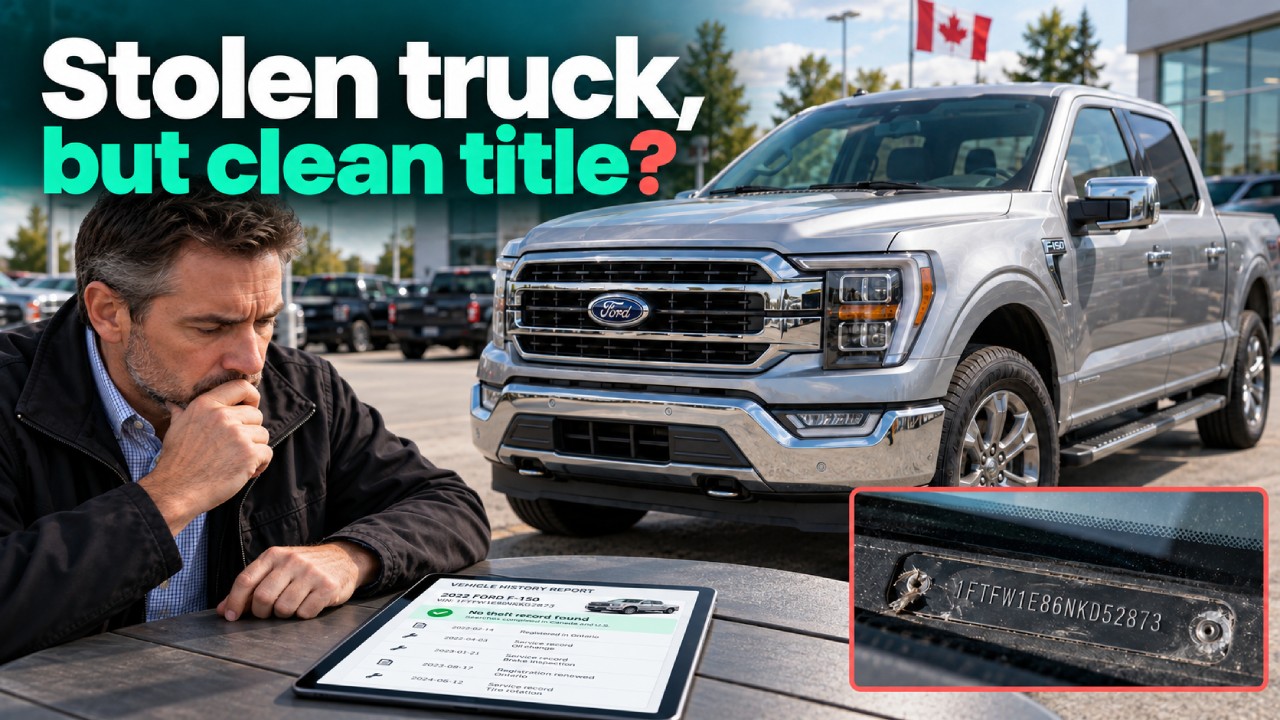
How can a stolen truck return a history report with nothing suspicious on it? The search may describe another truck. Criminal Intelligence Service Canada describes criminals putting a similar vehicle’s VIN on a stolen vehicle so they can register it under the borrowed number.
If you buy stock for an Alberta dealership, the danger is treating that clean result as proof that the seller owns the truck. You want something reliable before committing inventory money. A report gives you evidence to work with, but you still need to establish which truck it describes.
One pickup can borrow another’s history
That copying is called VIN cloning. It is a form of re-VINning, which means changing the identification number a vehicle displays to conceal its real identity.
Consider a made-up illustration: a stolen pickup carries the copied VIN of a similar pickup whose owner still has it. You search the displayed number and receive a clean history associated with the legitimate pickup. The stolen truck’s original VIN never enters the search.
The report may be genuine. The problem is that it belongs to the other pickup. Someone copied that pickup’s VIN onto the stolen one you are considering buying, so even complete records for the number you searched would not resolve the fraud.
What the different checks actually tell you
A history report helps you assess a truck’s past, including reported damage and registration history. CARFAX Canada explains that its reports contain information received from participating sources. Events that those sources have not supplied may be missing, and the report reflects what was available when it was produced.
That is a different problem from cloning. An unreported collision leaves a gap in the right vehicle’s history. A copied VIN can send you to the wrong vehicle’s history altogether. Neither problem makes reports useless, but they call for different questions.
A lien search concerns registered interests, not theft or ownership. The Government of Alberta allows personal property searches by vehicle serial number or debtor name. When a VIN search returns no match, it means no matching registration was found for that search in that registry. It does not establish that the seller owns the truck or that the VIN belongs on it.
Decoding serves another purpose: it translates the VIN into vehicle details. The Government of Canada’s Motor Vehicle Safety Regulations require truck VINs to encode characteristics including cab and engine type. A cab that conflicts with the decoded description needs explaining. A match is less conclusive, because a number copied from a similar pickup can produce exactly the description you expect.
The Canadian Police Information Centre also offers a public stolen-vehicle search by VIN and directs anyone receiving a positive result to police for confirmation. In a cloning case, the limitation follows from the number entered: a search of the borrowed VIN does not check the stolen truck’s concealed original number.
Matching VINs can repeat the same false information
The dash VIN, door-area certification label and registration should agree. But matching numbers are not necessarily separate confirmations. They can all repeat the same copied VIN.
The Calgary Police Service has described cloning schemes involving replacement VIN plates and certification decals, with fraudulent documents then used to obtain registration. That explains how a truck can arrive with matching labels and paperwork.
It also means the registration itself need not be counterfeit. A registry can issue a genuine document after receiving false supporting documents. Looking closely at the registration would not, by itself, uncover what happened before it was issued.
Ordering reports from different providers does not necessarily settle this either. Separate organizations can return consistent results because they all started with the same copied number.
A suspicious label still needs an explanation
A clean report should not talk you out of questioning something you can see on the truck. Calgary police advise comparing the public VIN’s appearance with a similar vehicle and looking for peeling around the certification label.
A disturbed label or a cab that contradicts the decoded details does not prove theft. It gives you a specific discrepancy to investigate before buying. The seller needs to explain it with evidence; another reassuring database result does not explain why the truck looks wrong.
Equally, finding nothing suspicious during an appraisal is not an ownership guarantee. The RCMP describes Alberta auto-theft investigators using specialist training and secondary identifiers to identify vehicles with altered VINs. If you suspect tampering, seek police assistance rather than trying to settle the matter with an ordinary walk-around.
The seller still has to account for the truck
Even after resolving questions about the VIN, you need to know whether the seller is entitled to sell the vehicle. The Government of Alberta’s private-purchase guidance calls for seller identification and ownership evidence separately from history and lien searches.
If the seller’s ID does not match the ownership paperwork, or the seller cannot substantiate how they acquired the truck, the purchase needs more investigation. Those gaps do not establish theft. They leave you without an answer to a question the vehicle report was never meant to settle.
A seller’s account gives you something to check. Documents from their purchase, verified with the relevant parties, can support that account. Simply accepting the story because the VIN search looks clean leaves the ownership question unanswered.
Keep using history reports and lien searches, but do not let them overrule an unexplained discrepancy. Before paying for stock, you need grounds to believe the VIN belongs on that truck and the seller has the right to sell it.