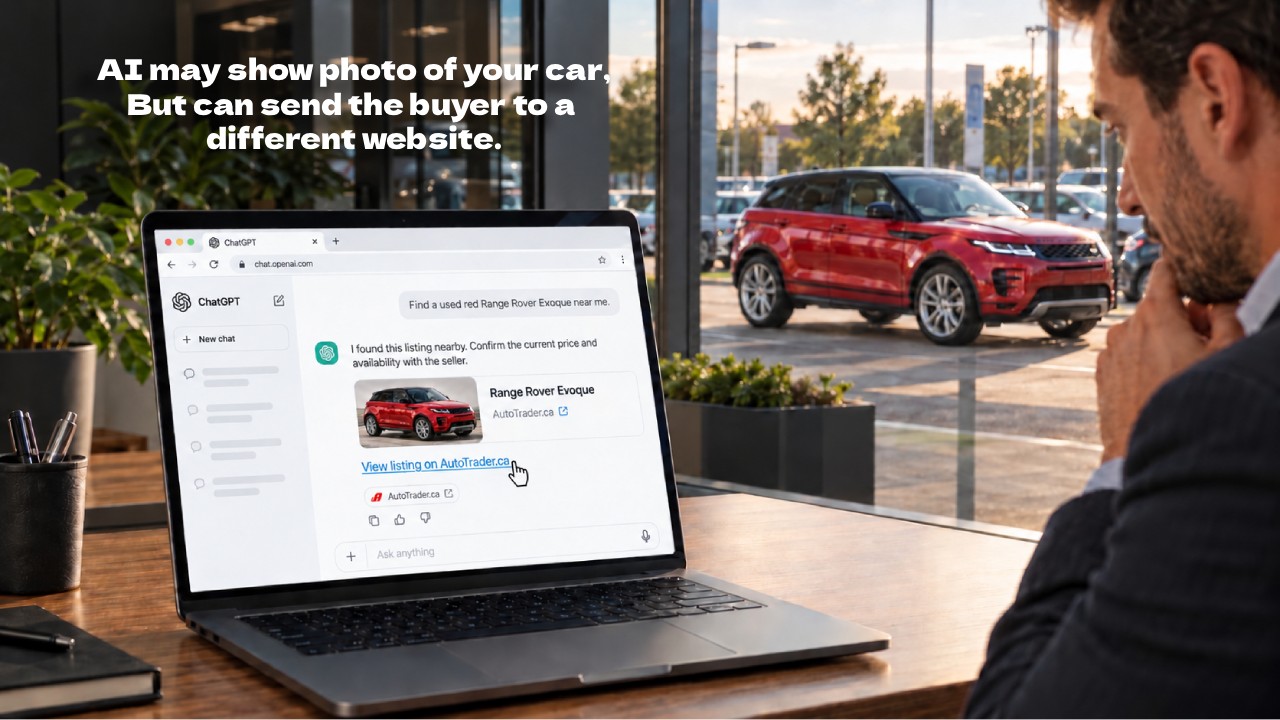
How can an AI assistant recommend a car on your lot yet send the shopper to somebody else's website? A syndicated listing can supply the vehicle information it needs without requiring it to retrieve your own vehicle detail page.
If you manage dealership marketing, the concern is who gets the shopper's next click. Seeing your inventory in an answer can look like a website success even when another publisher supplied the information. That distinction matters before you change either your website budget or your listing contracts.
A vehicle mention is not a website referral
Finding a vehicle means the assistant has identified a unit that appears to match the request. Naming your dealership connects that unit to your store, but the seller's name could have come from a third-party listing. Linking to your vehicle detail page, or VDP, gives the shopper a route onto your website.
Even that link is not a visit until somebody follows it. Inventory exposure and website traffic are different outcomes.
Search can reach the copy without visiting the original
A web-grounded answer uses information retrieved from the web. That does not necessarily involve browsing dealership websites one by one. OpenAI explains that ChatGPT sometimes works with outside search providers, reformulating a user's request into searches for those providers. It may then refine its searches after reviewing the results.
OpenAI's developer documentation distinguishes a search action from opening a page. Its API also supports searches using cached or indexed results without retrieving live content. These are documented API capabilities, not a description of the exact route taken in every ChatGPT conversation.
Consider a made-up inventory example: you distribute a used pickup listing to a marketplace, which publishes the truck's details and your dealership's name. A search service returns that listing, and the assistant uses the result or reads the marketplace page. It can identify your pickup and its seller without opening your VDP.
The marketplace supplies the retrieved information even though you supplied the listing. OpenAI's API guide distinguishes cited references from the fuller record of consulted URLs, so a marketplace citation alone does not establish that your website was never accessed.
Crawl access and index coverage are different conditions
Before your VDP can compete as a source, the relevant search system needs access to its content. OpenAI's crawler documentation identifies OAI-SearchBot as its search crawler and GPTBot as a crawler associated with model training. Their permissions are independent, so allowing search access does not require allowing training access.
Permission to crawl is still different from inclusion in an index, the search service's searchable record of pages. Google Search Central lists indexing and eligibility for a search snippet among the requirements for appearing in Google's generative search features. Google also says that meeting its requirements does not guarantee that it will crawl, index or display a page.
Finding your homepage does not establish that a search service has indexed every VDP. If the relevant index lacks your page but contains a marketplace's copy, your missing VDP cannot compete with that available listing.
A cross-dealer request may fit a cross-dealer page
Access does not explain every marketplace citation. The shopper's question also determines what information would answer it. A request for locally available SUVs from several sellers calls for different evidence than a question about the reconditioning completed on a particular unit.
Google explains that AI Mode and AI Overviews may expand a request into related searches across subjects and sources. It also notes that different models and techniques can produce different answers and supporting links.
A reasonable inference is that a searchable page collecting vehicles from several dealerships could help answer a broad shopping request. Your individual VDP documents one vehicle; it does not establish what competing sellers have available.
This explains how a marketplace page could fit a request. It does not establish a general preference for marketplaces.
Structured data describes the car, not who gets the citation
Structured data attaches machine-readable labels to information on a page. For example, Schema.org's Car vocabulary defines fields for a vehicle's VIN and odometer mileage. Those labels identify what the values mean rather than leaving software to infer everything from the page's layout.
Adding vehicle fields does not guarantee a link to your VDP. Google's generative search guidance says no special Schema.org markup is required, and OpenAI's search guidance says placement is not guaranteed.
Give shoppers evidence about the actual vehicle
Give shoppers a reason to open your VDP beyond the specification sheet you distribute. Publish completed repairs and inspection findings for that unit, with photographs that show imperfections rather than hiding them.
Identify equipment included with the sale and explain the terms of any warranty offered. A trim description cannot tell a buyer what your shop found or whether an accessory pictured comes with the vehicle. Put that evidence on the page to help shoppers judge the actual car, rather than simply recognize the model.
Finding a vehicle does not confirm it is still for sale
OpenAI's search help warns that results and citations can be outdated. An assistant could therefore recommend a vehicle you have already sold, or repeat an earlier asking price. Identifying the right vehicle does not confirm its current availability or price.
Check how quickly price changes and sold status reach both your website and distribution partners. If a published listing remains wrong, address that publishing delay rather than treating the stale recommendation solely as an AI problem. An updated page and an updated search result are separate things.
What to check at your dealership
Choose five current vehicles listed on both your website and marketplaces. Treat this as a diagnostic exercise to uncover specific problems, not a reliable estimate of your total visibility in AI answers.
Ask your website provider to check crawler access and Google indexing for those exact VDP URLs. Google's URL Inspection documentation distinguishes the indexed record from a live-page test; request both. Google indexing does not establish inclusion in another provider's search system.
Compare price, mileage and availability across the published copies. Record discrepancies against your current inventory records so your provider or distribution partner knows which version needs correction.
Try broad shopping questions and questions about a specific vehicle, identifying it by VIN or by stock number and dealership name. Save the prompts and search dates alongside the cited pages. This lets you compare which sources appeared for different kinds of requests without assuming the results represent every shopper's experience.
Review identifiable referral visits and resulting inquiries separately from those search observations. Use the connections you can document between visits and inquiries; a citation in your test is neither.
Evaluate distribution separately from website visits
The channels have different jobs. Marketplace distribution makes your stock available through another publisher; visits to your website bring shoppers into the experience you control. Judge each route by its costs and the inquiries you can attribute to it.
An isolated AI search cannot establish that either channel is dispensable. AI can find your car through a distributed copy. Your budget should reflect what each channel contributes, not which URL appeared in one answer.