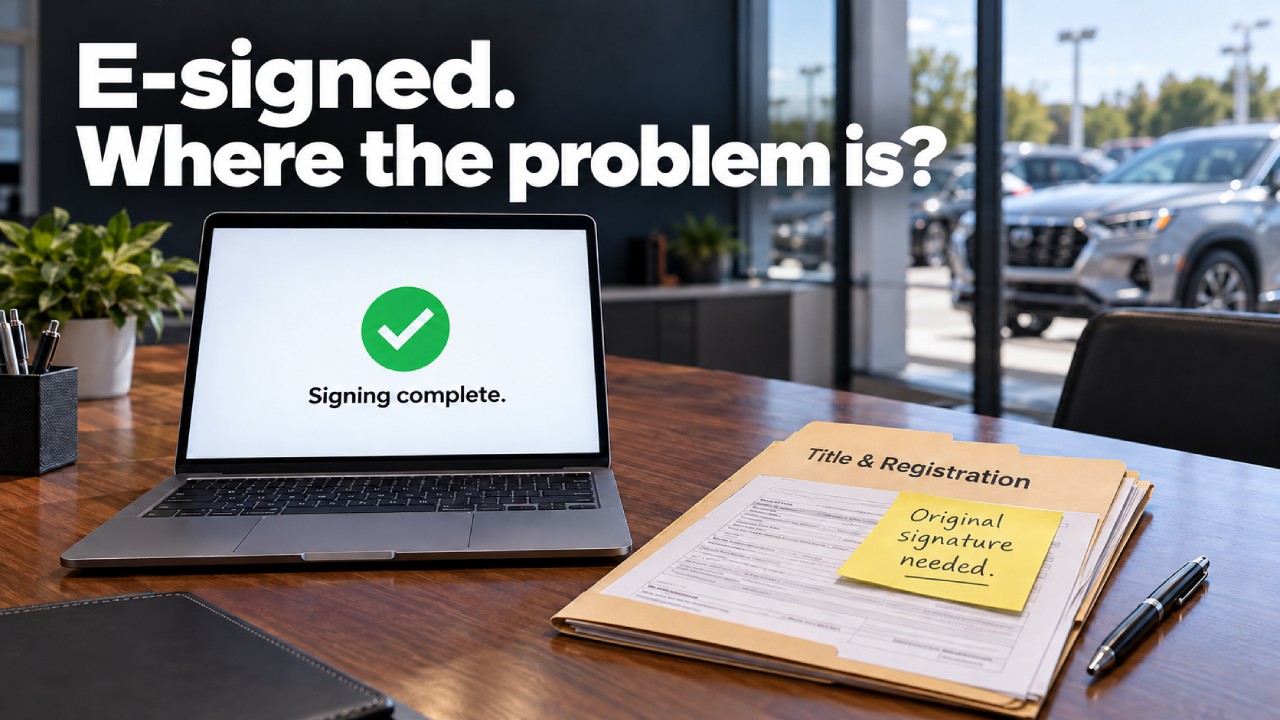
If the lender accepted your buyer’s e-signed contract, why can the registration packet still come back? The lender has accepted a financing document. It has not approved the paperwork or submission method that the destination motor vehicle agency requires. For U.S. dealerships delivering vehicles to New Jersey buyers, the state’s published instructions make that distinction concrete.
In F&I, you want to avoid calling a buyer back for signatures after telling them the paperwork is finished. Your title clerk wants documents that can actually be processed. The problem starts when both departments use “signed” to mean “ready to register.”
Contract validity is not filing approval
The federal E-SIGN Act provides an important protection. In 15 U.S.C. 7001, Congress generally prevents a covered contract or signature from losing legal effect just for being electronic. The law preserves other legal obligations and includes consent requirements for delivering certain required consumer disclosures electronically.
That protection does not give a dealership unrestricted choice over how it files government records. In 15 U.S.C. 7004(a), Congress preserves agency requirements governing filing standards and formats. A contract’s legal effectiveness and an agency’s acceptance of a submission are therefore separate questions.
The lender decides whether to accept your retail installment contract under its requirements and applicable law. For New Jersey registration, the New Jersey Motor Vehicle Commission lists separate requirements: title documentation and a registration application, plus financing information and a financing statement when applicable. It also requires a power of attorney when someone signs for the purchaser.
Those papers serve different purposes. The title application requests an ownership record. Lien documents support the lender’s interest in that record. A power of attorney establishes someone’s authority to act for another person. MVC controls acceptance of those submissions; the lender’s acceptance of the retail contract does not substitute for them.
An electronic file is not automatically an accepted filing
A scan is an electronic reproduction of a document. It can show an ink signature, but that does not establish whether the receiving agency accepts the reproduction instead of the original.
An electronic signature concerns the act of signing. Under the definition adopted by Congress in E-SIGN, the signer must intend to sign and use an electronic symbol, sound or process associated with the record. The existence of a signature does not, by itself, answer where that record can be submitted.
An approved electronic filing process answers a different question: how an authorized participant sends a qualifying transaction to the agency. The New Jersey MVC’s Dealer Online Services Program allows approved participating dealers to submit title and registration transactions electronically through approved providers. Its published eligibility requirements include a New Jersey dealer license.
The same MVC program description provides for providers to transport supporting paperwork. Electronic submission therefore does not necessarily mean that every underlying document becomes paperless. An out-of-state store cannot infer access to that program simply because its buyer lives in New Jersey.
Odometer disclosures have additional federal requirements
Odometer disclosure illustrates why a general e-signing capability is not enough. The National Highway Traffic Safety Administration established standards in its 2019 rule allowing states to support electronic disclosures. It permitted compliant electronic processes rather than requiring every state to accept an ordinary electronically signed PDF.
Under NHTSA’s current odometer regulations, electronic disclosures must meet requirements for identifying the signer and protecting the record. The rules also address document history and detection of unauthorized changes. When paper documents are scanned for these purposes, their security features must survive the conversion so alterations remain detectable.
For your deal, the question is whether the disclosure meets the applicable federal requirements and fits the state’s accepted process. A signing platform’s completion message cannot establish that on its own.
Powers of attorney deserve particular care here. NHTSA separately regulates their use for odometer disclosures, including circumstances involving unavailable titles. A general authorization to handle registration should not be treated as permission to execute every mileage disclosure.
New Jersey’s application distinguishes copies from originals
The New Jersey MVC’s Universal Title Application, form OS/SS-UTA, makes the acceptance gap visible on the page. Its instructions allow copies or scans of photo identification. They require original documents when a power of attorney is used or a lien release is requested.
The application’s signature instructions require original signatures written in blue or black ink. Its representative instructions distinguish permission to conduct a transaction from permission to sign: a representative who needs signing authority must obtain a notarized power of attorney carrying the original signature.
These are requirements for the application process described in those instructions. They are not a blanket statement that New Jersey rejects every electronic transaction. The dealer online program is a separate authorized route with its own participation requirements.
The practical distinction is document-specific. A scanned driver’s license and a scanned power of attorney may arrive in the same email, but MVC’s instructions do not give them the same status. Printing the email’s attachments does not resolve an original-document requirement.
That is why asking whether New Jersey “accepts e-signatures” is too broad. You need an answer for the particular form and submission route your title office will use.
Funding and a temporary tag leave work unfinished
A temporary registration is not evidence that the permanent title packet has passed review. The New Jersey MVC’s temporary-tag guidance provides a useful distinction: its electronic temporary-tag system does not collect lienholder information. That information belongs to the regular title and registration process.
The implication for a funded deal is straightforward. Money can reach the dealership while the paperwork needed to record the lender’s lien remains unfinished. A rejection still needs correction, even when the funding department has closed its part of the file.
The buyer faces a separate deadline. The registration requirements enacted by the New Jersey Legislature prohibit driving a vehicle that does not comply with the state’s registration and identification requirements. If corrections outlast the temporary permit and no other valid registration authority exists, the buyer cannot simply continue driving while the dealership resubmits.
Your delivery plan therefore has to account for the actual permit’s expiration, rather than assume another tag will be available. A rejected packet can become a transportation problem for the buyer, with the dealership trying to obtain replacement paperwork after delivery.
The handoff belongs before the signing invitation
A useful division of responsibility keeps lender acceptance with F&I and puts destination-state document acceptance with the title office. Before you send the signing invitation, the title clerk establishes the filing route and identifies which documents require originals. F&I then builds the signing arrangements around those requirements.
The internal question should be specific: “Which pages can this buyer sign electronically, and which originals must reach the title office?” That wording connects the buyer’s signing experience to the clerk’s actual submission, rather than to a general claim that the deal can be completed remotely.
Rejected submissions need an assigned owner as well. The title clerk should identify the defect and acceptable correction; a named employee should coordinate any buyer contact and follow the correction through resubmission. An outside processor can handle filing work, but someone at your store still needs responsibility for the unresolved deal.
This understanding changes what you can promise before delivery. Remote signing is available when the contract process supports it. A fully remote transaction requires an acceptable route for the remaining paperwork too. The decision rests on whether your dealership can complete that route, not whether its signing software can put a signature on every page.