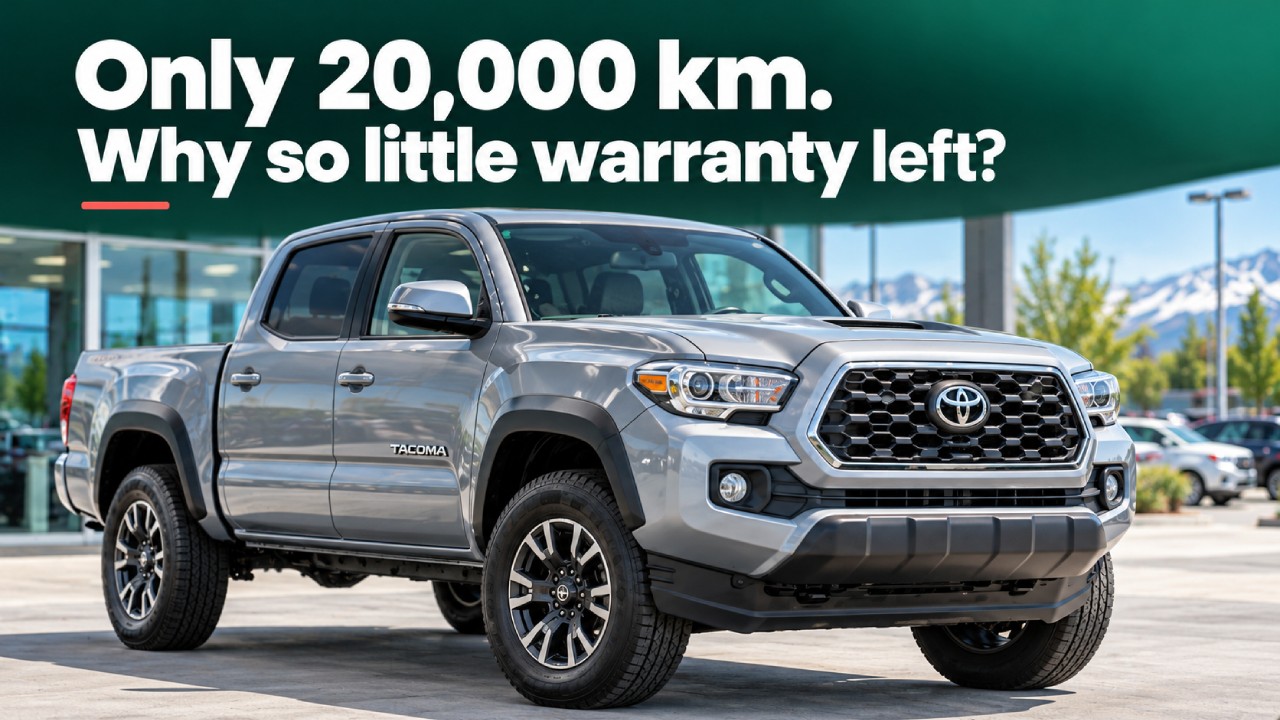
Low kilometres do not tell you how much factory warranty an ex-rental has left. Canadian manufacturer terms such as Toyota Canada's place both time and distance limits on basic and powertrain coverage. Either limit can end the protection, leaving a lightly driven vehicle close to its calendar deadline.
Your buyer may be choosing low kilometres partly to avoid repair bills and expecting years of manufacturer protection alongside them. Whether you are explaining the vehicle on the lot or discussing coverage in the finance office, that expectation needs a clear answer: how much warranty time remains, regardless of how little they plan to drive?
The original in-service date determines the start
Toyota says its warranty starts when the vehicle is registered in service, which can precede the purchase date. For an ex-rental, your customer's delivery date does not replace that earlier start. Where the manufacturer's coverage transfers, the buyer takes over the unexpired portion under its existing terms.
The model year cannot establish that date, and neither can the day your dealership bought the vehicle. Time spent parked between rentals or awaiting resale still falls within the running warranty period. A privately owned used vehicle can face exactly the same calendar deadline; the issue is how long coverage has been running, not simply who owned it.
Basic and powertrain coverage expire separately
Toyota Canada's 2024 owner's supplement specifies these limits. For each coverage, the earlier limit determines expiry.
| Coverage | Calendar limit from in-service date | Total odometer ceiling |
|---|---|---|
| Basic | 36 months | 60,000 km |
| Powertrain | 60 months | 100,000 km |
The terms run together from the original start. Powertrain protection does not wait for basic coverage to finish, and a change of owner does not create another kilometre allowance.
Toyota's powertrain warranty applies to specified engine and driveline components, including listed transmission parts. It is narrower than basic coverage. If basic protection has expired, saying only that the truck is under warranty can leave your buyer expecting coverage for components outside the remaining warranty.
Occasional use can leave the kilometre allowance largely untouched
A buyer who needs a truck for occasional farm work or towing may focus on the distance they expect to drive. Under time-or-distance terms, that forecast does not answer how long manufacturer protection will last. The calendar deadline remains relevant even if the truck spends most days parked.
To illustrate the difference, assume a former rental pickup has been in service for four years and has travelled 20,000 km. With the Toyota terms above, basic coverage has ended. Powertrain protection has at most another year, subject to its conditions, despite an 80,000 km gap between the odometer and its ceiling.
That gap is not distance the manufacturer promises to cover indefinitely. The buyer must remain within the calendar term as well. For an occasional-use truck, the expiry date can therefore matter much more than the apparent room below the kilometre limit.
A fleet history does not establish fleet warranty eligibility
A vehicle's description as commercial or fleet stock does not establish which warranty it received. Before you promise a higher kilometre ceiling, the manufacturer's records need to support both its original eligibility and its transfer to your buyer. Rental use and other commercial use are not necessarily treated alike.
Ford and GM apply different qualification terms
Ford's Canadian commercial warranty program provides eligible gasoline trucks with powertrain coverage lasting five years or 160,000 km, ending at the earlier limit. Eligibility requires a valid Fleet Identification Number and an original sale recorded as fleet. Ford says the extension remains attached to an eligible vehicle when it passes to a non-fleet owner before expiry.
GM Fleet Canada advertises transferable powertrain protection for qualified fleet customers, with limits of up to five years or 160,000 km, ending at whichever limit arrives first. Its offer excludes rental customers. That exclusion concerns the qualified-fleet benefit; it should not be read as a blanket cancellation of ordinary factory coverage on former rentals.
Remaining time does not make every repair eligible
Toyota Canada's 2026 owner's supplement excludes failures or damage caused by overloading and improper or missing maintenance. It also identifies routine maintenance and replacement items outside warranty coverage. A vehicle can be within its time and distance limits without qualifying for a particular repair.
Toyota also bases required maintenance on elapsed months as well as kilometres, and directs owners to pass service records to subsequent owners. A low odometer reading does not establish that every required service was completed. The maintenance history therefore matters even when a truck has seen little use.
The distinction is between having an unexpired warranty and having a covered failure. Review the applicable exclusions against the vehicle's history rather than treating previous commercial use as proof that everything is covered or that nothing is.
Describe the verified remainder, not a fresh warranty
A useful warranty explanation starts with information tied to the VIN. An authorized dealer for the manufacturer is the place to request confirmation of the recorded start date and the coverage still applicable. Separate calendar expiry dates and odometer ceilings make the distinction between basic and powertrain protection clear.
Any fleet entitlement or transfer condition belongs in that confirmation, because an auction label cannot establish either. Retain the information with the deal and use the correct model-year booklet to explain the covered components. A general warranty webpage describes a program; it does not confirm an individual vehicle's status.
You can put the distinction plainly: “Basic coverage has expired. The remaining powertrain warranty ends on this date, or sooner if the odometer reaches this limit.” Pair that explanation with the confirmed coverage details and relevant conditions, so the buyer knows what the statement includes.
Calling the balance “full factory warranty” hides the time that has already elapsed. Low kilometres may still make the vehicle suitable for your buyer, but they cannot establish how many protected months lie ahead. The buyer needs the verified expiry date to judge that, especially when the truck will be used only occasionally.