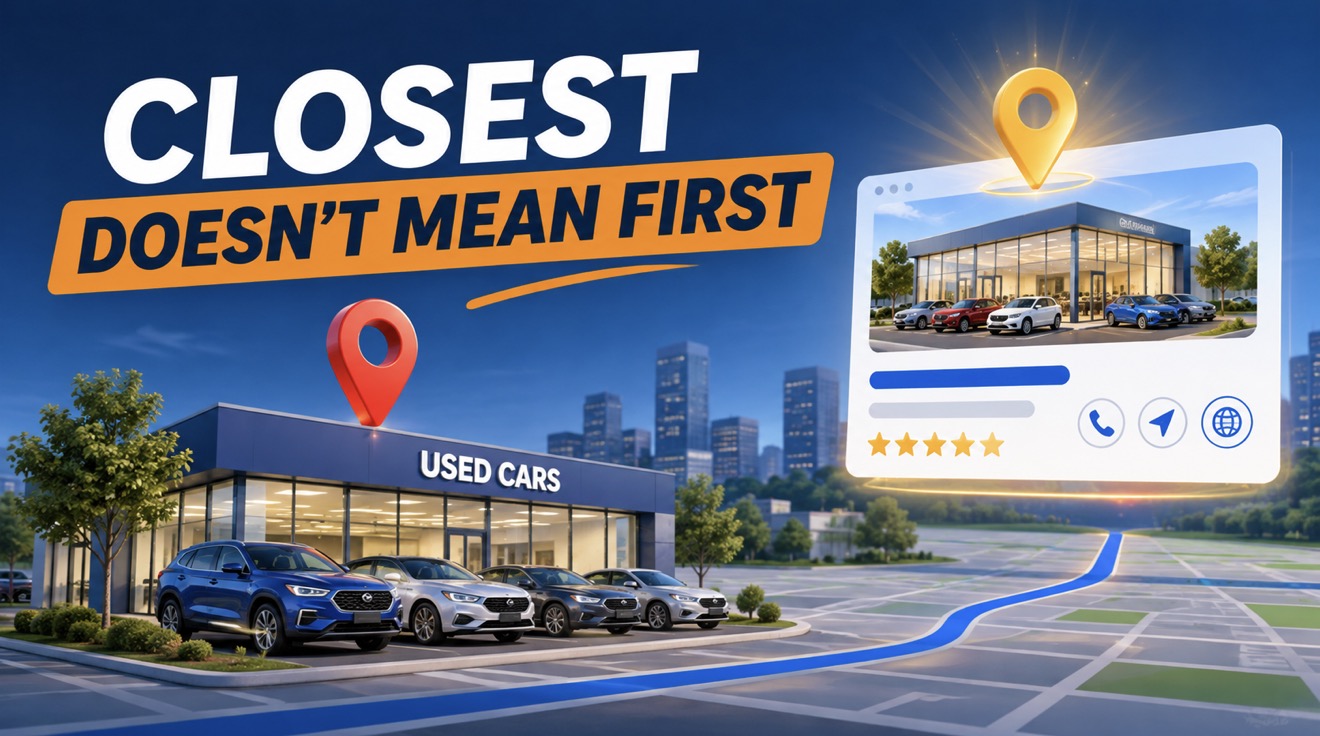
Why does a showroom farther away appear above yours on Google Maps? In its explanation of nearby search results, Google says a business can outrank a closer one when it better matches the search. For unpaid local results, distance gives you an advantage, not ownership of the first position.
If you handle dealership marketing, the worry is that nearby buyers are overlooking your stock. A reassuring search for your own business name does little to settle that concern.
Being found by name is a different test
Someone typing your dealership’s name has already identified the business they want. Someone searching for “used car dealers near me” is asking Google to suggest relevant businesses, without specifying yours.
That makes a branded search a limited test. It can show that a buyer who knows you can locate your profile; it cannot establish that an unfamiliar buyer will discover you. If your agency’s evidence is a screenshot of your showroom appearing for its own name, it has answered the easier question.
A better match can beat a shorter distance
In its local-ranking guidance, Google identifies relevance, distance and prominence as the main considerations. Relevance means the fit between your Business Profile and the buyer’s query. Distance concerns the buyer’s location; when the buyer does not share it, Google uses the location information available to it.
Prominence concerns how well known the business is. Google includes links from other websites and customer reviews among the information used to assess it. A nearby showroom can therefore lose its distance advantage when another dealership has a stronger combination of relevance and prominence.
Consider a made-up comparison. The nearer showroom has a vague profile that does not clearly describe its used-car business. A farther showroom is clearly categorised for that business and has a stronger genuine review record. Those differences give Google reasons to favour the farther showroom, even though the buyer would travel more.
This explains a possible result, not the exact cause of any competitor’s position. Google keeps its detailed ranking formula confidential. A review count alone cannot tell you why another dealer is ahead, or how many extra reviews would move you past it.
Accurate categories tell Google what you sell
In its category guidance, Google says category choices affect local ranking. It advises choosing a primary category that describes the business as specifically as the available options allow. For a used-car showroom, the relevant choice is the category that accurately identifies used-car retailing, rather than a broad label selected simply because it contains “car”.
Additional categories describe other genuine parts of the business. They are not extra spaces for search phrases, and Google advises against assigning a category to every offering. Selling cars does not make your showroom a car-hire business.
Google’s ranking guidance also says accurate, complete profiles are more likely to appear in local searches. Its profile-editing guidance covers the address and map pin, contact details and opening hours. For your showroom, accurate sales hours matter because a buyer needs to know when someone can actually show them a vehicle.
This is work you can control without pretending the dealership is something it is not. A more accurate profile gives Google clearer information about the business competing for that search.
Genuine reviews contribute, but do not decide the result alone
Google says review volume and favourable ratings can support local ranking. That differs from saying the dealership with the largest review count must appear first.
Under Google’s review policies, reviews must reflect real experiences. Paying for them or offering benefits in exchange breaks those rules. So does selectively requesting positive reviews while excluding unhappy customers.
For your dealership, a free accessory offered in return for a review is not a legitimate way to build prominence. The customer must also choose the rating and wording without pressure to include a locality or sales phrase. Google’s policies prohibit requests for specific review content.
In its guidance on obtaining reviews, Google allows reminders and invitations through a review link or QR code. That creates room for a straightforward request after a genuine customer interaction. It does not justify turning the request into a bargain over what the customer will write.
Added keywords and false locations misrepresent the showroom
Google’s business-representation rules require the profile name to reflect the name customers encounter in the real business. Adding “best used cars” or locality names merely to target searches is not allowed when those words are not genuinely part of that name. Google warns that unnecessary additions can lead to suspension.
The same rules require a real operating location. A rented postal address where you do not run the business is ineligible. A co-working office must have clear signage, and your own staff must receive customers there during its stated opening hours.
A neighbourhood you sell into is not another showroom. Creating a profile there to appear closer to its residents misrepresents where a buyer can visit you. Representing a genuine branch is different from inventing an address advantage.
There is no single first place across your market
In its Maps search guidance, Google explains that results can also reflect a user’s previous interactions with places. More fundamentally, buyers searching from opposite sides of town have different distances to competing dealerships. Your showroom’s distance advantage changes with the person searching.
The consequence for reporting is straightforward: a position needs a search phrase and a search location to mean anything. A screenshot taken inside your showroom cannot establish what buyers see across your catchment. Comparing the same unbranded searches from consistent locations gives you a more meaningful basis for judging visibility than a city-wide “number one” claim.
Google’s rules for agencies managing Business Profiles prohibit promises of top placement. An agency can be accountable for accurate profile work and clearly defined reporting. It cannot legitimately sell you the same first position for every buyer’s search.
A closer address remains useful, but a stronger match and greater prominence can outweigh it. The sensible marketing decision is to fund accurate representation and genuine customer feedback, then judge discovery beyond your business name. Your address is an advantage to work with, not a ranking entitlement to buy.
Frequently asked questions
Why has my dealership disappeared even when I search its name?
A dealership profile that buyers cannot find by name may have a verification or policy problem, rather than simply a weak position for general searches. Google’s guidance on finding your business identifies verification and profile restrictions as issues that affect visibility, and notes that recent changes can take time to appear. Check the profile’s status in the account that manages it before treating the problem as a ranking contest.