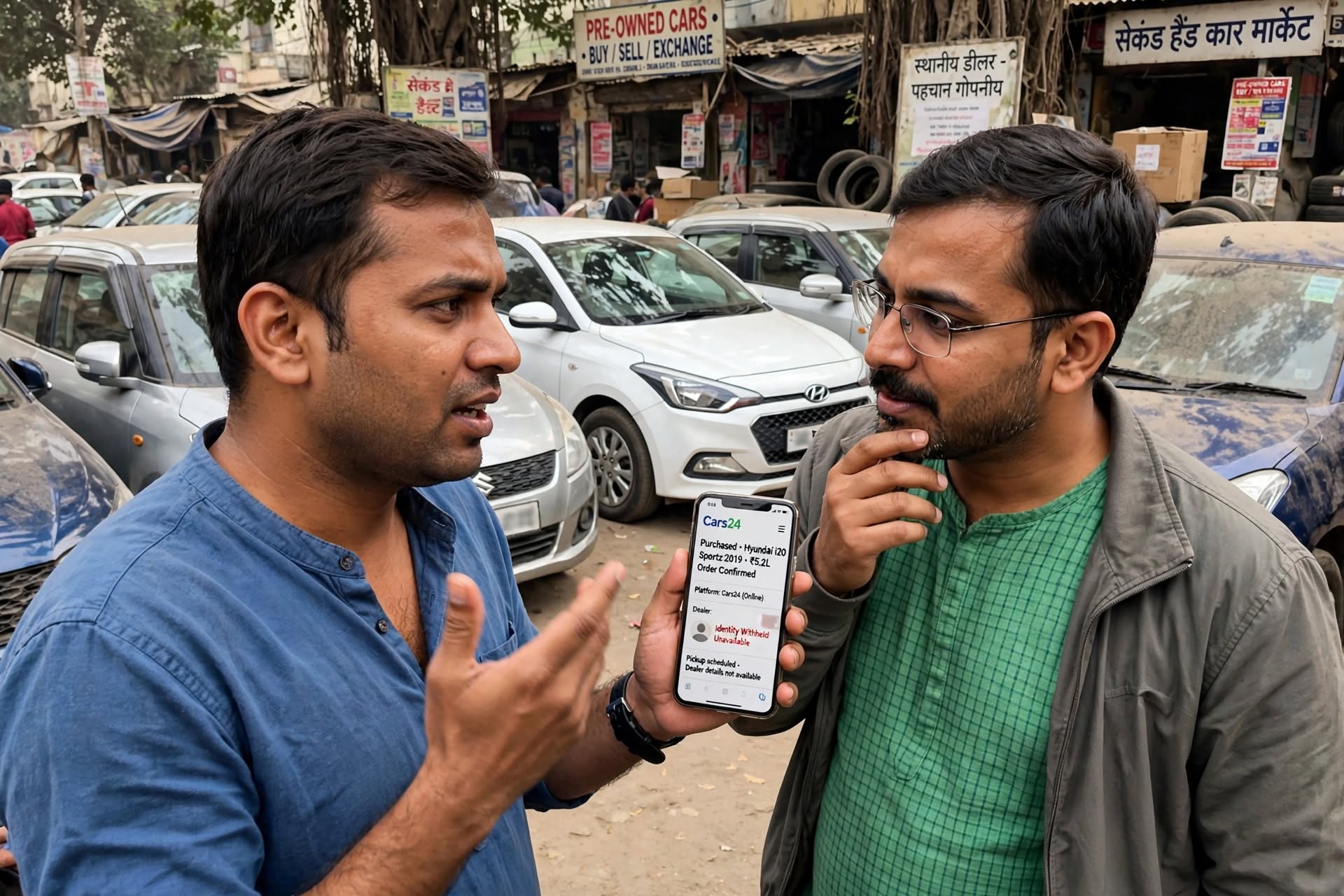
Why does someone who bought a car from your showroom tell a friend, “I found it on that app,” but struggle to remember your business name? For an independent used-car dealer in India, the distinction matters. You completed the sale, but the recommendation may send the next buyer back to a market full of other sellers.
A listing introduces a vehicle. It does not necessarily establish who deserves credit for selling it well. Your salesperson wants to keep the enquiry moving, while the buyer wants to avoid buying trouble. Both can concentrate on the car so completely that nobody makes the dealership’s identity clear.
How the seller disappears during the sale
Consider an invented sale at Banyan Lane Cars, a dealership operated by BLC Vehicle Trading LLP. A buyer finds its white hatchback on a listing app. She notices the app’s name as she browses, but the advert gives nearly all its attention to the vehicle. The seller’s name sits in a field she barely reads.
She calls and hears, “Yes, the white car is available. I’ll send you the photos.” The WhatsApp message comes from a number with a personal photograph and a first name. The pictures arrive without a caption identifying the dealership, followed by directions to the lot.
At the premises, the sign says Banyan Lane Cars. The salesperson gets straight into the vehicle, points out a repainted rear door and agrees to an inspection by her mechanic. She buys the car, receives an invoice headed BLC Vehicle Trading LLP and leaves satisfied. Nobody explains how that name relates to the showroom sign.
She has encountered the dealership’s name, but it has never held the transaction together. The app introduced the car, a person answered her questions, and a differently named business issued the invoice. Those connections are obvious to the dealer, not necessarily to her.
Car-only advertising gives recognition a short life
Advertising the vehicle is necessary. Its condition and asking price give someone a reason to enquire. The weakness appears when every message depends on the buyer remembering where that particular car was advertised.
A forwarded photograph shows the hatchback but may say nothing about its seller. A saved number labelled “white car” helps during the search, but gives the buyer little to work with when a friend later asks for a dealer. The information has travelled; the business name has not.
This explains why completed sales and dealership recognition are different things. You can answer every enquiry promptly and still present each vehicle as an isolated offer. Once that vehicle is sold, the next advert starts again unless buyers have also learnt something about the business behind the stock.
A recognisable name needs a reason to recommend it
A logo can identify a document or a photograph. It cannot, by itself, explain why someone should buy from you. The more useful identity connects your name to something the buyer can describe from experience.
At Banyan Lane Cars, that reason could be the way the salesperson handled the repainted door. The buyer saw the work identified before payment and could bring her own mechanic. That is more specific than an advert calling the showroom trustworthy.
For that experience to represent the dealership, it needs to reflect how the business operates rather than a favour from one salesperson. A condition sheet that records known repairs gives the conversation something concrete to refer to. Its claims must stay within what the dealership’s records and inspection can support.
Your reason to recommend the business need not be something no other dealer offers. It does need to be something you actually do. A buyer cannot pass on a meaningful recommendation if all you have given them is a name beside a claim that any showroom could print.
The name has to survive each change of channel
Now change how Banyan Lane Cars identifies itself without changing the vehicle or the quality of the sale. Its listing uses the dealership’s trading name in the permitted seller fields. The first reply makes the connection explicit: “You’re speaking to Banyan Lane Cars. Yes, the white hatchback you enquired about is here.”
According to WhatsApp, a business profile can display the business name and address, along with other business information. That provides somewhere to establish the seller’s identity, but the conversation should not depend on the buyer opening the profile. A brief introduction connects the number answering the enquiry to the showroom selling the car.
The condition sheet can carry that same trading name. An appointment message can name the showroom alongside its location, so the buyer knows which sign to look for. These references explain who is communicating; they need not turn every reply into an advertisement.
The same principle applies when the buyer searches for directions or checks the business online. Google requires a Business Profile name to reflect the name used by the business in the real world, including on its premises and website. A different promotional name online asks the buyer to work out another connection.
You cannot control every part of a listing app’s presentation. Where it gives sellers limited space, the identification in your own conversation becomes especially important. The answer is to carry your name into the relationship, not to stop using a channel that brings suitable enquiries.
Explain the relationship between trading and legal names
Consistency does not mean pretending that a trading name and a legal name are interchangeable. The GST registration certificate format published by the Central Board of Indirect Taxes and Customs provides separate fields for them. The practical task is to make their relationship understandable to the buyer.
For Banyan Lane Cars, a plain explanation would be: “Banyan Lane Cars is the trading name of BLC Vehicle Trading LLP.” Showing that relationship on the quotation introduces the legal entity before the buyer pays a booking amount. Carrying it into the sale documents connects the paperwork to the showroom they visited.
This is an explanation alongside the correct legal details, not a reason to replace them with a logo. The buyer should be able to identify the business taking responsibility for the transaction without asking whether the invoice came from someone else.
The referral reveals who received the credit
After the first version of the sale, the buyer might tell a friend, “I found mine on that app. Have a look there.” She can be pleased with the purchase and still direct the recommendation towards the place where she began searching.
After the version with clear seller identification, her recommendation has somewhere more specific to go: “Speak to Banyan Lane Cars. They pointed out the repainting before I paid and let my mechanic inspect it.” The name now belongs to an experience she can explain.
The app deserves credit for helping her discover the vehicle. Your dealership earns a different kind of recognition when she knows who handled the sale and has a supportable reason to recommend that seller.
That distinction changes how you judge your advertising. An enquiry tells you a listing attracted interest; a completed sale does not establish that the buyer remembers your business. Keep the channels that work, but treat seller identification as part of the transaction itself. Your name needs to remain connected to the work you want the buyer to remember.