Black Book’s U.S. figures for the week ended October 3, 2026 show a 0.73% wholesale decline overall, versus 2.40% for minivans.
For your used-car department, lower auction bills can improve the next buy without rescuing cars already in stock. Even a bargain purchased this week can deliver less gross than you expected if its retail price weakens before a customer takes it home. The opportunity lies in paying less; the risk lies in what happens between purchase and sale.
Your next purchase and your existing stock have different economics
Here, vehicle gross means the selling price less the acquisition price, auction fees, transport and reconditioning. Those expenses make up the all-in vehicle cost used in this analysis. F&I income, floorplan interest and dealership overhead are outside that calculation.
Lower replacement costs help vehicles you have yet to buy. They do not change the acquisition costs of vehicles you already own. Your department can therefore replenish at better prices while earning weaker gross on earlier purchases.
Older unsold stock also keeps cash or borrowing capacity committed to those vehicles. That is why a falling average purchase price does not, by itself, tell you whether the department’s economics are improving. You need to distinguish the savings on incoming inventory from the gross still available on existing units.
A minivan-heavy inventory deserves a closer comparison
In its September 29, 2026 report, Black Book describes increased auction volume and more selective buying. More supply can give bidders alternatives, but it does not make every vehicle equally attractive.
If minivans account for much of your stock, cheaper competing vans matter more than the average movement across all vehicle types. Your exposure is greater when those cheaper vehicles closely match inventory you acquired before the decline.
Still, a segment average cannot tell you what an individual van should retail for. Differences in mileage or equipment can put vehicles in different shopping decisions. The question is plain: could your customer find a comparable vehicle at another store for less? A cheaper van that does not meet the customer’s needs is a weak reason to cut your price.
Lower-cost competitors have room to move
A competitor that acquires an equivalent car for less can undercut your asking price and retain the same vehicle gross. It can also share only part of its saving with the buyer and keep the rest. Either choice can put pressure on a vehicle you bought earlier.
That is a possible response, not proof that local retail prices have fallen. The competing dealer might keep its price unchanged. Buyers may also support current prices when suitable vehicles remain scarce locally. A national wholesale reading cannot settle either question.
New listings show the offers your customers can choose from, not the prices at which those vehicles ultimately sell. Your recent completed deals and negotiated discounts help you judge what buyers will actually pay. Before treating a lower listing as a direct competitor, account for meaningful differences in condition and specification. Otherwise, you risk giving up gross to match a vehicle your customer would not choose.
A cheaper purchase can still miss its expected gross
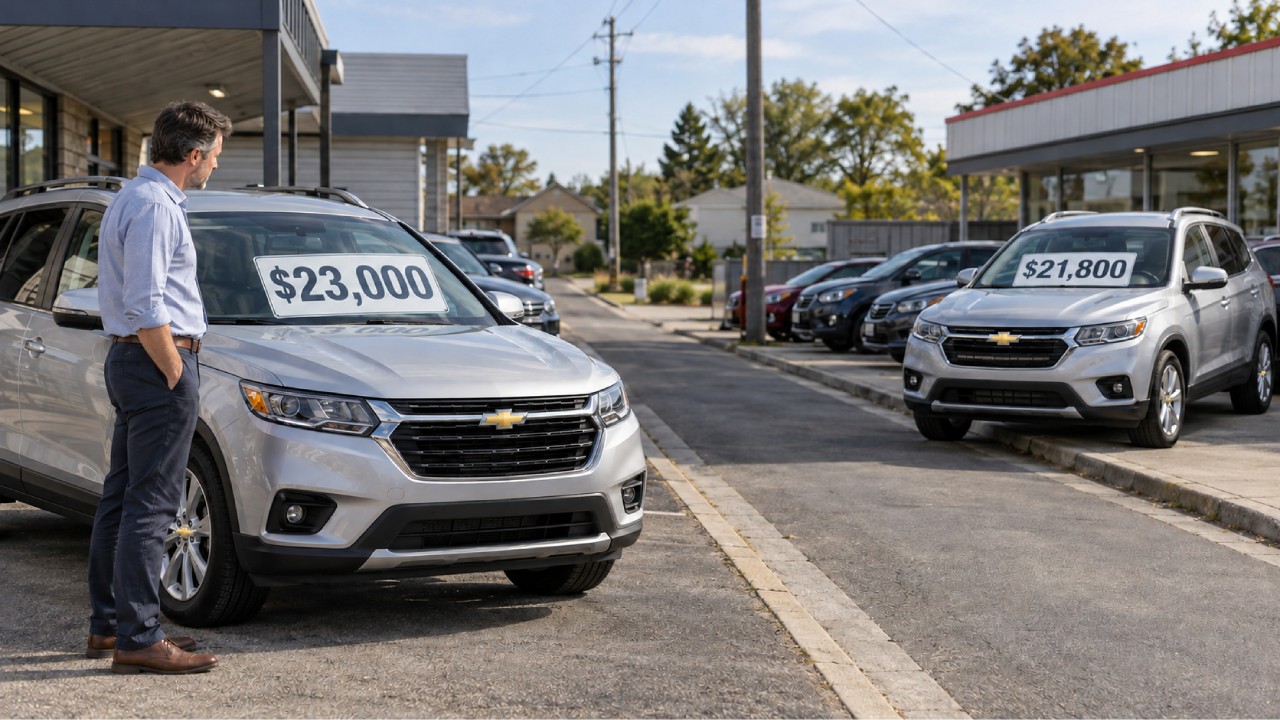
Consider this hypothetical purchase. The budgeted all-in cost is unchanged when the vehicle sells, but the achievable selling price falls:
| Measure | At purchase: expected | At sale: actual |
|---|---|---|
| All-in vehicle cost | $20,000 | $20,000 |
| Selling price | $23,000 | $21,800 |
| Vehicle gross | $3,000 | $1,800 |
The selling-price decline removes $1,200 from the expected gross without any cost overrun. You may have bought this vehicle cheaply compared with earlier purchases, yet the deal still delivers less than you anticipated. Comparing acquisition prices tells you whether you paid less; comparing the eventual selling price with all-in cost tells you what you kept.
Reconditioning delays matter, and readiness does not end the exposure
In its workshop on reconditioning, the National Automobile Dealers Association identifies slow recon as an obstacle to used-car profitability. When retail competition is getting cheaper, the risk goes beyond the work order: other dealers can bring lower-priced vehicles to market while yours awaits transport, parts or a place in the shop.
Recon can finish on budget and still leave you with less expected gross. If your bid relied on the retail prices available at the auction date, those prices may no longer be achievable when the work is complete. The repair bill did not cause the shortfall; the market moved during the delay.
Quick preparation removes one barrier to making a sale. It does not lock in the selling price. A finished vehicle that waits on the lot remains exposed to competing offers, so purchase-to-ready time and ready-to-sale time both belong in the economics.
That makes the expected selling window more important than the completion date alone. A low-priced acquisition needing extensive work may spend much of that window unavailable for delivery. Paying more for a vehicle needing little preparation can shorten that delay, but it does not guarantee a prompt buyer.
Financing creates another cost while you wait. The Office of the Comptroller of the Currency explains that floorplan interest usually reflects the average daily outstanding loan balance. That holding expense is separate from the vehicle-gross calculation above, but it still matters to the dealership’s return.
When cheaper buying really does improve margin
The favorable case is straightforward: your all-in cost falls by more than your eventual selling price does. If retail demand supports the price and preparation expenses do not absorb the acquisition saving, the lower purchase cost leaves more vehicle gross.
A store with prompt recon and customers seeking vehicles that are difficult to find locally has less exposure to this competitive squeeze. A department carrying common models through a long preparation queue has more, particularly when other dealers can replenish and begin selling comparable stock sooner.
Neither description follows automatically from a segment label. Nor does a weekly decline justify assuming the same depreciation every week through the selling period. The owner’s judgment should rest on current comparable offers and evidence from actual sales, rather than a national percentage applied mechanically to every vehicle.
An owner’s check on the gross still available
The useful warning is a gap between the retail price that supported your bid and the price a buyer would reasonably pay now. Keep the review short enough to use with your used-car manager:
- Compare newly listed equivalents. Look beyond competing vehicles that have been advertised for weeks. Fresh arrivals may reveal lower-priced alternatives, provided their condition and specification genuinely match yours.
- Track purchase-to-ready days. Identify how much time passes before each vehicle is deliverable, then track its wait for a buyer separately. Faster recon should not conceal a growing ready-to-sale delay.
- Refresh expected vehicle gross. Use today’s achievable retail price, supported by comparable offers and recent deals, less the unit’s current all-in cost estimate. Keep any unfinished recon costs in that estimate.
Cheaper auction inventory improves your economics when enough of the buying saving survives through the sale. These checks help you judge that spread while there is still a pricing or purchasing decision to make, rather than discovering the difference after delivery.