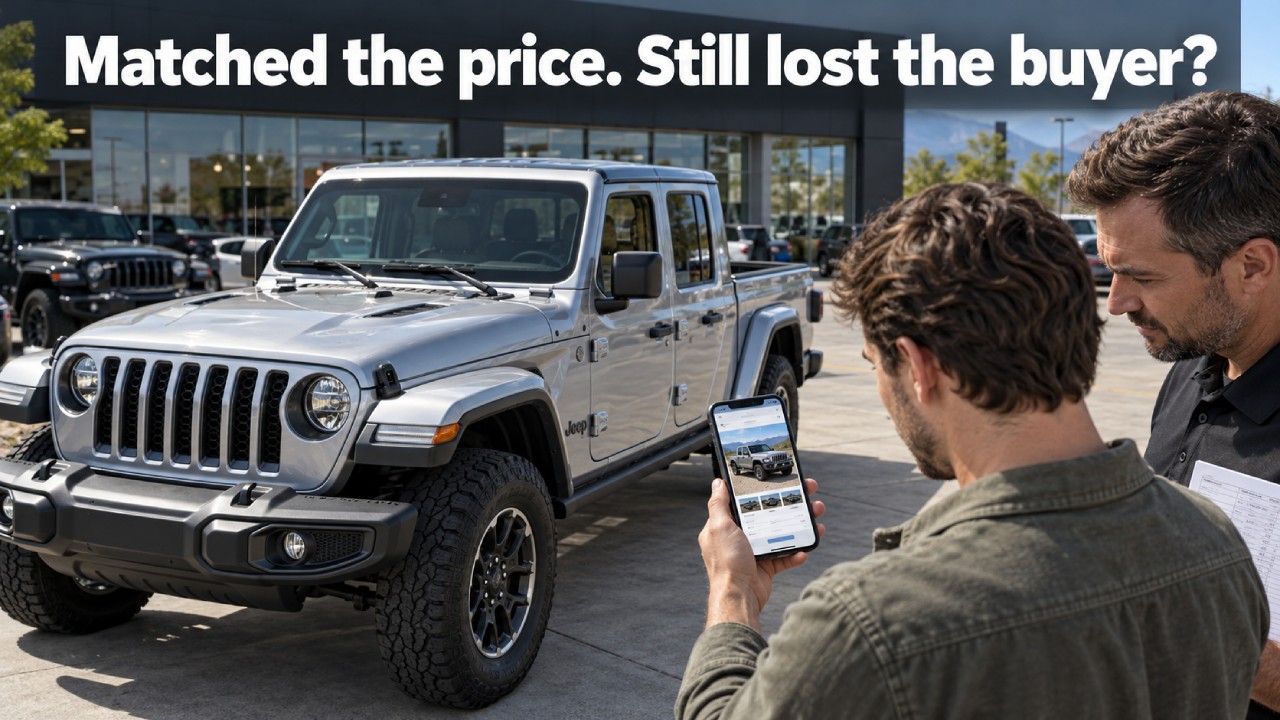
Why would a buyer still choose an out-of-state truck after you match its price? You may have matched the number without offering the vehicle they actually want.
If you manage sales or buy inventory, the important comparison is the buyer's shortlist, not your total stock. Someone protecting a particular capability may see your truck as a compromise, even when you see a close comparable. The question is whether a lower price can make that compromise acceptable, or whether you need a different vehicle.
The buyer compares configurations, not your stock count
A model name gets a vehicle into the initial search. Trim and drivetrain can narrow that search sharply, while specific equipment determines whether a remaining candidate belongs on the shortlist. Availability then matters: the right vehicle must also arrive when the buyer needs it.
These differences can reach beyond appearance. For the 2026 Gladiator, Jeep specifies the Rock-Trac four-wheel-drive system on Rubicon models and describes the Mojave's suspension as tuned for desert use. A buyer seeking a particular off-road setup has a reason to distinguish between trucks carrying the same model name.
That is why a full row of trucks may leave you without a suitable choice for one customer. Your stock count answers how much you have invested. It does not answer how many vehicles this buyer would willingly own.
Combining locations helps when it adds missing choices
Assortment means the range of configurations you can offer. Bringing vehicles from several locations into one search can broaden that range without requiring every location to stock every combination. The advantage comes from adding choices that the local selection lacks.
Research summarized by Dartmouth's Tuck School of Business used U.S. dealership data from 2006 and 2007 to examine inventory and sales. It found that expanding variety affected sales differently from adding duplicate inventory. More units and more meaningful choices were not interchangeable.
The implication for a nationwide search is straightforward: another location matters when it supplies an acceptable configuration the buyer cannot obtain nearby. More listings of an unwanted configuration do not fill that gap.
There is an important limit for your store, however. A vehicle appearing in a shared search is not necessarily one you can acquire. Until you establish access and a workable delivery date, visibility alone has not expanded what you can offer.
The selection advantage can change from Gladiator to Ram
Consider an illustrative comparison between Gladiator and Ram 1500 shopping. A national selection could contain Gladiator configurations missing locally, while nearby Ram inventory could already cover the combinations a buyer wants. Expanding the search would change the Gladiator comparison much more than the Ram comparison.
Even that distinction depends on the individual shopper. Ram lists both HEMI and Hurricane engine choices for the 2026 1500. A deep local selection with the wrong engine would still leave a buyer who insists on the other engine looking elsewhere.
The conclusion is conditional: national reach creates an advantage where it adds relevant choices. It does not establish that the distant seller has the better selection for every model.
Inventory and registration counts also answer different questions. Stock on a particular date is not purchase activity accumulated over a reporting period, and neither count records which alternatives a buyer rejected. Those figures alone cannot establish that assortment caused an individual purchase.
Matching the price does not pay for the compromise
Some differences have a price. A buyer who prefers a certain color may accept another for worthwhile savings. When both vehicles meet the buyer's needs, a lower price can compensate for a less desirable finish.
Even that flexible buyer may reject a price match. If the distant truck has the preferred equipment, equal prices still leave your vehicle at a disadvantage. Your offer would have to make the compromise worthwhile after delivery costs, rather than merely draw level with the advertised number.
Other differences exclude the vehicle. If the buyer needs a particular bed configuration for an existing setup, an unsuitable bed does not become suitable when you reduce the selling price. You are discounting something that still cannot do the required job.
The dividing line belongs to the buyer. Color may be negotiable for one person and the reason another person started searching nationwide. Calling something a preference does not establish that the customer will trade it for savings.
A useful question is: “If both vehicles cost the same to get home, which would you choose, and what decides it?” An answer about missing equipment gives you a different problem from, “I prefer yours, but I can't justify paying more.” The first answer calls for understanding the vehicle requirement before discussing another concession.
Fit does not erase a budget ceiling. The desired truck may still be unaffordable, leaving the buyer to wait or reconsider what they need. But reducing the price of a vehicle they have ruled out does not resolve the affordability of the one they want.
A dealer trade or order changes what you can offer
For a franchised new-vehicle department, a dealer trade makes sense when another store has the right truck and will release it on workable terms. The commercial question is whether acquisition and transportation costs leave you an offer the buyer will accept. Locating the VIN is not the same as securing the vehicle.
A factory order addresses a different situation. It can suit a buyer who cannot find an obtainable match and is willing to wait, provided the manufacturer accepts the desired configuration. Build availability and expected delivery belong in that discussion because the buyer is exchanging immediate possession for a closer fit.
An order request should not be presented as a firm arrival commitment. If the customer's deadline cannot accommodate the expected wait, the order has not solved the mismatch. For a used-vehicle buyer, sourcing another existing VIN is the relevant alternative; ordering a new truck changes the purchase altogether.
Sometimes neither route works within the customer's limits. A candid acknowledgment that your available truck does not meet the requirement is better than another reduction aimed at changing a decision the buyer has already made about the vehicle itself.
Judge the delivered offer before changing the price
The Federal Trade Commission advises buyers to obtain written purchase totals that include taxes and fees before discussing financing. For a distant vehicle, transportation or pickup expenses also belong in your comparison. Matching an advertised price is not necessarily matching what the buyer will spend to take possession.
Timing belongs beside that total. An exact configuration that arrives too late may be unusable for this purchase, while a more expensive delivered vehicle may remain attractive if it meets a requirement your stock cannot satisfy.
For inventory buying, repeated requests for missing configurations deserve a different diagnosis from losses between genuinely comparable vehicles. Adding more of the existing mix does not address an equipment gap.
Before changing the price again, understand what would have to change for this buyer to choose your offer. If the answer is the vehicle itself, your next decision concerns sourcing. A competitive price can win a comparison only when the buyer considers the vehicle an acceptable choice.