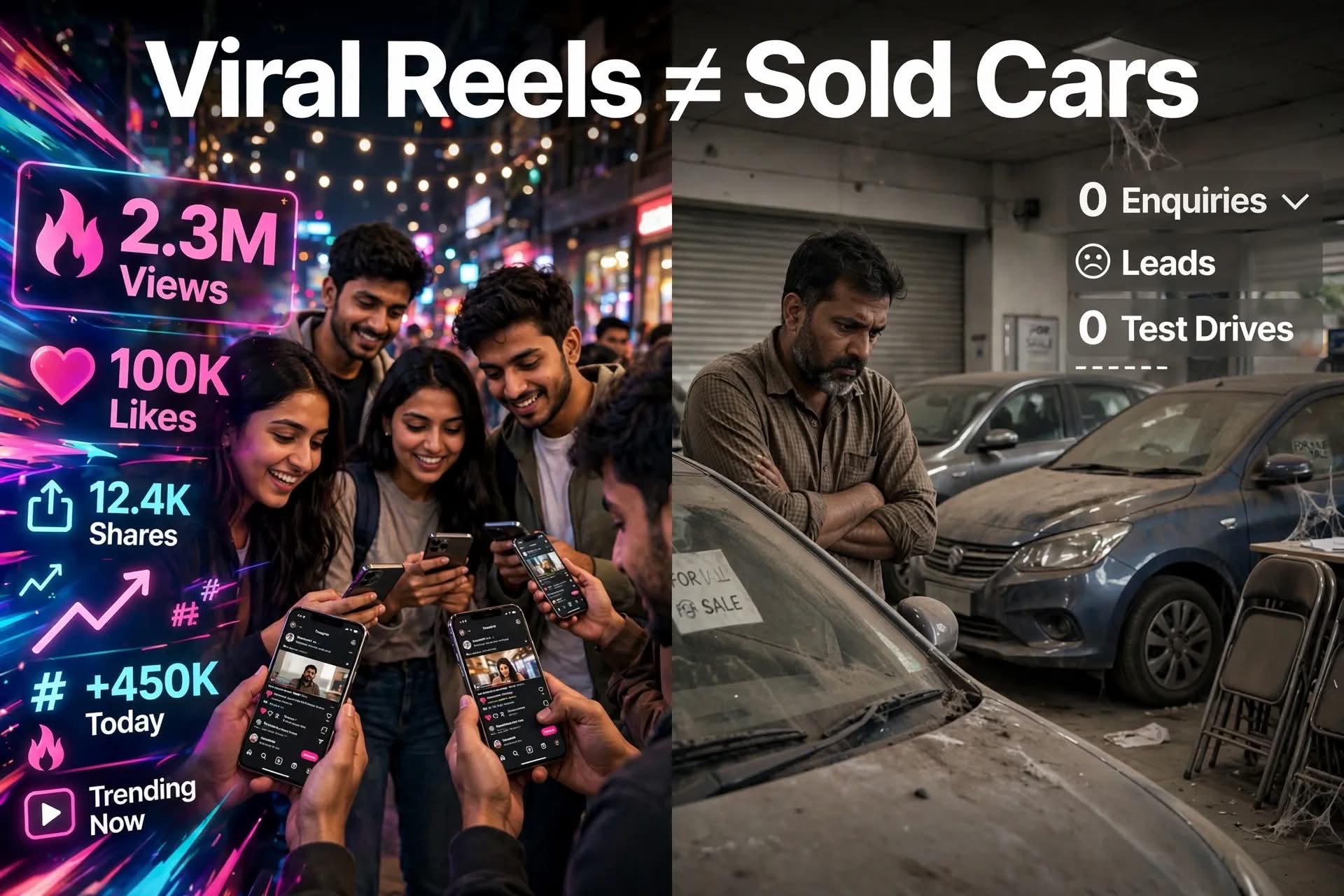
Why are people watching your cars but not coming to inspect them? If you run a used-car showroom in India, a rising reel count cannot answer that question. The missing connection may be between liking the footage and knowing enough about the car to justify a visit.
A buyer may be protecting their savings or trying to avoid a wasted journey. Before you spend another hour filming, it helps to understand which uncertainty your existing marketing leaves them with. More exposure and better support for an interested buyer solve different problems.
A viewer has not yet qualified as a buyer
In its explanation of content recommendations, Meta describes how Facebook and Instagram use people’s interests and interactions to select content, including material from accounts they do not follow. Watching a video or liking a post helps inform those recommendations.
For your showroom, the distinction is straightforward: interest in car content is not evidence of a purchase plan. Someone can enjoy a walk-around of an SUV without wanting to replace their own car. Even an active shopper may have a budget that does not match your asking price.
Distance introduces another boundary. A viewer might like the vehicle but have no intention of travelling to your showroom. A view does not establish that willingness, even when the person lives in your city.
This does not make the attention worthless. A reel gives you room to show the car and introduce the person selling it. The mistake is counting that introduction as evidence that a suitable buyer is ready for a sales conversation.
The footage leaves buying questions open
A polished exterior does not explain the car’s maintenance history. A cabin shot cannot establish whether the air conditioning works properly. Video can show a defect or demonstrate a feature, but a quick presentation cannot stand in for an inspection.
The buyer also needs to distinguish what you claim from what you can support. Service invoices provide something to examine; a caption calling the car well maintained does not. Ownership details need support from the RC, rather than a spoken assurance that the vehicle has had a single owner.
Where records are incomplete, the gap itself belongs in the conversation. Otherwise, the buyer has to travel before discovering how much of the car’s history remains uncertain. Close-up photographs and available inspection findings give them material to consider before making that commitment.
Finance creates a separate question. State Bank of India specifies income requirements and supporting documents for its certified pre-owned car loan, and links the permitted repayment period to the vehicle’s age. A reel advertising finance does not establish that a particular applicant and car meet the lender’s requirements.
The purpose of the information after the reel is therefore to make the car worth investigating. It should not pretend to settle matters that require document checks or a lender’s decision.
Being seen does not mean being found again
A viewer may return later by searching for your showroom name. They may instead compare similar cars near them, without remembering which account posted the original video. Those searches ask a different question from a social feed: where can I find a suitable car now?
Google explains that local results depend mainly on relevance, proximity and how well known a business is. It also says complete, accurate business information makes a business more likely to appear in relevant local searches.
The practical implication is that another reel cannot substitute for an accurate showroom address or clear opening hours. Your social profile and your Google Business Profile need to identify the same business without making the buyer work out whether they have found the right place.
Finding the business still leaves the question of current stock. An old video shows what you advertised, not necessarily what remains available. Clear availability information matters because a buyer comparing cars needs to know which ones can actually be inspected.
How interest becomes an inspection appointment
The connection starts with somewhere to obtain the vehicle details. A page on your website can do that, but a website is not compulsory. An organised WhatsApp message with photographs and a written vehicle summary can serve the same immediate purpose.
The information needs to identify the exact car, including its variant and year, odometer reading, ownership details and asking price. It should explain what the price includes and what would cost extra. Available condition evidence and service records then help the buyer decide whether to continue.
Keeping the price behind “DM for details” may feel like a way to start conversations. It also requires someone to contact you merely to discover whether the car fits their budget. That creates an enquiry without necessarily creating a prospect.
A clear contact option gives the interested viewer somewhere to take the questions that remain. That could be a phone number or a message channel, provided someone at your showroom takes responsibility for answering it. Publishing a contact number does not complete the connection if nobody handles the enquiry.
Consider a made-up exchange. A buyer asks, “Can I see the service records before I bring my mechanic?” A reply of “Come to the showroom and we’ll discuss it” leaves the reason for their hesitation untouched.
A useful answer would sound different: “I can send the available service entries. There is a gap in the records, which I’ll point out. Let me confirm when you and your mechanic can inspect the car.” The answer supplies evidence and acknowledges its limit before asking the buyer to travel.
The appointment then needs agreement, not just an invitation to drop in. The buyer and your salesperson should settle a time and confirm that the particular car will be available. The buyer also needs the correct location and to know who will meet them.
That is the work between the view and the inspection: enough information to consider the car, followed by a conversation that resolves the immediate hesitation and produces an agreed visit.
Your next hour belongs where progress stops
A reach problem exists when too few suitable shoppers encounter your stock. Another locally relevant reel may deserve your time if the vehicle information is accessible and existing enquiries are being handled. The filming has a clear job: introducing available cars to people who might consider them.
Few enquiries, however, do not automatically prove that reach is inadequate. Viewers may be unable to find the price or work out where the showroom is. They may also find the offer unsuitable. A larger audience does not explain which of those things is happening.
When enquiries arrive but inspections do not follow, the conversations become more useful evidence than the view count. Unanswered requests for records point towards missing information. Discussions that stop after a finance question deserve attention to eligibility, rather than another general assurance that loans are available.
Your records should distinguish an appointment someone agreed to from a suggestion your salesperson made. They should also show whether the buyer attended. Otherwise, apparent success in arranging visits can conceal a problem that starts before anyone reaches the showroom.
Attribution needs care too. A buyer can discover you through a reel and later call after searching for your business. Recording only the final contact would miss the reel’s contribution; crediting the reel alone would miss the information and conversation that followed it.
Keep making reels when introducing your stock is the work that needs doing. When interested people are already waiting for answers, give them the next hour. The question is not how much attention the video collected, but whether your showroom gives that attention somewhere useful to go.