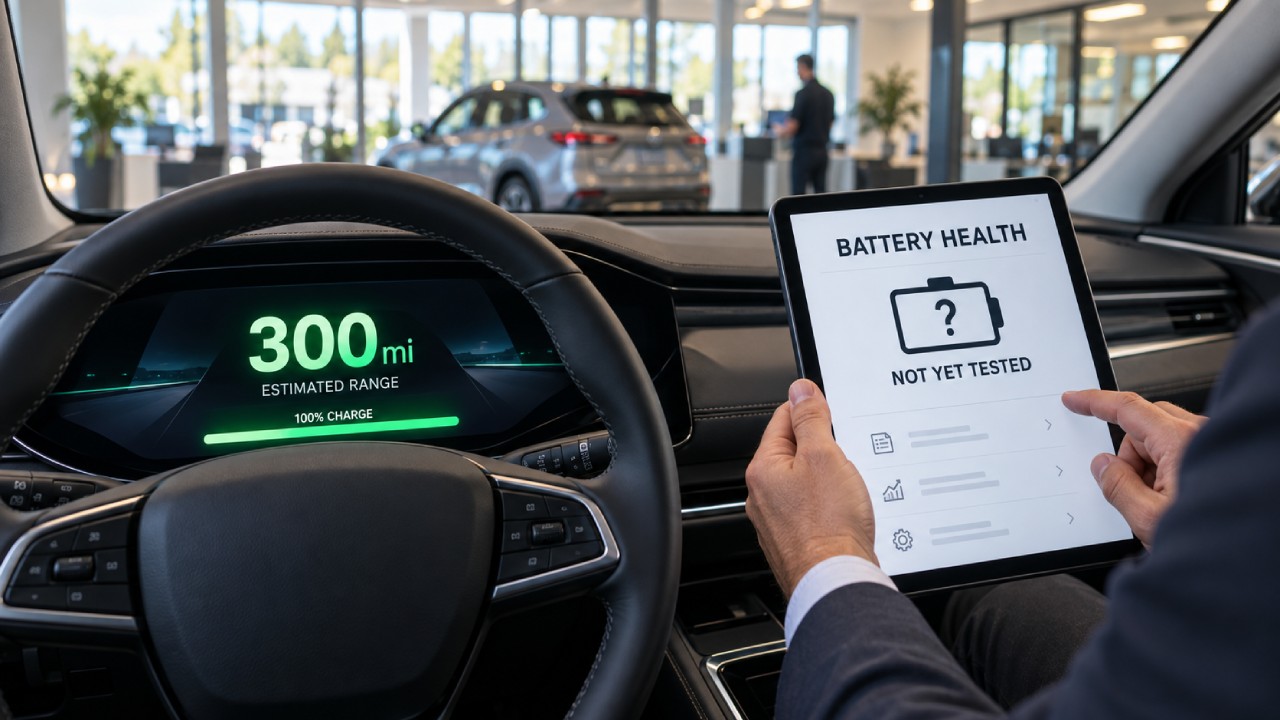
Can you use the miles showing on a used EV’s dash to justify calling its battery healthy? No. For a U.S. used-EV appraisal, that number estimates driving distance. It does not establish how much usable capacity the battery has retained.
The temptation is understandable when you need to value a trade before a battery report is available. But a range photograph and a documented capacity assessment support different claims. Keeping that distinction clear matters when your appraisal becomes a vehicle description or a salesperson’s explanation.
Range depends on the energy available and the calculation behind it
In its U.S. Model 3 owner documentation, Tesla describes the main range readout as estimated remaining battery energy converted into distance using EPA-rated consumption. Charging adds available energy, so the displayed miles can increase without any improvement in the battery’s underlying condition. Tesla separately describes projections in its Energy app that use recent consumption.
That distinction prevents a common mistake: assuming every EV’s range display responds to driving history in the same way. Ford says Intelligent Range considers outside temperature and driving speed, among other inputs. In its software notes for the 2021 and 2022 Mustang Mach-E, Ford also describes using driving behavior to refine distance-to-empty calculations.
Recent high-consumption driving can therefore influence a behavior-based estimate without demonstrating permanent capacity loss. A model that uses a rated consumption assumption needs a different interpretation. Before comparing displayed miles between vehicles, you need to know which calculation produced each number.
Temperature adds another distinction between temporary availability and lasting degradation. Tesla’s Model 3 documentation explains that cold can make some stored energy temporarily inaccessible until the battery warms. A lower reading in those conditions cannot, by itself, tell you how much capacity the battery has lost through aging.
Retained capacity does not describe every battery problem
State of charge describes how full the battery is now. Retained usable capacity concerns how much energy remains available across its operating window compared with an appropriate new-battery reference. Filling an aged battery does not establish that it still holds its original amount.
A capacity assessment addresses that energy question. A diagnostic investigation addresses detected problems in the battery or its supporting systems. Physical inspection addresses damage that a capacity percentage cannot describe. Those findings belong alongside one another in an appraisal, not underneath a single unsupported label such as “excellent battery.”
The National Highway Traffic Safety Administration warns that physical damage to a high-voltage battery can create electrical and fire hazards. The implication for appraisal is straightforward: even a reassuring energy-retention result cannot certify that a damaged pack is safe.
Match the evidence to the question it actually answers
Manufacturer-supported testing offers a stronger basis for a capacity claim because the manufacturer defines the assessment and its reference. But you still need to distinguish a calculated status from a completed test.
For example, Tesla’s Model 3 battery-health documentation separates a battery-management-system evaluation from an optional Battery Health Test. The evaluation compares operating data with expected retention for the battery’s circumstances. The completed test reports energy retention relative to new. Tesla cautions that some vehicles lack the feature, specifies prerequisites, and recommends the test when energy retention is a concern. Active battery or thermal-system alerts can prevent testing.
Tesla says the optional test can take up to 24 hours while the vehicle stays connected to an AC charger. If you need to value a trade while the customer waits, you may have to make the initial appraisal before a capacity result is available.
A fault review produces different evidence. Tesla’s Service Mode guide distinguishes active alerts from recent alerts and identifies service alerts that drivers do not ordinarily see. That makes an absence of dashboard warnings weaker evidence than a properly scoped diagnostic review. Neither observation automatically supplies a capacity measurement.
Read those manufacturer documents together, and the limits of each type of evidence become clearer:
| Evidence | What it supports | What it does not establish |
|---|---|---|
| Range display | The vehicle’s distance estimate at the recorded charge level | A retained-capacity percentage or overall battery condition |
| Completed manufacturer-supported capacity assessment | The reported energy-retention finding under that method’s conditions | Freedom from physical damage or a forecast of remaining life |
| Model-capable fault scan or service-alert review | The faults retrieved from the systems checked at that time | Retained capacity merely because no relevant faults appeared |
These are evidence categories, not a universal testing recipe. Tesla’s service guide explicitly notes that available panels vary with the vehicle and its software. For your stock, the applicable documentation must match the model year and battery configuration. A familiar test name is not enough if its definition or applicability is unclear.
EPA range and warranty coverage cannot fill the capacity gap
The Environmental Protection Agency explains that its range labels come from prescribed laboratory driving tests, with adjustments and combined city/highway results. The original rating describes a vehicle configuration under that framework. It is not a current test of the particular battery sitting in your parking lot.
Dividing today’s full-charge range display by the original EPA range does not turn those different figures into a verified health percentage. The calculation still depends on the dashboard’s estimation method and the comparability of its assumptions. It is an inference from range, not an assessment of retained energy.
Warranty coverage answers a contractual question. Tesla’s warranty summary, for example, lists a minimum capacity-retention threshold of 70% for its listed Model 3 variants, subject to coverage limits, and directs owners to their vehicle’s actual warranty. Remaining coverage does not establish the battery’s present capacity. A warranty threshold is not an appraisal result.
Keep the claim no broader than the report
A useful appraisal identifies the evidence behind its conclusion. For a range photograph, that means recording the displayed miles with the charge level and relevant conditions. For a capacity assessment, it means retaining a vehicle-linked report that identifies the method, assessment date and result. Those details let someone distinguish a fresh completed test from an unexplained screenshot.
The wording should preserve that distinction. Here is an illustrative description for a vehicle that received a diagnostic review but no capacity assessment: “The inspection report records no battery-related faults in the systems checked. Retained battery capacity was not assessed.” That statement tells a buyer what the inspection established without upgrading it into a broader condition claim.
When a report contains a retention result, describe the reported metric and name the assessment rather than rewriting it as “battery like new.” Likewise, an expected-for-age evaluation should remain an expected-for-age finding. It should not become a percentage of original capacity unless the assessment actually provides one.
If the available evidence cannot support the capacity claim you want to make, a model-qualified EV specialist needs to identify an appropriate assessment. Fault warnings or suspected damage require diagnostic or safety evaluation before capacity testing. NHTSA specifically calls for technicians with EV high-voltage training to service these systems.
You can make an appraisal with uncertainty. What you cannot do is make that uncertainty disappear by treating the most visible number as the strongest evidence.
Frequently asked questions
Can the charger’s energy total prove how much capacity the battery has left?
No. Energy delivered during charging is not automatically the usable energy stored in the battery. The EPA explains that AC charging involves losses in the charging equipment and onboard charger. A charging receipt therefore cannot substitute for a capacity assessment that defines its measurement boundaries and starting conditions.