When a seller says their EV has lifetime battery cover, what can you promise your next customer? For an Indian dealership buying a privately registered used EV, that distinction belongs in the appraisal. You should not value or advertise a benefit that your buyer cannot inherit.
The seller may be repeating an assurance they received when buying new. Your customer wants reassurance about a future battery bill. MG Windsor provides a documented example of how their entitlements can differ; transfers of battery-rental contracts are outside this discussion.
Lifetime cover can belong to the owner, not every future buyer
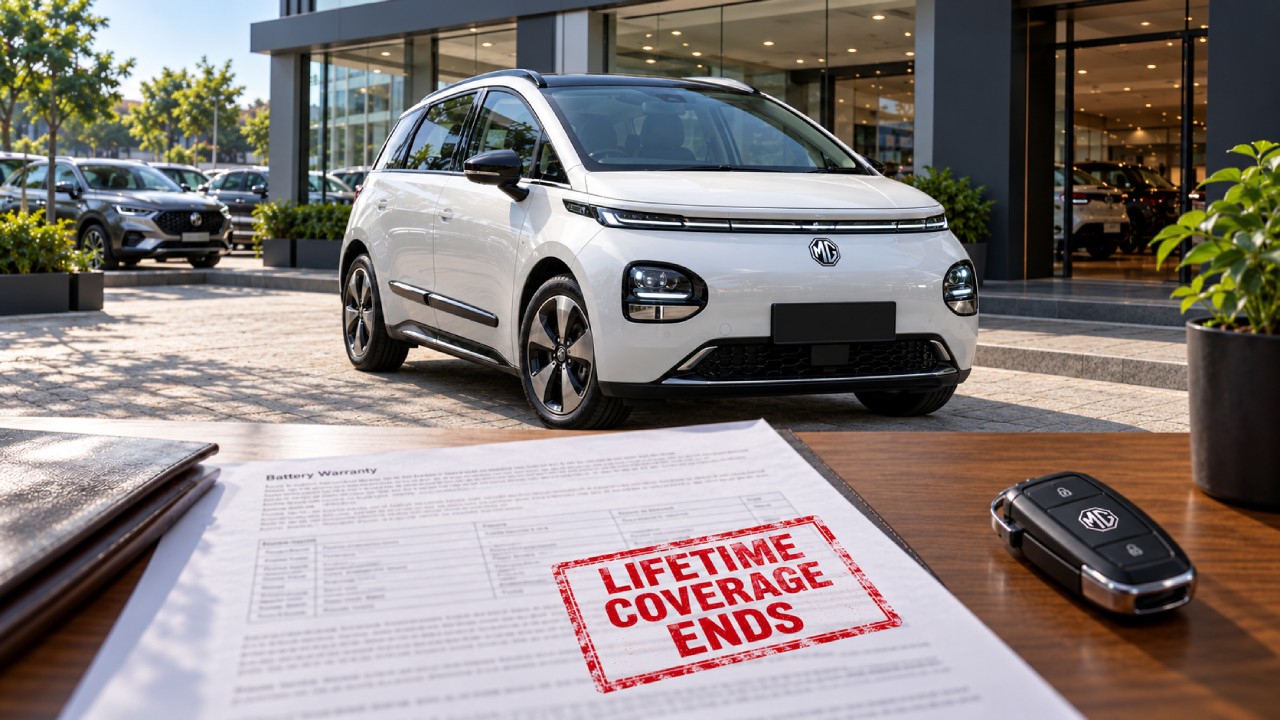
As of 22 October 2026, JSW MG Motor India describes the Windsor’s battery warranty in its website FAQ as lifetime protection restricted to the first owner. That qualification matters more to your appraisal than the word lifetime.
An older MG Windsor brochure explains the ownership distinction more fully. It limits lifetime eligibility to the original registered owner of a privately registered car. Following an ownership change, it describes battery protection lasting eight years, with an odometer ceiling of 1,60,000 km. The period starts at the car’s original delivery, and whichever limit arrives first ends the cover.
These statements do not establish that MG has withdrawn protection from subsequent owners. They describe a lifetime entitlement for one qualifying owner and a limited entitlement after ownership changes. MG’s published Windsor service-and-warranty booklet also retains that ownership-change provision.
The distinction explains how lifetime cover can end without leaving the battery entirely unprotected. It does not make an old brochure sufficient evidence for every Windsor you buy. Your appraisal needs the policy applicable to that particular vehicle, including its eligibility conditions, rather than whichever document offers the most attractive headline.
Resale does not restart either limit
Under MG’s brochure provision, the calendar endpoint is the original delivery date plus eight years. The available distance is 1,60,000 km minus the current odometer reading. Your buyer receives only the unused portion of those limits, assuming the car remains eligible.
Both limits must still have room left. A low-mileage car cannot recover years that have elapsed, and a recently delivered car cannot recover kilometres already travelled. If either ceiling has been reached before resale, this provision leaves no remaining protection for the incoming owner.
That makes “eight-year battery warranty” an incomplete description of used stock. Without the starting date, a buyer could understand it as eight years from their purchase. “Warranty until” is more useful, provided the listing also states the mileage ceiling.
For valuation, keep the expiry date and remaining kilometres together. A buyer expecting substantial running may reach the odometer limit well before the calendar deadline. Refresh the remaining-distance calculation at handover because test drives and other stock movements consume part of that allowance.
Battery condition and warranty entitlement answer different questions
A battery-health assessment concerns the battery’s present condition. Warranty entitlement concerns the manufacturer’s obligations under the applicable terms. A favourable health report cannot establish that a subsequent owner qualifies for cover, while an unexpired warranty cannot establish that the battery is fault-free.
MG’s booklet covers defects in materials or assembly. Its capacity provisions distinguish excessive degradation from normal ageing, which it assesses against internal standards. Where excessive loss qualifies, repair is possible; if repair cannot resolve it, the replacement pack may be new, remanufactured or reconditioned.
For your sales description, this means an expiry date alone cannot support a promise of a brand-new battery whenever range falls. The cause of a problem and the remedy permitted by the policy still matter. Ask the authorised service centre to explain the applicable capacity-assessment standard before making any specific capacity guarantee.
Keep the health assessment and entitlement confirmation separate in the vehicle file. One supports what you say about the battery you are selling. The other supports what you say about the protection available to its buyer.
The VIN connects the published terms to your stock
A model-wide answer is not enough when you are committing money to an individual car. A useful written response from the manufacturer’s authorised service channel identifies the vehicle identification number, or VIN, and the policy it is applying. It should describe the incoming owner’s entitlement, not merely confirm that the seller currently has cover.
The registration certificate and ownership trail help establish who has held the car. Its use history matters too: MG’s booklet excludes demonstrators, test-drive vehicles and courtesy cars from its private-retail lifetime offer. A private registration entry should therefore prompt examination of the history, not end it.
Original delivery evidence establishes the starting point for the time limit. The odometer reading establishes the distance already used. Service invoices give the authorised centre evidence to assess compliance with the relevant maintenance conditions; a missing invoice calls for clarification rather than an unsupported declaration that everything is covered or everything is void.
The confirmation should state the expiry date and kilometre ceiling, identify any unresolved eligibility issue and explain any transfer action still required. If the documents disagree, have the authorised channel resolve that disagreement against the VIN before you attach a warranty benefit to your buying price. You need an answer about this car, not another copy of the sales brochure.
Describe the protection your buyer will receive
Once the entitlement is confirmed, the listing should describe remaining high-voltage battery cover. Keeping “lifetime warranty” in the headline and putting the ownership restriction underneath leaves the wrong benefit leading the sale.
A suitable wording template, completed with the confirmed details, would be:
“High-voltage battery warranty for the incoming owner: cover until [expiry date], capped at a total odometer reading of [kilometre limit]. At [recorded mileage] km on [date], [remaining distance] km remains. Cover ends when either limit is reached, subject to the supplied manufacturer terms and [confirmed transfer requirement].”
The handover record should match that description and include the applicable terms alongside the written entitlement confirmation. Explain material conditions in ordinary language rather than expecting “terms apply” to carry the whole explanation. Keep any battery-health report separately identified so the buyer does not mistake it for a warranty certificate.
MG’s booklet requires the subsequent purchaser to inform MG or an authorised dealer about an ownership transfer during the warranty period. Your handover record should therefore say whether that notification has been completed and identify any outstanding action. Do not leave the buyer to assume that the registration transfer also completes the manufacturer’s requirement.
A change of owner need not leave the battery without protection. It does mean your valuation and sales promise must reflect the buyer’s confirmed entitlement, not the lifetime benefit the seller is leaving behind.