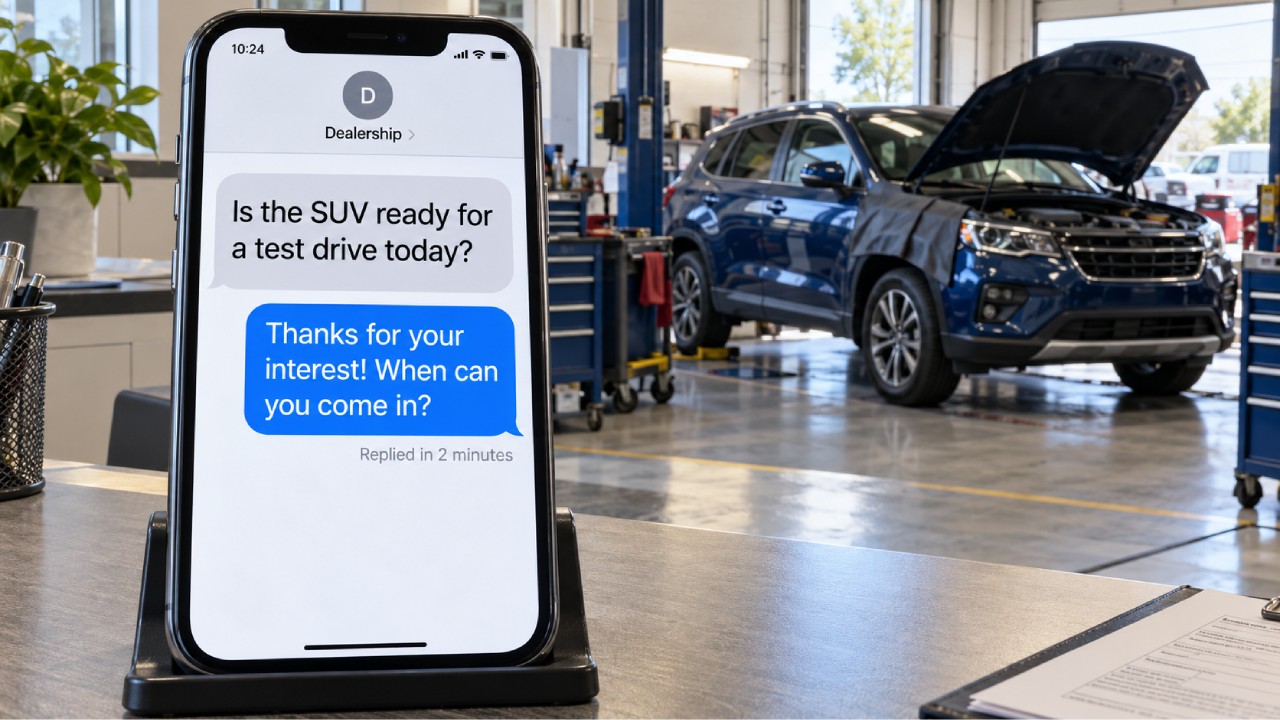
A buyer asks whether a used SUV is available. Your sales team replies within five minutes: “Thanks for your interest! When can you come in?” The CRM records a quick response. But the buyer still does not know whether the SUV is on your lot, whether it is ready for a test drive, or whether someone has already placed a deposit on it. You have asked them to make the trip before giving them the information they requested. A prompt reply matters. So does what it contains. The first reply should answer the buyer’s question and help them decide whether visiting your dealership is a sensible next step.
Response time measures only part of the interaction
In its October 4, 2026 report on mystery shops conducted with LeadVantage, Car Dealership Guy described different strengths in dealership lead handling. Five of seven Carvana CDJR stores emailed a price quote, compared with four of 10 traditional franchise dealerships. All 10 traditional dealers named a representative in their emails; none of the seven Carvana stores did.
The audit also weighted calls more heavily than texts or emails. Those scores describe performance against the audit’s criteria; they do not establish which approach sold more cars. For an independent dealer, the practical question is what your own first reply accomplishes. Does it contain an answer, a useful detail and someone who can help? Or does it simply move the conversation toward an appointment?
Answer the question before interpreting the concern
“Is it available?” is a straightforward question. Start with a straightforward answer based on the vehicle’s current status. There may also be a concern behind it. The buyer might have driven to another dealership only to discover that the advertised car was sold. They might want to know whether this vehicle can be driven today.
Those are possibilities, not facts about this buyer. You do not need to invent a backstory. Confirm what you know and clarify what matters when the inquiry is unclear. For “What condition is it in?”, one useful question might be: “Is there a particular area you would like me to photograph or check?” That is more focused than sending a long questionnaire before providing any information.
Availability: confirm the actual vehicle and its readiness
Buyer: “Is the blue SUV still available?”
Weak reply:
“Yes! What time can you come in?”
Stronger reply, after checking:
“Yes - the blue SUV, stock 214, is on our lot and available as of 10:15 this morning. It is ready for a test drive. I’m Aman, and I can arrange that for you. What time were you thinking of visiting?”
This confirms which vehicle you mean, where it is and what the buyer can do when they arrive. It does not promise that the car will remain available indefinitely.
If it is still being prepared, explain that instead:
“The SUV is available, but it is in our workshop today and cannot be test-driven yet. I’m checking when it will be ready and will update you by 11 a.m. before we arrange your visit.”
A car can be available for sale without being ready for the visit the buyer has in mind. Make that distinction clear.
Condition: replace reassurance with something the buyer can inspect
Buyer: “Are there any scratches on the passenger side?”
Weak reply:
“It’s in great shape for its age. Come and see it!”
Stronger reply, after inspecting that side:
“There is a small scratch near the rear passenger door handle. I’ve attached a close-up and a wider photo taken today so you can see its location. Would another angle help you assess it before visiting?”
The photos address a specific concern. The wider view gives context; the close-up shows the detail. Neither requires the buyer to accept a vague description such as “excellent condition.” If you have not checked, say so: “I haven’t inspected that side personally yet. I’ll check it and send current photos by 2 p.m.” Choose a time you can meet, and assign someone to complete the check. Keep each piece of evidence within its limits. A cosmetic photo cannot confirm mechanical condition, and a clean vehicle-history report cannot establish that every component works.
Price: answer the price question before asking for the trip
Buyer: “What is the total price?”
Weak reply:
“We have competitive pricing. Come in and we’ll work out a deal.”
That leaves the buyer unable to compare the purchase with their budget.
A stronger reply gives a verified figure and explains its scope:
“For the vehicle you asked about, I’ve attached an itemized quote showing the selling price, applicable taxes and required charges. It assumes a cash purchase with no trade-in or optional products. The total is [verified amount].”
If an accurate total depends on something you do not know, ask for that detail and explain why: “Which province or state will you register it in? I need that to confirm the applicable taxes and registration charges.” Do not substitute a monthly payment for a requested purchase total. If the buyer asks about financing, explain the assumptions behind any payment estimate and what still requires approval.
Make the invitation relevant to the buyer’s decision
Once you have answered the question, connect the visit to something the buyer wants to establish in person.
If they mentioned seat comfort, offer time to adjust the seat and take a drive. If they asked about cargo space, suggest bringing the item they need to fit. If they asked about a scratch, arrange for them to inspect that area in suitable light.
“If the photos look acceptable, you can inspect that door and take the SUV for a drive. I’m Aman. Would 4 p.m. work? Once you confirm, I’ll check availability again and arrange the vehicle for your visit.”
After agreement, confirm the time, location, named contact and arrangements you have actually made. If the vehicle has not been reserved, do not imply that an appointment reserves it.
Review the last 10 first replies your team sent
Open the original inquiries alongside the replies. Check four things:
- The answer: Did the reply address what the buyer actually asked?
- The support: Did it provide a verified detail, relevant photo or clearly explained quote?
- The uncertainty: Did it identify anything still being checked and who would resolve it?
- The invitation: Did it offer a next step connected to the buyer’s concern?
Use the review for coaching alongside response-time targets. Track subsequent replies, appointments and completed visits to see how your approach performs, without treating a small sample as proof of a sales increase.
Before sending the next first reply, ask: “After reading this, what will the buyer know that they did not know before?” If the answer is only that your dealership wants an appointment, the message still needs work.
All buyer inquiries and reply examples above are illustrative. Use only details, prices and arrangements verified for the actual vehicle and customer.